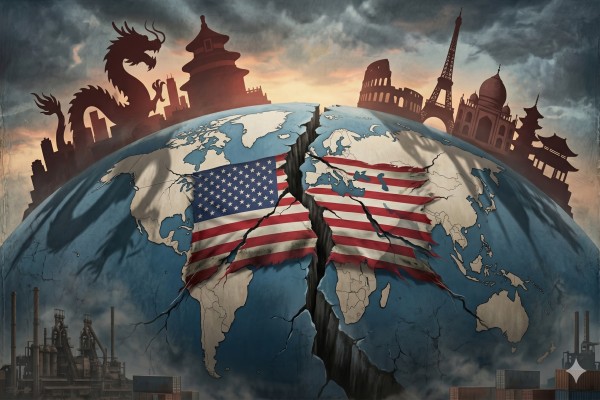
The recently released Council on Foreign Relations report, The Future of American Strategy, reads less like a roadmap for renewed American dominance and more like an admission that the American-led order is beginning to fracture.
The authors never state this outright. They are too institutional, too invested in preserving the idea of American leadership.
But the message running through the essays is unmistakable: Washington no longer has the political unity, economic confidence, or strategic freedom it once enjoyed. The post-Cold War era is ending, and even America’s strategic establishment seems unsure what comes next.
What makes the report striking is not alarmism. It is the tone of exhaustion.
Again and again, the contributors describe the same world. The liberal international order is fragmenting. China cannot be contained cheaply. Allies are hedging against American unpredictability. Domestic politics are broken. AI threatens social disruption. Congress is paralysed. And the bipartisan consensus behind U.S. global leadership has collapsed.
This is not the language of a rising power preparing for expansion. It is the language of an empire trying to manage decline without admitting it openly.
The report’s central contradiction appears immediately. Most contributors acknowledge that the United States can no longer dominate the world economically the way it once did. Charlie Kupchan writes openly about the “end of the West’s long run of material and ideological hegemony” and argues that a “decentered and multipolar world lies ahead”.
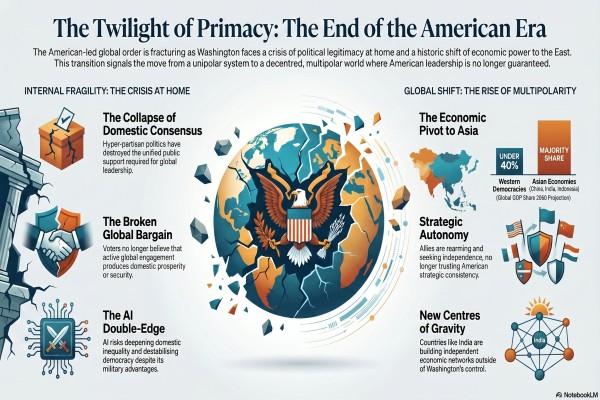
He points to the biggest structural shift of the century: power is moving from West to East. By 2060, the combined economic output of Western democracies is projected to fall below 40 per cent of global GDP, while three of the world’s four largest economies could be Asian: China, India, and Indonesia.
That observation alone undermines the assumption that the twenty-first century will remain American-led by default.
Yet despite recognising this shift, the essays still assume America must remain the organising force of the global system. That tension runs through the entire document. Washington’s elite understands the old order is fading, but it has not accepted what replacing it actually means.
The report repeatedly identifies the real source of American weakness, and it is not China, Russia, or Iran. It is the United States itself.
Several contributors admit that the American public no longer supports the costs of empire. Gideon Rose notes that voters increasingly see few gains from “active global engagement”. Elliott Abrams warns that foreign policy has become hyper-partisan and that future U.S. strategy may survive only in four-year electoral cycles.
Steve Sestanovich argues that American foreign policy now swings between overreach and retrenchment because public consensus repeatedly collapses after wars and economic shocks.
That may be the report’s most important conclusion. America’s crisis is not primarily military. It is political.
Washington still possesses immense hard power. The U.S. Navy dominates the oceans. The dollar anchors global finance. American technology firms shape the digital economy. But endurance matters more than raw capability, and endurance requires political legitimacy at home.
For decades, Americans accepted the argument that global leadership produced prosperity and security domestically. That bargain has broken down. Endless wars, deindustrialisation, inequality, and political fragmentation destroyed it.
This is why the report treats Trump less as an anomaly than as a symptom.
Several essays effectively admit that Trumpism emerged because the foreign policy establishment failed. Globalisation enriched financial elites while hollowing out industrial America. China entered the global economy without liberalising politically. Military interventions produced fatigue instead of victory. Millions of Americans concluded that Washington cared more about managing the world than managing their decline.
The establishment now faces a dilemma it cannot solve. It cannot fully reject Trump’s critique because too much of it proved politically effective. But it also fears Trump’s nationalism because it accelerates alliance fragmentation and weakens U.S. influence abroad.
That explains why many contributors search for a middle path: burden sharing, selective engagement, transactional alliances, and smaller coalitions instead of universal liberal leadership. In effect, they are trying to design a post-primacy strategy without calling it that.
But America’s allies are already adapting to a world where Washington may no longer be dependable.
The essays on Europe and Asia reveal growing anxiety about strategic autonomy. European states are rearming because they suspect America may eventually step back. Indo-Pacific allies are deepening regional cooperation because they fear future American inconsistency. Middle powers are building flexible coalitions outside traditional U.S.-led systems because they no longer trust the permanence of American leadership.
This matters because empires rarely collapse when enemies destroy them outright. More often, allies quietly stop depending on them.
That process appears to be underway.
The report is especially revealing on China. Unlike Cold War discussions about the Soviet Union, the language here is cautious because Washington understands China is deeply integrated into the global economy in ways the USSR never was.
The United States cannot fully decouple from China without damaging itself and its allies. Yet dependence on China creates obvious strategic vulnerabilities. The report’s answer is “friendshoring”, supply-chain resilience, and selective economic blocs. But this is really an attempt to partially reverse globalisation without accepting the costs of fully reversing it.
India appears here in a revealing way. One essay notes that if India shifts exports away from the United States toward Europe, it will gradually adapt to EU standards and regulations, strengthening a rival economic order outside Washington’s control.
That is a remarkable admission. It recognises that rising powers like India are no longer simply partners in balancing China. They are becoming independent centres of economic gravity capable of shaping rival systems themselves.
That is the deeper problem facing Washington. The more multipolar the world becomes, the harder it becomes for the United States to remain the indispensable centre of every major network simultaneously.
The report also exposes another contradiction at the heart of American strategy: technology is both Washington’s greatest advantage and one of its biggest threats.
The essays on artificial intelligence are particularly revealing. AI is presented as essential for military superiority over China and critical for economic competitiveness. But contributors also warn that AI could destroy jobs, deepen inequality, expand surveillance, and destabilise democracy itself.
In other words, the same technologies America sees as necessary for geopolitical competition may also accelerate domestic breakdown.
History shows this combination is dangerous. Great powers decline faster when external rivalry collides with internal fragmentation. Rome faced pressure at its borders while its political system decayed. Britain struggled to maintain imperial dominance while industrial competitors rose and domestic strains deepened. The United States now faces a similar convergence.
Yet the most revealing aspect of the report may be what it avoids discussing seriously.
Very few contributors question whether the United States should continue trying to dominate Europe, the Middle East, and the Indo-Pacific simultaneously. The assumption of global military reach survives even as economic and political foundations weaken. This reflects a deeply rooted belief in Washington that reducing military commitments equals surrender.
But maintaining supremacy across multiple theatres against nuclear-armed rivals may no longer be sustainable.
The report circles this reality repeatedly without fully confronting it.
That hesitation reveals the deeper fear inside the American establishment. The real anxiety is not military defeat. It is the loss of centrality.
For seventy-five years, the United States has not just been powerful. It has structured the global system itself. The dollar, global trade rules, military alliances, technology standards, and financial institutions all reinforced American dominance. A genuinely multipolar world would reduce that dominance even if the United States remained enormously powerful.
That is why the report feels uneasy. The authors understand the old order is fading, but they still cannot imagine a world where America is no longer at the centre of it.
In the end, The Future of American Strategy is less a blueprint for renewed leadership than a document of strategic uncertainty. It reveals an American elite trying to preserve influence amid political fragmentation, economic anxiety, rising rivals, weakening alliances, and technological disruption.
Its most important insight may also be its least intentional: the age of uncontested American primacy is probably already over.
Washington may not fully accept that reality yet.
But much of the world already has.