For decades, India’s greatest energy concern in West Asia has been the Strait of Hormuz.
Nearly every geopolitical crisis involving Iran has triggered fears that the narrow waterway could be blocked, choking off the flow of Gulf oil.
But the latest threat from Yemen’s Iran-backed Houthi rebels suggests India’s energy vulnerability is no longer confined to Hormuz. It is now increasingly centred on another strategic chokepoint: Bab el-Mandeb.
The Houthis’ declaration of a naval blockade against Saudi Arabia, coupled with threats to attack vessels linked to Saudi ports, marks a significant escalation in the regional conflict. The group says the move is retaliation for years of Saudi-led military operations in Yemen and a recent strike on Sanaa airport.
Whether the Houthis possess the capability to enforce a sustained blockade is almost beside the point. Their record over the past two years has shown that even sporadic missile and drone attacks can reshape global shipping patterns, drive up insurance costs and unsettle energy markets.
For India, which imports more than 85 per cent of its crude oil, the implications extend far beyond another episode of regional instability.
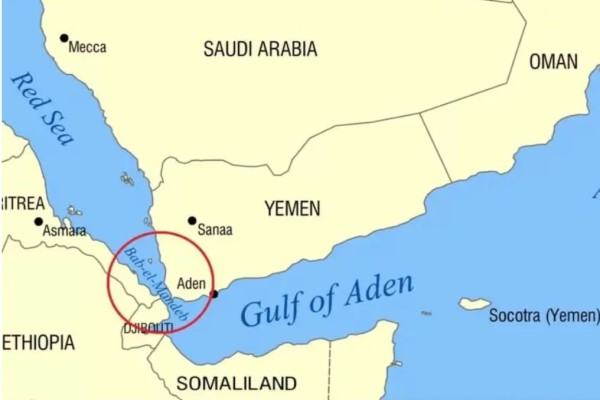
Bab el-Mandeb, the narrow strait separating Yemen from Djibouti and Eritrea, connects the Red Sea to the Gulf of Aden and the wider Indian Ocean. It is one of the world’s most important maritime chokepoints, handling millions of barrels of oil each day as well as a substantial share of global container traffic through the Suez Canal.
Unlike the Strait of Hormuz, which controls the exit of Gulf oil into the Arabian Sea, Bab el-Mandeb determines whether that oil can move efficiently onwards to European markets and whether Asia-Europe trade can continue through the Suez Canal.
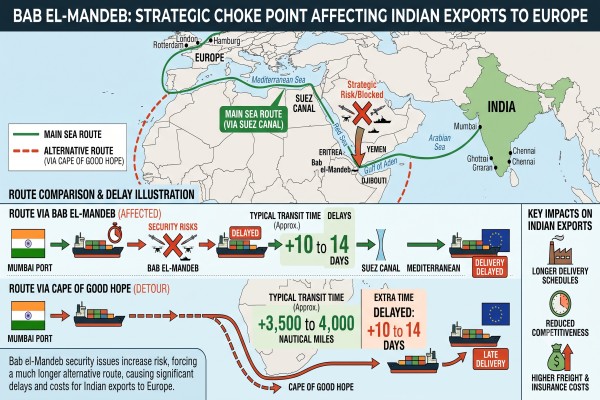
For India, it is also a vital artery for exports of petroleum products, chemicals, engineering goods and manufactured items destined for Europe.
The Houthis have already demonstrated how vulnerable this corridor is. Since late 2023, they have repeatedly attacked merchant vessels in the Red Sea using anti-ship missiles, drones and explosive-laden boats, prompting many of the world’s largest shipping companies to divert vessels around the Cape of Good Hope.
That diversion adds up to two weeks to voyages, significantly increases fuel consumption and raises freight costs.
Now, by explicitly targeting ships linked to Saudi Arabia, the Houthis are attempting to weaponise Bab el-Mandeb once again. Within days of the announcement, several vessels reportedly altered course while shipping companies began reassessing Red Sea transit.
European naval forces operating under Operation Aspides also issued fresh advisories to merchant shipping, underscoring that the threat is being taken seriously even before a large-scale disruption has occurred.
For India, the immediate risk is not a shortage of oil but a surge in the cost of transporting it.
Global energy markets react quickly to geopolitical uncertainty. Even isolated attacks can trigger sharp increases in insurance premiums, charter rates and benchmark crude prices.
Shipping companies factor additional war-risk costs into every voyage, and those expenses are eventually passed on to consumers. The impact is felt across the economy through higher fuel prices, increased transport costs, more expensive imports and renewed inflationary pressures.
The challenge becomes even greater because Bab el-Mandeb is no longer the only maritime flashpoint affecting India’s energy supplies.
At the other end of the Gulf, tensions between the United States and Iran continue to cast a shadow over the Strait of Hormuz. While Tehran has stopped short of attempting to close the waterway, periodic threats and military stand-offs have kept global markets on edge.
The emergence of sustained instability at Bab el-Mandeb means India now faces risks at both ends of the Arabian maritime corridor.
The two chokepoints serve different but complementary roles.
Hormuz determines whether crude oil from Saudi Arabia, Iraq, Kuwait, Qatar and the United Arab Emirates can leave the Gulf. Bab el-Mandeb determines how efficiently that oil, along with India’s exports and global container traffic, reaches Europe and the Mediterranean. Disruption at either point raises costs. Pressure on both simultaneously magnifies the economic consequences.
Saudi Arabia itself has spent years trying to reduce dependence on Hormuz by developing infrastructure along its Red Sea coast, including pipelines that enable crude to bypass the Gulf.
A renewed Houthi campaign targeting shipping in the Red Sea undermines that strategic flexibility, potentially forcing greater reliance on longer and more expensive export routes. Even if production remains unaffected, transport becomes slower, riskier and costlier.
India has made important strides in strengthening its energy resilience. Strategic petroleum reserves provide a buffer against temporary disruptions, while diversified sourcing, including higher imports from Russia since 2022, has reduced dependence on any single supplier.
Indian refiners have also demonstrated considerable flexibility in adjusting procurement patterns to changing market conditions.
Yet diversification has limits.
Regardless of where crude is produced, it must still travel safely across the Indian Ocean. Maritime security has therefore become inseparable from energy security. A diversified supplier base offers little protection if shipping lanes themselves become contested.
The implications extend beyond crude oil. India’s refining sector exports large volumes of diesel, aviation turbine fuel and other petroleum products to Europe through the Red Sea.
Delays or diversions increase operating costs and reduce the competitiveness of Indian exports. Container traffic carrying pharmaceuticals, textiles, machinery and engineering products also depends heavily on the Suez route.
The Indian Navy has already recognised this changing security environment. Since the Red Sea crisis began, Indian warships have maintained an enhanced presence across the Arabian Sea, Gulf of Aden and western Indian Ocean, escorting merchant vessels, responding to distress calls and countering piracy.
These deployments reflect an increasingly important reality: safeguarding India’s economic interests now requires protecting maritime trade far beyond its immediate coastline.
Diplomatically, New Delhi is likely to continue its carefully balanced approach. India enjoys strong strategic and energy partnerships with Saudi Arabia, the UAE and other Gulf states while also maintaining channels of communication with Iran. Preserving those relationships will remain essential as regional tensions deepen.
The broader lesson is that India’s energy security can no longer be measured solely by the availability of oil. It depends equally on the security of the sea lanes that carry it. The Houthi blockade threat demonstrates how non-state actors armed with relatively inexpensive missiles and drones can disrupt global commerce without physically closing a waterway.
For India, this is a reminder that the country’s economic future is increasingly shaped not only by energy diplomacy but also by maritime security. As conflict spreads across the western Indian Ocean, Bab el-Mandeb is emerging alongside Hormuz as one of the defining strategic chokepoints for India’s energy and trade.
The challenge for New Delhi will be ensuring that its dependence on these vulnerable sea lanes does not become its greatest strategic liability.