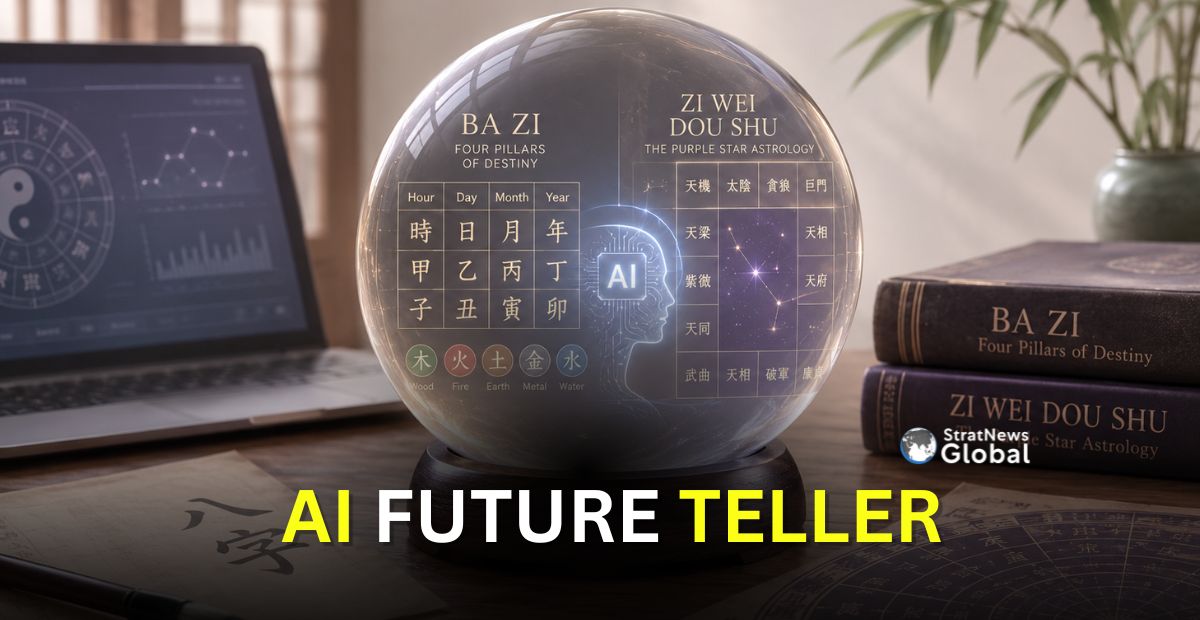
Tian Qi, an AI-powered astrology platform, developed by a Singapore based astrologer, promises personalised fortune readings based on a) the year, month, day and hour of birth, and b) Ba zi (Four pillars of Destiny) and ‘Purple Start Astrology’, traditional Chinese astrological system that maps a persons destiny through 12 life palaces and over 100 celestial stars.
Unlike conventional AI chatbots that draw largely from publicly available information, Tian Qi’s developers say the platform has been trained on his own archives. The model, they claim, can not only generate detailed destiny readings but also explain traditional concepts and answer follow-up questions in a conversational manner.
Over the past few years, Chinese users have increasingly turned to AI chatbots for emotional support, career advice and even metaphysical guidance. During periods of economic uncertainty and a sluggish job market, many young Chinese have experimented with AI-generated fortune tellings, seeking reassurance about careers, relationships and major life decisions.
Across East Asia, religious institutions have begun experimenting with AI. In Japan, Buddhist temples have introduced robotic monks capable of delivering sermons and explaining Buddhist philosophy to visitors. South Korean Buddhist organisations have also explored AI-generated sermons, chatbot-based spiritual counselling and digital monks as a way of engaging younger generations while addressing declining temple attendance.
Yet the technology has not been universally embraced within the profession.
According to Tian Qi’s developers, the platform is intended to assist rather than replace human practitioners. Some astrologers see value in using AI to perform preliminary chart analysis, explain complex concepts and handle routine queries, allowing them to focus on deeper interpretation during consultations.
Others remain sceptical. They argue that astrology is not simply about calculating birth charts but also about understanding a client’s circumstances, emotions and lived experiences. In their view, AI may be able to process data and recognise patterns, but it still lacks the intuition, empathy and contextual judgment that define a seasoned practitioner.
Even so, many acknowledge that AI is unlikely to disappear from the field. Instead, it may become another tool in the astrologer’s toolkit, much like software that digitised birth-chart calculations years ago. If that happens, Tian Qi could represent not the replacement of an ancient profession, but its next evolution where artificial intelligence handles the mechanics, while human practitioners continue to provide the interpretation.