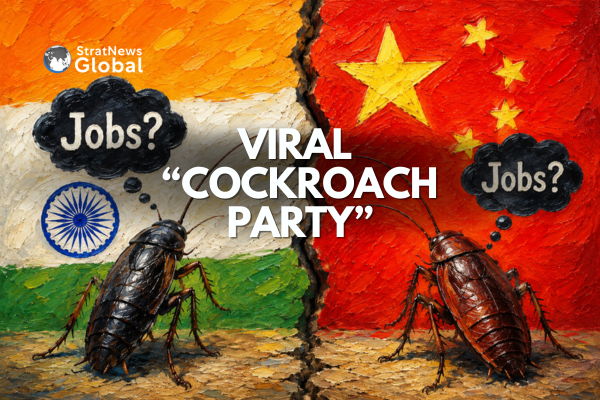
A new digital movement called the “Cockroach Janta Party” (CJP), that went viral on Indian social media with echoes in China, has been shut down. Apparently, the authorities could not allow a movement launched only the other day to overtake Prime Minister Modi on Instagram. That was how The Hindu put it.
What triggered CJP? Reportedly, remarks attributed to India’s Chief Justice describing unemployed young people drifting towards journalism and activism as cockroaches and parasites. In response, an Indian student studying in Boston, Abhijeet Dipke, with some history in the opposition AAP, launched an online “party” that was clearly a parody of India’s ruling BJP.
It gained millions of followers and hundreds of thousands of self-declared members. Some say it became popular because the current generation of youth is disillusioned with politics that doesn’t represent them. Many feel their education does not hold the promise of a job or even a future.
Dipke was quoted by the BBC as saying “Gen Z has given up on traditional political parties and wants to create its own political front in a language they understand.”
The CJP website describes itself as “the voice of the lazy and unemployed,” while also claiming “zero sponsors” and inviting supporters to join a movement for people “tired of pretending everything is fine”.
Chinese social media picked up the “cockroach storm”, some seeing it as an opportunity to mock India’s youth. Others however saw it as reflecting China’s own “lying flat” culture, joking that “young people should not be provoked while they are still lying flat”.
“Lying flat” (Tang Ping) is a Chinese internet term used by younger people to describe withdrawing from intense social and economic competition, rejecting overwork culture and choosing a minimalist lifestyle rather than chasing traditional markers of success such as high-paying jobs, marriage or property ownership.
Lying flat is something China has known for some years, yet state-linked narratives claimed it was being influenced or amplified by “foreign forces” seeking to weaken Chinese society and confidence.
An article circulating on China’s platform Zhihu titled “After being called cockroaches, Indian youth refused to stay silent: the rise of the self-styled ‘Cockroach Janta Party’ movement” portrayed the trend as evidence of rising frustration among Indian youth over unemployment, corruption, inequality and governance issues.
It framed the movement as a reaction to institutional insensitivity, while also contrasting India’s global ambitions with the economic insecurity faced by many young people. The article further drew parallels with youth-led unrest in countries such as Bangladesh and Nepal, hinting at wider anti-establishment sentiment in the region.
But many of the issues used to criticise India youth unemployment, economic pressure, rising competition and graduate disillusionment are also challenges for China.
China has also seen labour protests, factory demonstrations over unpaid wages and anger during the 2022 “White Paper Protests”, where many young people linked strict COVID restrictions with economic uncertainty and lack of opportunity. China incidentally, does not produce any youth unemployment data.
Broader Regional Context
CJP also underscored India’s relatively open digital environment that allows viral satire and online political movements. But CJP reflects a wider Asian reality: a generation increasingly using humour, irony and digital culture to express frustration with economic pressure, uncertain futures and political systems many feel are failing to address youth concerns.