Part two of a two-part series
The expiry of the Ganges Water Treaty in 2026 could become the next major crisis point between India and Bangladesh.
Water disputes carry unusual political sensitivity because they combine nationalism, agriculture, sovereignty, and domestic politics.
From Bangladesh’s perspective, India has repeatedly delayed meaningful movement on Teesta water sharing while expecting Dhaka to cooperate on Indian security priorities.
From India’s perspective, Bangladesh cannot simultaneously deepen strategic ties with China and Pakistan while expecting automatic concessions on sensitive river issues.
Both sides increasingly see the other as transactional.
The Teesta dispute also reveals a larger weakness in Indian regional diplomacy. New Delhi often struggles to align domestic politics with strategic objectives.
West Bengal’s internal political calculations repeatedly complicated negotiations with Bangladesh. China exploited the resulting vacuum.
India frequently expects neighbouring countries to accommodate Indian security concerns while underestimating the domestic political pressures operating within those countries.
Bangladesh, meanwhile, has become increasingly skilled at leveraging India’s internal divisions.
The Minority Question
The treatment of minorities inside Bangladesh has become another major source of tension.
Political instability in Bangladesh has historically produced violence against Hindu communities. Such incidents generate immediate political reactions inside India, especially in West Bengal and Assam. The rise of Jamaat-e-Islami and other Islamist political forces has intensified these concerns.
India’s dilemma is complicated.
If New Delhi publicly pressures Dhaka too aggressively on minority rights, Bangladeshi political forces can portray India as interfering in domestic affairs. That strengthens nationalist and anti-India narratives inside Bangladesh.
But ignoring attacks on minorities is politically impossible for any Indian government.
This issue therefore intersects directly with border stability and migration concerns.
Large refugee flows from Bangladesh would immediately affect the politics and demography of eastern Indian states. India’s security establishment is particularly sensitive to this possibility because migration issues already generate intense political conflict domestically.
For Bangladesh itself, minority insecurity creates risks beyond bilateral tensions. Rising communal polarisation weakens social stability and increases the influence of radical political actors.
That trajectory would eventually hurt Bangladesh’s own economic and political interests.
Crowded Bay
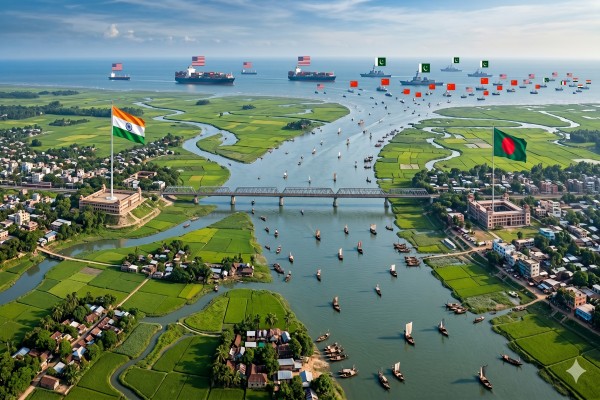
One of the most important changes in the India-Bangladesh relationship is that the Bay of Bengal is no longer a relatively quiet strategic space.
China is expanding its presence. The United States is increasing engagement. India is modernising its eastern maritime posture. Bangladesh is trying to leverage all sides.
This growing competition creates opportunities for Dhaka but also serious risks.
Bangladesh benefits when multiple powers compete for influence because it increases strategic leverage. But excessive militarisation of the region could also reduce Bangladesh’s room for manoeuvre over time.
The proposed US defence agreements illustrate this balancing act.
If Bangladesh permits regular American military access while continuing major defence and infrastructure ties with China, it could eventually find itself caught between competing strategic expectations.
China will resist any arrangement that significantly strengthens American operational reach in the Bay of Bengal.
India, meanwhile, will remain uncomfortable with any development that turns Bangladesh into an arena for overt great power rivalry.
Dhaka believes it can manage these contradictions through balancing. Perhaps it can. But balancing becomes harder as regional competition intensifies.
Delhi’s Dilemma
India’s biggest mistake in Bangladesh was assuming goodwill could substitute for long-term institutional strategy.
New Delhi relied too heavily on personal equations with Sheikh Hasina and the Awami League leadership. It failed to build broad political relationships across Bangladesh’s opposition, bureaucracy, military, media, and civil society.
As a result, India now finds itself associated too closely with one political era.
China operates differently. Beijing engages whichever political force holds power and focuses on long-term structural influence through infrastructure, trade, and financing.
India’s regional strategy therefore becomes vulnerable whenever political transitions occur in neighbouring states. Bangladesh is now demonstrating that vulnerability.
Options And Choices
India cannot reverse Bangladesh’s diversification strategy entirely.
Nor should it attempt to.
Neighbouring states will inevitably maintain ties with multiple powers. That is normal behaviour in international politics. India’s objective should instead be narrower and more realistic.
First, India must protect core security interests. Preventing hostile military infrastructure near the Siliguri Corridor and avoiding the revival of insurgent sanctuaries will remain top priorities.
Second, India needs faster execution. Delayed projects, unresolved water disputes, and bureaucratic inertia steadily weaken Indian influence.
Third, India needs wider political engagement inside Bangladesh. Relations cannot depend entirely on one party or one leader.
Fourth, India must avoid overreaction. Treating every Bangladeshi engagement with China or the United States as a strategic betrayal would push Dhaka further away.
Confidence matters in regional diplomacy.
Large powers that constantly demand reassurance from smaller neighbours usually reveal insecurity rather than strength.
Dhaka’s Red Lines
Bangladesh also faces dangers in the current trajectory.
Its strategy of balancing India, China, the United States, and Pakistan may produce short-term leverage. But managing competing powers becomes increasingly difficult once military and intelligence relationships deepen.
Bangladesh’s geography ensures it cannot escape India’s influence entirely. India surrounds much of Bangladesh geographically, controls important transit routes, and remains central to regional connectivity.
A permanently hostile relationship with India would impose serious long-term costs on Bangladesh’s economy and security environment.
At the same time, Bangladesh’s internal political trajectory matters.
If radical political forces gain greater influence, if minority insecurity worsens, or if extremist networks re-emerge, Bangladesh risks damaging its own economic progress and international credibility.
Dhaka therefore faces its own balancing challenge. It must diversify externally without creating instability internally.
Geography Rules
Despite growing tensions, India and Bangladesh remain bound together by geography.
They share rivers, borders, trade routes, migration flows, transport networks, and security concerns. Neither side can disengage from the other.
But the relationship is entering a more competitive phase.
The old framework built around political alignment and historical memory is fading. A harder framework based on leverage, deterrence, bargaining, and strategic competition is emerging in its place.
That does not make conflict inevitable.
But it does mean India and Bangladesh will increasingly deal with each other as cautious strategic actors rather than exceptionally close political partners.
The question now is whether both sides can manage that transition without allowing mistrust to dominate the relationship completely.