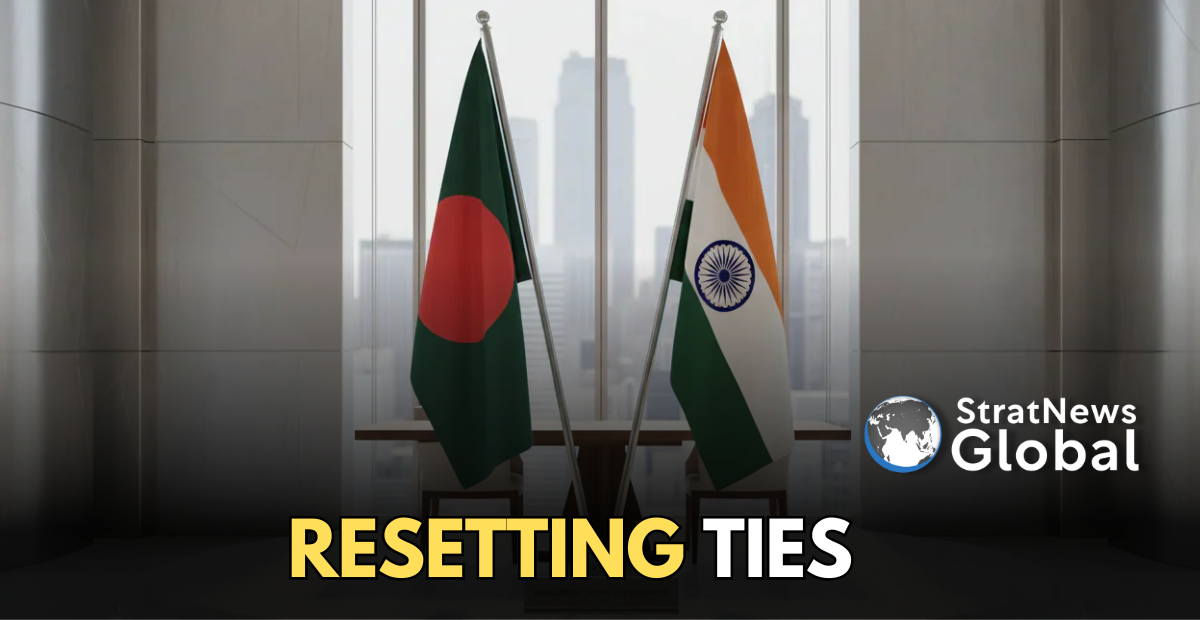
Bangladesh Foreign Minister Khalilur Rahman’s visit to India (April 7 to 9), carries more weight than the official description of “goodwill trip” suggests. It is the first real political contact between India and the new government in Dhaka, and in many ways, a quiet test of how both sides intend to deal with each other after a period of unease.
For India, the change in leadership in Bangladesh has created an unfamiliar situation. For years, ties were built around a predictable political understanding with Sheikh Hasina’s government.
Things have changed. The BNP-led administration under Tarique Rahman represents not just a different leadership, but a different political instinct, one that is still being assessed in New Delhi.
Dhaka, for its part, seems aware of this hesitation. The messaging ahead of the visit has been careful: talk of “mutual respect,” “normal relations,” and a desire to move forward without reopening old bitterness. But behind that language is a clear expectation that India will also adjust to the new reality.
During his two-day visit, Rahman will have meetings with S Jaishankar and NSA Ajit Doval, and also Petroleum and Natural Gas Minister Hardeep Singh Puri, as the neighbouring country looks to mend ties with India.
The agenda reflects this mix of caution and urgency. Water remains the most stubborn issue. The Teesta question has lingered for years, and now the Ganges water treaty is approaching its deadline later this year.
Bangladesh is likely to push for movement, but it also knows the constraints India faces internally, especially with political sensitivities in West Bengal. That makes any breakthrough difficult, though even a signal of progress would matter.
Then there is the border. Incidents involving civilian deaths have repeatedly strained public sentiment in Bangladesh. These are not just diplomatic talking points; they impact domestically. If the new government wants to show it can manage relations with India without appearing weak, this is an issue it cannot ignore.
At the same time, there are areas where both sides have more room to work together. Energy is one of them. In view of the uncertainty in the supply chain as well as Bangladesh’s growing demand, India is now considered an important partner. Electricity trade and diesel supplies will be discussed, too.
Recently, M.Riaz Hamidullah, High Commissioner of Bangladesh to India, said that the bilateral ties go beyond trade, rooted in shared sacrifice and dignity. While official figures place bilateral goods trade at $12 billion, Hamidullah provided a broader perspective on the economic partnership, estimating comprehensive transactions at a minimum of $28 billion to $30 billion.
During the celebrations of his country’s 56th Independence Day, quoting a recent message from Prime Minister Tarique Rahman to Prime Minister Narendra Modi, Hamidullah reiterated Dhaka’s commitment to a “pragmatic and mutually respectful” partnership.
Visa restrictions in recent months have affected students, patients, and businesses. Restoring easier travel would be one of the simplest ways for India to signal goodwill, and Dhaka will be looking for that.
Still, it is the political undercurrents that make this visit sensitive. The possible raising of Sheikh Hasina’s extradition is one such issue. Even if it comes up quietly, it places India in a complicated position. How New Delhi handles such sensitive matters without derailing the broader engagement will be closely watched.
Trade restrictions imposed last year are another point of friction. Bangladesh sees these as unfriendly measures, especially at a time when it is trying to stabilise its economy. If India wants to build trust quickly, easing some of these constraints could make a difference