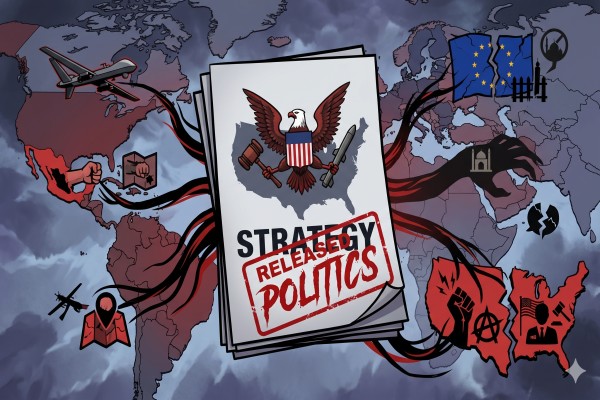
The most honest way to read the just-released 2026 United States Counterterrorism Strategy is this: it is a political worldview disguised as national security doctrine.
Gone is the old Washington language of democratic values, multilateralism and careful diplomatic phrasing. In its place comes a document that reads less like a bureaucratic strategy paper and more like a campaign rally with cruise missiles attached.
The tone alone is extraordinary.
Entire sections are soaked in grievance, ideological score-settling and civilisational panic. The Biden administration is accused of “weaponising” counterterrorism. Europe is portrayed as decadent and suicidal. Migration is framed almost as an invasion. “Violent left-wing extremists” are elevated into the same strategic universe as ISIS and al Qaeda.
This is not the language of a superpower calmly managing threats. It is the language of a country convinced it is under siege from enemies abroad, traitors at home and weak allies everywhere else.
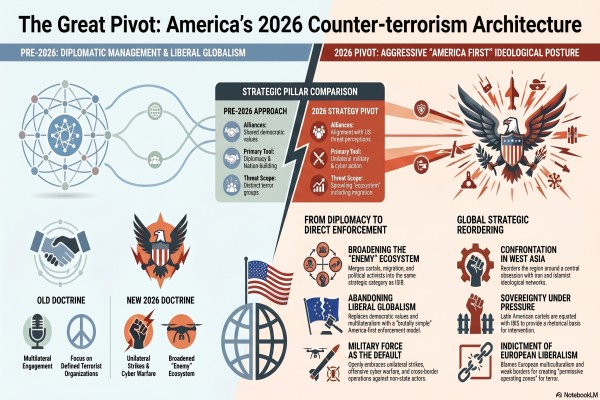
For more than two decades after 9/11, American counterterrorism policy operated under at least the pretence that terrorism was a distinct category of threat. This strategy detonates that distinction. Cartels, anarchists, Islamist groups, transgender radicals, narco networks, hostile states and political extremists are all folded into one sprawling ecosystem of enemies.
Once you do that, everything becomes terrorism. Borders become battlefronts. Political dissent becomes a security concern. Migration becomes insurgency. Drug trafficking becomes warfare. And military force becomes the default policy instrument.
The strategy openly embraces cross-border military action against cartels, unilateral strikes, covert operations and offensive cyber warfare. The Monroe Doctrine is back, except now it comes wrapped in drone footage and counterterror branding.
Latin America should pay very close attention. Washington is no longer even pretending to speak as a polite neighbour. It is speaking like an imperial power that has rediscovered its appetite for direct enforcement. Venezuela is framed as a narco-terror state tied to Hezbollah and Iran. The implication for Mexico is impossible to miss. Once cartels are legally and rhetorically equated with ISIS, the argument for unilateral military operations writes itself.
The Middle East section is even more revealing. Iran remains the grand obsession, described as the world’s leading terror sponsor and the central threat to American security. But the bigger shift is ideological. The strategy declares the Muslim Brotherhood the root source of modern Islamist terror.
For years, Western governments treated Brotherhood-linked movements with calculated ambiguity. Some were political actors. Some were tolerated. Some were useful intermediaries. This document burns that distinction to the ground. It effectively argues that the entire ideological ecosystem matters as much as the gunmen themselves.
Europe gets perhaps the harshest treatment of all. The document practically reads like an indictment of modern European liberalism. Weak borders, mass migration, declining identity, insufficient nationalism, political correctness and multiculturalism are all blamed for turning Europe into a permissive operating zone for terror networks.
Translated from diplomatic language into plain English, Washington is essentially telling Europe: you did this to yourselves.
That alone would have been unthinkable in official American strategy papers a decade ago.
Then comes the domestic angle, where the document slips fully into ideological warfare mode. It insists that previous administrations abused counterterror powers against conservatives while simultaneously demanding expanded focus on “violent secular political groups” tied to radical transgender activism and anarchism.
The contradiction is almost comic.
The strategy condemns politicised counterterrorism while producing one of the most openly politicised counterterrorism documents in modern American history.
And yet, dismissing this as mere rhetoric would be a mistake.
Because buried beneath the bombast is a very real strategic shift. America is abandoning the exhausted fantasy of liberal global management and returning to something older, harder and more transactional. The doctrine is brutally simple: America first, allies second, everyone else on notice.
No more nation-building. No more democracy sermons. No more pretending globalisation solved anything. If Washington sees a threat, it intends to hit it quickly, directly and unapologetically.
That has consequences far beyond America.
Allies will now be judged less by shared values and more by whether they align with Washington’s threat perceptions. Europe is being told to harden up. Latin America is being warned. West Asia is being reordered around confrontation with Iran. Africa and Asia are being pushed toward “burden-sharing” under American strategic direction.
The irony is that the document claims to restore “common sense” to counterterrorism. In reality, it does something far bigger. It transforms counterterrorism into the organising principle of an entire political worldview. Everything becomes security. Everything becomes ideology. Everything becomes war.
And once a superpower starts thinking that way, the rest of the world rarely gets a choice.