There are coincidences, and then there are coincidences that arrive in clusters, uninvited and just a little too well-timed.
The recent surge in refinery and energy facility fires across the world falls uncomfortably into the second category.
From Russia to Australia, from West Asia to India, flames have been licking at some of the most critical nodes of the global energy system.
Each incident comes with its own explanation. Taken together, they invite a more unsettling question. Is this simply a run of bad luck or something more patterned and systemic, perhaps even deliberate?
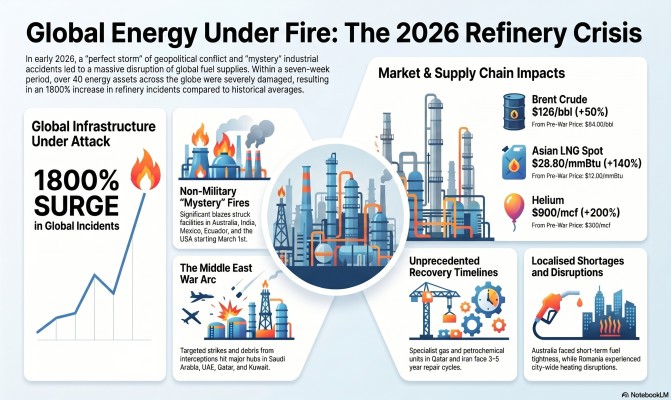
Experts from the International Energy Agency note that the scale of damage to over 40 assets since early March has upended the global economy already struggling to cope with the West Asia crisis. Leading to acute fuel shortages, supply chain interruptions and heightened fears over the long-term vulnerability of global energy networks. While some officials cite technical failures, the frequency of these disasters has prompted international counter-terrorism investigations.
India sits awkwardly at the centre of that question.
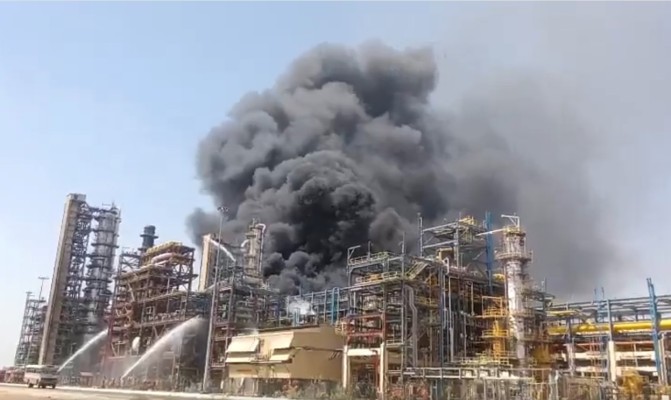
The fire at the HPCL Rajasthan Refinery in Pachpadra earlier this month is officially being treated as a technical incident, likely linked to a leak. That explanation is plausible. Refineries are complex, high-pressure environments where minor faults can escalate quickly.
But the context complicates things. The refinery is one of India’s most significant upcoming energy assets, and the incident occurred just a day before Prime Minister Narendra Modi was supposed to inaugurate it. Authorities have not ruled out sabotage. That alone is enough to keep the speculation alive.
This was not an isolated case either. India has seen a string of industrial fires in recent years, from oil depots to chemical plants, often attributed to safety lapses or equipment failure. Individually, they are explainable. Collectively, they begin to sketch a picture of a system under strain.
To understand why India matters here, you have to look at its energy trajectory.
India is one of the fastest-growing consumers of oil in the world, heavily dependent on imports but increasingly focused on expanding domestic refining capacity. Mega projects like Pachpadra are not just industrial investments. They are strategic bets on energy security, export potential, and geopolitical leverage.
That makes them valuable. And anything valuable, in today’s geopolitical climate, is also vulnerable.
Now widen the lens.
In Russia, Ukrainian drone strikes have repeatedly targeted refineries, turning energy infrastructure into a frontline asset. In Saudi Arabia, past attacks on facilities like Ras Tanura have demonstrated how even heavily protected sites can be hit. Elsewhere, fires have broken out under less clear circumstances, with investigations ongoing and explanations ranging from electrical faults to “unknown causes”.
On paper, these are unrelated events. Different countries, different contexts, different causes.
In practice, they share three common threads.
The first is stress.
Global refining capacity is being pushed harder than usual. Demand remains high, margins are tight, and many facilities are ageing. Maintenance cycles can be delayed, upgrades deferred, and systems run closer to their limits. In such an environment, the probability of accidents increases. Not dramatically, but enough that clusters begin to appear.
India fits squarely into this story. Rapid expansion often brings growing pains. New facilities face teething issues, while older ones operate under pressure to maximise output. Safety systems are robust on paper, but execution can vary. When something goes wrong, it rarely stays small.
The second thread is geopolitics.
Energy infrastructure is no longer just an economic asset. It is a strategic target. Disrupting a refinery can have cascading effects, from local fuel shortages to global price spikes. It is a way to exert pressure without engaging in direct, conventional conflict.
India is not at war, but it is not insulated from geopolitical competition either. Its energy supply chains stretch across volatile regions. Its infrastructure is increasingly digital, and therefore exposed to cyber risks. And its strategic importance makes it a potential target, whether through direct means or more ambiguous forms of disruption.
This does not mean the Pachpadra fire was sabotage. It does mean the possibility cannot be casually dismissed.
The third thread is perception.
In an era of fragmented information, every fire becomes a story before it becomes a fact. Social media fills in gaps faster than official investigations can. Patterns are drawn, sometimes accurately, often prematurely. Conspiracy theories flourish, but they do so in a vacuum created by uncertainty.
And here is where the conversation gets uncomfortable.
It is easy to dismiss talk of a “pattern” as paranoia. After all, refineries have always had accidents. Industrial fires are not new. But it is equally easy, perhaps too easy, to dismiss the possibility that something more complex is unfolding.
The truth likely sits somewhere in between: Not every fire is sabotage, but not every fire is entirely innocent either.
What we may be possibly witnessing is not a coordinated global conspiracy but a convergence of vulnerabilities. A system where ageing infrastructure, operational stress, and geopolitical tension intersect. In such a system, disruptions do not need to be centrally planned to appear patterned. They simply need to occur within the same fragile framework.
India’s experience underscores this point.
The Pachpadra incident is a reminder that even flagship projects are not immune to risk. It highlights the importance of robust safety protocols, transparent investigations, and, crucially, public communication that does not leave room for speculation to spiral unchecked.
Because the real danger is not just the fire itself. It is the uncertainty that follows.
Energy security is as much about perception as it is about supply. A series of unexplained incidents can erode confidence, influence markets, and shape policy decisions. For a country like India, which is positioning itself as a major energy player, that perception matters.
So is there a pattern to these fires?
Yes, but not necessarily the kind that lends itself to dramatic, cloak-and-dagger narratives. The pattern is structural. It is about a global energy system operating under pressure, where accidents, attacks, and ambiguities coexist. India is not an outlier in this story. It is a case study.
And that is precisely why its recent fire matters. Not because it proves a conspiracy, but because it illustrates a vulnerability that is shared, global, and increasingly difficult to ignore.
The flames, in that sense, are not just incidents. They are signals.
The question is whether we are reading them correctly.