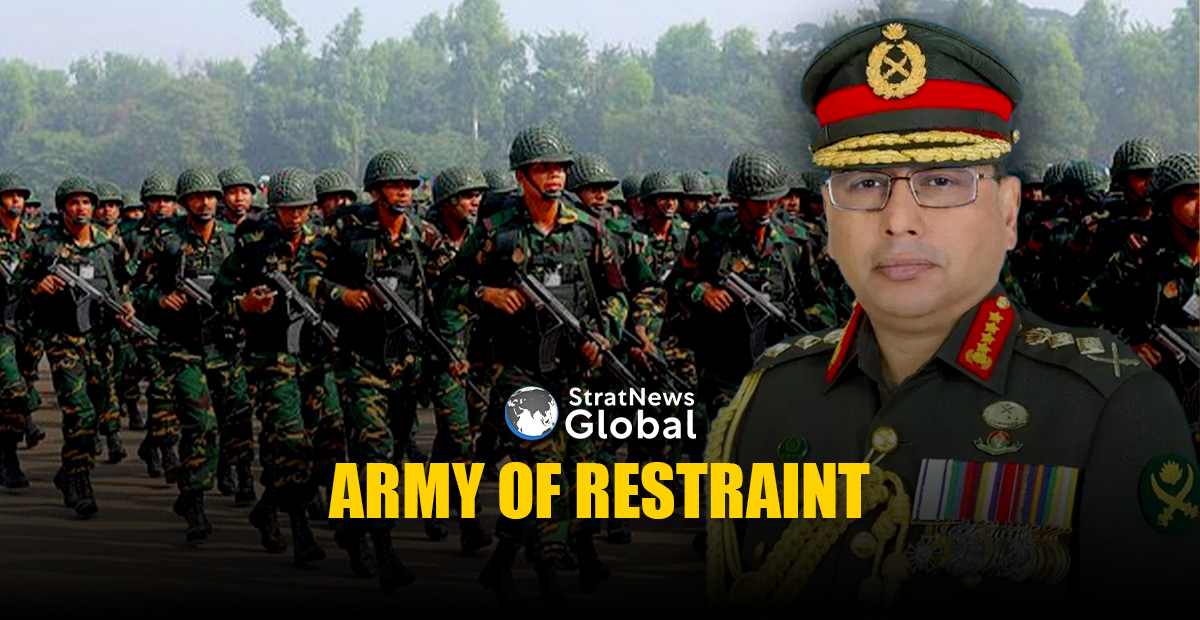
Among military chiefs in the Indian subcontinent, Bangladesh’s General Waker-uz-Zaman has perhaps the most paradoxical job right now.
While his Pakistani counterpart Asim Munir got himself elevated to Field Marshal after a confrontation with India, Waker spent much of 2025 fighting to keep his own job. His crime? He kept insisting Bangladesh hold elections and return to democracy.
When Hasina was ousted in August 2024, many thought Waker, six weeks into the job, would take over the country. Handpicked by Hasina, a distant relative, he refused to fire on the students filling Dhaka’s streets, prompting her former Home Minister Asaduzzaman Khan to say, “He backstabbed her.”
But Waker, true to his nickname ‘General Manager’, showed restraint. In a meeting with the interim government, he was categorical: Army protects borders, not streets. He stepped back, handed power and pledged support to Yunus’s interim government ‘come what may’.
What followed was eighteen months of thankless balancing: pushing for elections that Yunus kept delaying, blocking a pro-Pakistan faction within his own ranks from unseating him, and remaining a solitary voice of reason when retired Bangladeshi officers were making jingoistic noises about India’s northeast.
That restraint carries deep roots. The Bengali nation fought for self-determination against Pakistan. The language movement of 1952, the six-point program of the 1960s turned Bengali cultural identity into the bedrock of its politics long before any army existed to police it.
The 1971 Liberation War was itself driven by a people whose primary political desire was a democratic system, blatantly denied to them after the 1970 elections. The nation that emerged spoke Bengali, sang Rabindranath, and had bled rivers for its language. That cultural memory sits inside the army too. It knows people will never accept military dictatorship.
Pakistan’s army built something entirely different by using military capital for the personal benefit of the officer class, outside any public accountability. The Fauji Foundation, Army Welfare Trust, National Logistic Cell: fertiliser, cement, real estate, highways.
Any democratic control over them goes against its general’s retirement income, his family’s housing, and his children’s prospects.
Bangladesh’s army is not entirely clean. Retired generals run thinktanks, sit on institution boards, and head businesses. But it is patronage, not empire. Politicians still hold the key. When the moment came twice, once in 1990 and in 2024, the generals chose to honour the people’s will.
But that institutional restraint is now under pressure from multiple directions. Islamisation is creeping upward through junior officer ranks, and in general, in society too. A pro-Pakistan faction, led by Lt. Gen. Faizur Rahman, was reportedly passing intelligence to the ISI.
The Jamaat, despite marginal influence, has consolidated due to Awami League’s absence. Yunus, navigating between students, Islamists and an army chief he could not remove, has given radicals room they have not had in decades.
Bangladesh held elections in February 2026. The army backed the process and returned to barracks. But the institution that twice walked away from power is now operating in a country that looks less like the Bangladesh in which it learned restraint.
Pakistan’s army made itself the state. Bangladesh’s army chose not to. In a neighbourhood where that distinction is vanishing, it matters more than it should have to.