
Plans by the United States and Israel to target Iran’s electricity grid may appear to offer a decisive way to pressure Tehran, but a recent analysis argues that such a move would deliver limited military benefit while creating far-reaching humanitarian and strategic consequences.
The report contends that although the capability to destroy Iran’s grid exists, the outcomes of doing so would fall short of stated objectives and could instead deepen the crisis.
The assessment, authored by Joseph Webster—a senior fellow at the Atlantic Council’s Global Energy Center and editor of the China-Russia Report—focuses on the gap between intent and likely outcome.
It argues that attacks on electricity infrastructure are often assumed to weaken a state’s overall functioning, but in practice, modern militaries are structured to operate independently of civilian grids. In Iran’s case, this separation reduces the direct impact such strikes would have on its ability to continue military operations.
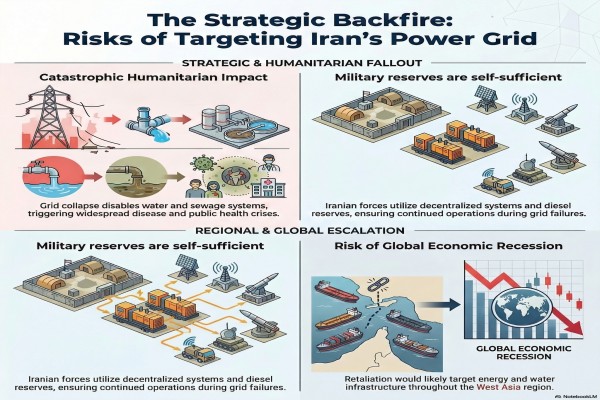
At the centre of the analysis is a simple point: the burden of a grid collapse would fall overwhelmingly on civilians. Iran’s electricity network supports water extraction, treatment, and distribution systems, as well as sanitation and food supply chains.
If the grid were to fail, these systems would break down quickly. The report warns that this could lead to shortages of clean water, disruption of sewage systems, and the spread of waterborne diseases. In this sense, the most immediate and severe consequences would be humanitarian rather than military.
To underline this risk, the analysis draws on historical precedent. After the First Gulf War, damage to Iraq’s electricity infrastructure contributed to widespread public health crises. Studies cited in the report link the collapse of water and sanitation systems to tens of thousands of excess deaths, particularly among children.
The comparison is used to suggest that infrastructure attacks can produce large-scale civilian harm without delivering decisive military results.
The report also examines whether such strikes would degrade Iran’s military capabilities in any meaningful way. It concludes that the impact would likely be limited. Key systems, including ballistic missile launchers and drone platforms, require relatively small amounts of power. Many are mobile and designed to operate in austere conditions.
In addition, the Iranian military relies heavily on diesel, both for vehicles and for its own localised power generation. Diesel can be stored for long periods, allowing operations to continue even if refineries and the broader electricity network are disrupted.
This creates what the report presents as a strategic imbalance. Civilian systems—water, food, health—are highly vulnerable to power loss, while military systems are comparatively resilient. As a result, the overall effect of a grid attack would be to impose heavy costs on the population without proportionately reducing Iran’s capacity to fight.
Beyond the immediate impact, the analysis highlights the risk of escalation. Targeting a country’s national power system is seen as a significant step, one that could reinforce the perception in Tehran that it is facing an existential threat.
Iranian officials have already indicated that they would respond to such actions by targeting infrastructure across the region. The report suggests that energy and water facilities could become primary targets, where even limited damage could have outsized consequences.
There is also the question of how such a move would affect the Strait of Hormuz, a critical artery for global energy supplies. The report argues that destroying Iran’s grid would not compel it to keep the strait open.
Instead, it could have the opposite effect, strengthening Iran’s incentive to disrupt shipping as a form of retaliation. Given that a significant share of global oil and liquefied natural gas passes through this route, any sustained disruption could push energy prices higher and place strain on the global economy.
The analysis further points to a broader, longer-term concern: precedent. If major powers begin to treat civilian electricity systems as legitimate military targets, it could reshape the norms governing conflict.
Infrastructure that supports everyday life—power, water, and transport—may increasingly be viewed as fair game. In a world where advanced economies are deeply dependent on such systems, this shift could expose civilian populations to greater risks in future conflicts.
The report also places this argument in the context of great power competition. It notes that countries with strong positions in global infrastructure supply chains may draw lessons from such actions.
If one major power targets civilian grids, others may consider similar strategies in future crises, expanding the scope of warfare beyond traditional military targets.
Taken together, the analysis presents a consistent conclusion. Striking Iran’s electricity grid may appear to offer a quick way to apply pressure, but it is unlikely to weaken the country’s military in a decisive way.
Instead, it risks causing large-scale civilian suffering, triggering retaliation across the region, and introducing wider economic and strategic instability.