The latest West Asia crisis has jolted India’s energy security calculus, bringing the vulnerability of the Strait of Hormuz back into sharp focus.
According to Asia Briefing and other assessments, India’s response is not improvised but the result of a layered strategy built over time to absorb precisely such shocks.
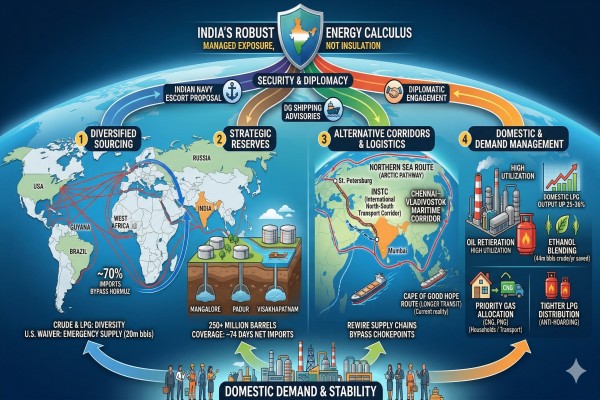
At its core is diversification. India now sources crude from roughly 40 countries, with about 70 per cent of imports routed through channels that do not depend on Hormuz.
This includes rising volumes from the United States, West Africa, Brazil, and Guyana, alongside a parallel shift in liquefied petroleum gas (LPG) sourcing toward North America. The intent is not to replace the Gulf—which remains central—but to dilute concentration risk so that disruptions in one region do not translate into systemic supply shocks.
This diversification is reinforced by storage buffers that give policymakers time to respond. India maintains strategic petroleum reserves exceeding 250 million barrels of crude and petroleum products, distributed across underground caverns in Mangalore, Padur, and Visakhapatnam, as well as offshore and above-ground storage.
These reserves cover roughly 74 days of net imports, effectively acting as an insurance mechanism against short-term supply disruptions. In crisis conditions, such buffers are less about long-term substitution and more about buying time—time to reroute cargoes, negotiate supplies, or stabilise domestic markets.
Logistics has emerged as the second pillar of resilience. India is working with Russia to operationalise alternative transport corridors that bypass traditional chokepoints such as Hormuz and the Suez Canal.
The International North-South Transport Corridor (INSTC), a 7,200 km multimodal network, reduces transit time between Russia and India while lowering costs.
The Chennai-Vladivostok maritime corridor opens a direct eastern route to Russian energy and mineral resources, while the Northern Sea Route—though still constrained by infrastructure and seasonal factors—offers a shorter Arctic pathway as navigation conditions evolve.
Together, these corridors represent a strategic attempt to rewire supply chains rather than merely reroute shipments.
In the immediate term, however, global shipping realities still dominate. Tankers are increasingly taking the longer route around the Cape of Good Hope to avoid high-risk zones in the Gulf and the Red Sea, adding weeks to transit times and raising freight and insurance costs.
Regional alternatives—such as routing oil through Saudi Arabia’s East-West pipeline to Yanbu or the UAE’s pipeline to Fujairah, and using Omani ports like Duqm and Salalah—offer partial bypasses but come with capacity constraints and their own security risks.
The result is a system that is more flexible than before, but not immune to cost escalation.
India’s tactical response to the current crisis reflects this balance between structural preparedness and short-term improvisation.
State refiners secured a temporary 30-day waiver from the United States to purchase around 20 million barrels of Russian oil that had been stranded at sea or stored near Indian shores.
This move ensured immediate supply continuity without breaching sanctions frameworks, highlighting how diplomatic coordination can be used to unlock supply in constrained conditions. It also underscores a broader trend: India’s willingness to leverage opportunistic barrels—whether discounted or logistically stranded—to stabilise domestic markets.
Domestic capacity has been pushed to complement these external measures. Indian refineries are operating at very high utilisation levels, in some cases exceeding nameplate capacity. By diverting specific hydrocarbon streams within refineries and petrochemical complexes, authorities have managed to increase domestic LPG production by 25 to 36 per cent, cushioning the impact of potential import disruptions.
At the same time, structural initiatives such as the 20 per cent ethanol blending programme are reducing crude demand by an estimated 44 million barrels annually. While not a crisis response in itself, such measures incrementally lower import dependence and therefore vulnerability.
Demand management has been deployed as a stabilisation tool rather than a blunt restriction. Government orders prioritise natural gas supply for essential sectors such as household piped gas and transport CNG, while curtailing allocations to industrial users when necessary.
On the LPG side, measures to prevent hoarding—including extending the minimum interval between cylinder bookings and tightening delivery authentication—are aimed at maintaining orderly distribution and preventing panic-driven demand spikes. These steps reflect an understanding that crises can be amplified as much by domestic behaviour as by external shocks.
In effect, the current crisis is testing a strategy years in the making. The early indicators suggest that while costs may rise and logistics may tighten, India has built enough redundancy into its system to avoid outright disruption. That does not eliminate vulnerability—but it does transform it from an immediate threat into a manageable challenge.
• Diversified sourcing: ~40 supplier countries; ~70% imports bypass Hormuz
• Strategic reserves: 250+ million barrels; ~74 days cover
• Alternative corridors: INSTC, Chennai–Vladivostok, Northern Sea Route
• Emergency supplies: 20 million barrels of Russian oil via US waiver
• Domestic buffers: Refining at peak levels; LPG output up 25–36%
• Demand controls: Priority gas allocation; tighter LPG distribution rules
• Security & diplomacy: Vessel advisories, monitoring, escort proposals
Security and diplomacy form the final layer of India’s response. The Directorate General of Shipping has issued advisories mandating enhanced security protocols for Indian-flagged vessels and established round-the-clock monitoring of maritime traffic in the Persian Gulf.
There have also been proposals to deploy the Indian Navy to escort vulnerable shipments, signalling readiness to secure sea lanes if required. Parallel diplomatic engagement has enabled selective transit for energy shipments, including Indian gas carriers and a Saudi oil tanker bound for India, even amid heightened tensions.
The broader picture that emerges is one of managed exposure rather than complete insulation. India cannot decouple from the Gulf, nor can it fully neutralise the impact of global price movements.
What it has done, however, is reduce the probability that a single chokepoint disruption will cascade into a full-blown supply crisis. Diversification spreads risk geographically, reserves buy time, alternative corridors expand logistical options, and domestic adjustments smooth consumption patterns.
Diplomacy, meanwhile, acts as the connective tissue that keeps these elements functioning under stress.