Three weeks into “Operation Epic Fury” against Iran, the tactical maps in the Situation Room bear little resemblance to the triumphant simulations of early February.
When the United States and Israel launched their air campaign on Iran on February 28, 2026, the working assumption—shared by the White House and the IDF—was that the Iranian regime would splinter within 72 hours under the weight of “escalation dominance”.
Instead, the conflict has settled into a grinding, high-tech stalemate that defies conventional military logic.
Despite the near-total suppression of Iran’s formal command-and-control hubs and the destruction of much of its surface navy, the world is witnessing a “pre-logistical” crisis that has turned the Persian Gulf into a strategic bog.
This raises a jarring question for the modern strategist: Why is the world’s most sophisticated military machine, possessing absolute air superiority and precision-guided dominance, struggling to deliver a decisive blow against an adversary relying on a “tanker war” strategy and an outdated air force?
The answer is not found in the sorties of F-35s but in a series of “invisible” vulnerabilities and decentralised doctrines that have effectively held the global economy hostage.
1. The Two-Tiered Sea: Iran’s “Flexible Control” of Hormuz
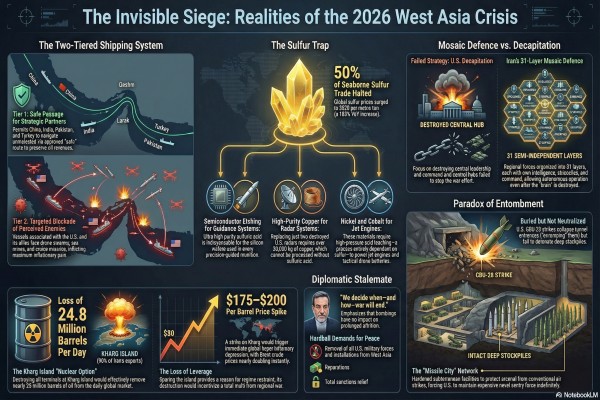
Rather than attempting a conventional, total blockade of the Strait of Hormuz—which would invite immediate international intervention—Tehran has implemented a doctrine of “flexible control”.
This is managed through a sophisticated, counter-intuitive two-tiered shipping system that treats maritime traffic based on national affiliation rather than cargo type.
- Tier 1 (Safe Passage): Iran permits a select group of nations—specifically China, India, Pakistan, and Turkey—to navigate the Strait unmolested.
- Tier 2 (Targeted Vessels): Any vessel associated with “perceived enemies” is subject to drone swarms, sea mines, and anti-ship cruise missiles.
“Iran permits a small number of cargoes from friendly or neutral nations to safely traverse the Strait. These vessels are allowed to use an approved ‘safe’ route, such as the passage between Larak and Qeshm, ensuring they are not targeted.”
This flexible control is far more insidious than a total closure. By allowing a trickle of traffic to reach its partners, Iran preserves its vital oil revenues—primarily from China—while inflicting maximum inflationary pain on the West.
It forces the U.S. into a reactive posture, unable to secure the waterway for its own allies without risking a massive escalatory response that could shut the Strait for everyone, including those currently enjoying Tier 1 status.
2. The Sulfur Trap
The most significant strategic failure of the 2026 crisis was treating industrial chemistry as “background noise”. For decades, planners wargamed oil and gas disruptions but completely ignored the sulphur trap.
The Strait of Hormuz accounts for 50 per cent of the world’s seaborne sulphur trade. As shipments halted, global sulphur prices surged to over $650 per metric tonne—a 165 per cent year-over-year increase, with 25 per cent of that surge occurring just since the war began on February 28.
This is a “byproduct trap” for the U.S. defence industrial base.
Sulphur is primarily a byproduct of processing sour gas and crude oil; it cannot be independently “scaled up” in a military emergency. As the Modern War Institute notes, this is a “left of boom” problem where the defence industrial base cannot obey military demand signals because it is tethered to hydrocarbon production.
Sulphuric acid is the hidden material base of warfighting, and its scarcity is now crippling readiness:
- Semiconductor Etching: Ultra-high-purity sulphuric acid is indispensable for the silicon wafers used in the guidance systems of every precision-guided munition and interceptor in the U.S. arsenal.
- Copper Processing: Sulphuric acid is required to turn low-grade ore into the high-purity copper needed for radars and electrical grids. Replacing just two destroyed U.S. radars in Bahrain and Qatar requires over 30,000 kilograms of copper.
- Nickel and Cobalt: These materials are essential for jet engines and the tactical batteries powering drone fleets; they require high-pressure acid leaching, a process entirely dependent on sulphuric acid.
Military planners missed this vulnerability because they focused on “mines, refineries, and batteries” while ignoring the invisible industrial foundations. Washington is discovering that its combat endurance is physically capped by an obscure reagent it cannot simply “will” into existence.
3. Mosaic Defence: Why “Decapitation” Is a Failed Strategy
A cornerstone of U.S. strategy is “decapitation”—the belief that destroying central leadership will cause a military to freeze. In 2026, this strategy has been rendered obsolete by the Mosaic Defence, a decentralised architecture formulated by former IRGC chief Mohammed Ali Jafri.
Under this doctrine, Iranian forces (IRGC and Basij) are reorganised into 31 regional, semi-independent layers. Each layer functions as a self-sufficient “complete military”, possessing its own independent intelligence, weapon stockpiles, and command-and-control. Because there is no single “brain” to destroy, the U.S. finds itself fighting 31 separate, localised wars simultaneously.
The futility of the decapitation strategy was summarised by Iranian Foreign Minister Abbas Araghchi, whose quote has become the focal point of Tehran’s resistance: “Bombings in our capital have no impact on our ability to conduct war… [we] decide when—and how—war will end.”
By the time U.S. strikes took out the central hubs in Tehran, the 31 layers had already transitioned to autonomous operations, ensuring that the ability to launch missiles and harass shipping remained intact despite the loss of national leadership.
4. Underground “Missile Cities” and the Entombment Paradox
To sustain the Mosaic Defence, Iran relies on “passive defence”—a vast network of subterranean “missile cities”. These hardened facilities store nearly the entire Iranian arsenal, protecting it from thousands of conventional strikes.
However, the U.S. attempt to neutralise these via GBU-28 “bunker-buster” bombs has triggered the Paradox of Entombment. Repeated strikes often collapse the access infrastructure and tunnel entrances without necessarily detonating the deep-storage stockpiles. While this prevents Iran from bringing the missiles to the surface to fire, it does not neutralise the threat; it merely “buries” it.
This has forced the U.S. into a brutal and expensive waiting game. To ensure these missiles never re-emerge, the U.S. must maintain a multi-billion-dollar sentry force of naval and air assets indefinitely to monitor and re-strike any attempt to clear the tunnels. It is a war of attrition where the “buried” threat continues to drain American resources without ever needing to be launched.
5. The Kharg Island “Nuclear Option”
As the stalemate continues, domestic political pressure is mounting on the Trump administration to take the “nuclear option”—the total destruction of the oil terminals on Kharg Island. Kharg handles 90 per cent of Iran’s oil exports, making it the regime’s primary economic lifeline.
The data surrounding this target is catastrophic:
- Total Global Impact: Destroying Kharg, combined with retaliatory closures and infrastructure damage across the Gulf, would remove 24.8 million barrels of oil per day from the global market.
- Market Shock: Brent crude would spike instantly to between $175 and $200 per barrel, triggering a global hyper-inflationary depression.
Sparing the island is the essence of “Loss of Leverage”. As long as the terminals stand, the Iranian regime has a reason for some restraint. If they are destroyed, the regime—facing total economic collapse—has every incentive to launch a multi-front regional war, activating the “Axis of Resistance” from Hezbollah to the Houthis.
Furthermore, the political stakes in Washington are immense; such an energy spike would devastate Republicans in the upcoming midterms and utterly collapse President Trump’s efforts to lower domestic costs, a reality the source context refers to as “Project Dubious”.
The New Center of Gravity
The 2026 Persian Gulf Crisis has fundamentally shifted the “centre of gravity” of modern conflict. It is no longer found in the ability to occupy territory or suppress an air force. Instead, victory is being determined by economic stamina and the resilience of “invisible” chemical supply chains.
The U.S. finds itself in a war where traditional military supremacy is being checked by “sulphur traps” and “mosaic defences”—vulnerabilities that planners previously dismissed as background noise.
As we look toward the future of global security, we must ask: In an era where a decentralised adversary can hold the world’s industrial chemistry hostage, is traditional military supremacy still the ultimate decider of modern conflict?