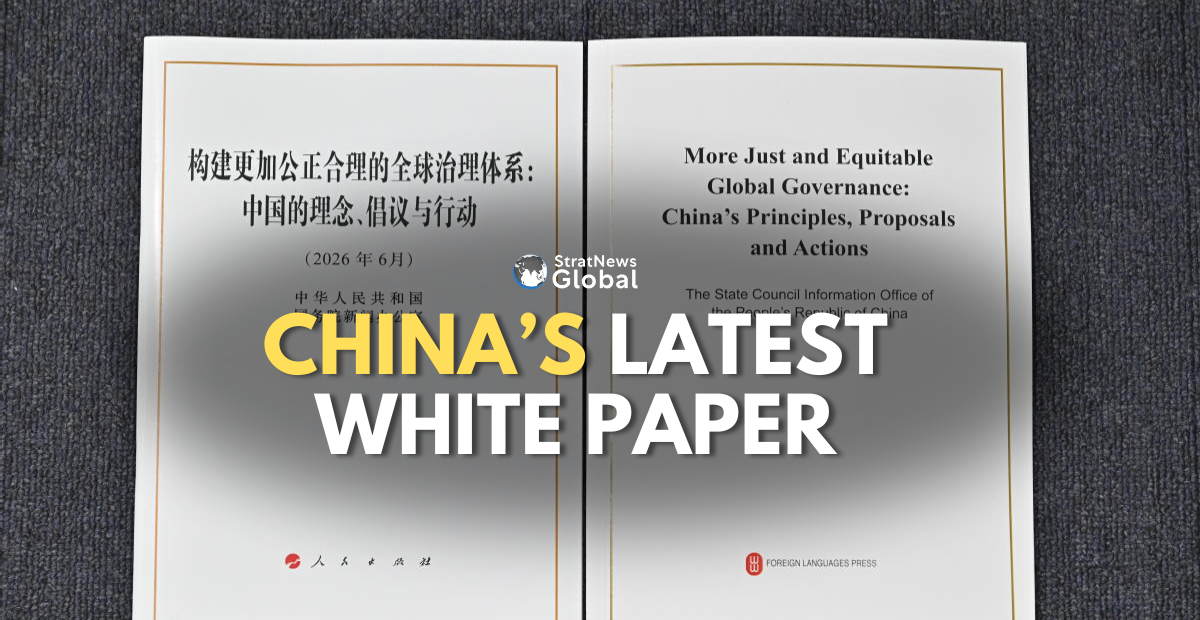
China’s State Council Information Office on Wednesday released a white paper titled “More Just and Equitable Global Governance: China’s Principles, Proposals and Actions”, setting out Beijing’s vision for reforming global governance amid growing geopolitical tensions and mounting international challenges.
The document presents China’s proposals for strengthening multilateral cooperation, improving global governance institutions and increasing the representation of developing countries in international decision-making.
Global Governance Initiative Takes Centre Stage
A key focus of the white paper is the Global Governance Initiative (GGI), proposed by Chinese President Xi Jinping in 2025.
According to the document, the initiative seeks to address two major questions facing the international community: what kind of global governance system should be built and how existing institutions can be reformed to better reflect contemporary realities.
Chinese officials say the initiative has received support from nearly 160 countries and international organisations, while more than 60 countries have joined the Group of Friends of Global Governance.
Five Core Principles
The white paper identifies five key concepts underpinning China’s approach to global governance: sovereign equality, international rule of law, multilateralism, a people-centred approach and practical action.
It argues that all countries, regardless of size, economic strength or level of development, should have equal participation in global affairs. The document also stresses that international relations should be governed by international law rather than power politics.
China further describes multilateralism as the only viable path for addressing global challenges, ranging from security threats to economic development and climate issues.
Strong Support for the United Nations
The white paper places particular emphasis on the role of the United Nations, arguing that any reform of global governance must be built around the existing UN-centred international system.
Beijing says countries should uphold the international order based on international law and the principles of the UN Charter rather than create alternative structures that weaken established institutions.
The document also calls on major powers to assume greater responsibility in addressing global peace and development challenges.
Greater Voice for the Global South
A recurring theme throughout the paper is the need to strengthen the representation of developing nations.
China argues that emerging economies and Global South countries remain underrepresented in global governance institutions and should play a larger role in shaping international rules and policies.
The document states that growing global challenges require governance mechanisms that better reflect the interests and concerns of a broader range of countries.
Highlighting China’s Global Contributions
The white paper also presents China as an active contributor to international peace, development and cultural exchange.
It highlights Beijing’s efforts through initiatives such as the Global Development Initiative, Global Security Initiative and Global Civilization Initiative, portraying them as complementary frameworks designed to promote development, security, cultural understanding and improved governance.
The document also points to China’s role as the world’s largest developing country and its support for infrastructure development, economic cooperation and South-South collaboration.
Call for Collective Action
Concluding the paper, China urges countries to translate the goals of the Global Governance Initiative into practical cooperation and institutional reform.
The document argues that global governance reform requires sustained effort from all nations and warns that countries should not remain passive in the face of mounting international challenges.
Beijing says broader participation and stronger multilateral cooperation will be essential for building what it describes as a more just, equitable and effective system of global governance.
(with inputs from agencies)