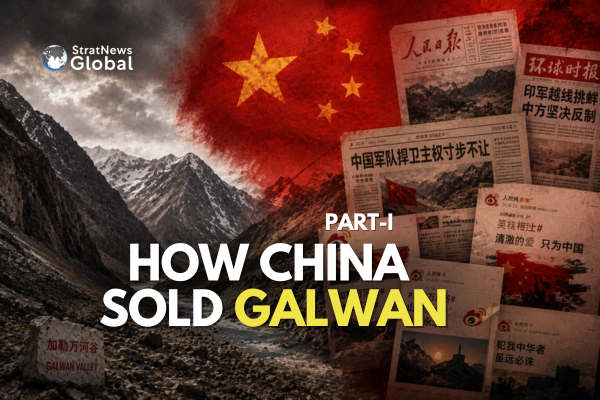
Six years after the Galwan Valley clash, China’s public messaging on India sounds very different.
The accusations that dominated Chinese media in 2020 have largely given way to calls for cooperation, economic engagement and stable relations.
Yet Beijing’s core narrative has not changed.
The evolution of China’s Galwan story is not about changing facts. It is about changing emphasis. Between 2020 and 2023, Chinese state media moved from assigning blame, to celebrating Chinese soldiers, to analysing India’s strategic behaviour. The tone softened, but the underlying message remained consistent: China was portrayed as a stabilising force, while India was presented as the source of tensions.
The first chapter of this narrative emerged immediately after the clash.
On June 25, 2020, then Chinese Ambassador to India Sun Weidong laid out Beijing’s official position. He said Indian troops had crossed the Line of Actual Control in the Galwan Valley, which he described as Chinese territory, and argued that India bore full responsibility for the confrontation.
Chinese media quickly reinforced that position.
A 2020 report by Beijing News argued that the clash stemmed from India’s growing border infrastructure, geopolitical ambitions and domestic political pressures. According to the report, Galwan was the result of increasing Indian assertiveness along the frontier. (Source: 从洞朗到加勒万河谷:印度走火入魔的“边境基建竞争”)
The Global Times advanced a similar argument. Writing shortly after the clash, scholar Guan Peifeng claimed China had consistently exercised restraint while India had repeatedly challenged stability along the border. He linked Galwan to earlier disputes and to India’s post-independence “Forward Policy”, portraying the incident as part of a longer pattern of Indian behaviour. (Source: Global Times, 30 June 2020 Guan Peifeng: The Galwan Valley — China Has Never Been the Provocateur Global Times, 30 June 2020)
Other reports argued that New Delhi was exploiting a moment when China was distracted by the COVID-19 pandemic and rising tensions with the United States. Analysts cited by Chinese media suggested India was using border nationalism to divert attention from domestic economic problems while strengthening ties with Washington.
By the end of 2020, the narrative was firmly established: India crossed the line, China defended its sovereignty.
A significant shift occurred in 2021.
In February, China publicly disclosed details of its Galwan casualties for the first time, stating that four PLA soldiers had been killed. While questions remained about the actual number of casualties, Chinese media shifted its focus away from assigning blame and towards honouring the soldiers involved.
The centrepiece of this campaign was 19-year-old PLA soldier Chen Xiangrong. His reported final words, “My pure love is only for China”, were amplified across state media and social media platforms. Tribute videos, patriotic hashtags and official coverage transformed Chen into the face of China’s Galwan story.
Galwan was no longer presented simply as a border clash. It became a symbol of sacrifice, heroism and national unity.
At the same time, Chinese commentary increasingly connected India to broader geopolitical competition. Several articles questioned whether relations could improve while India deepened cooperation with the United States. Others warned that New Delhi was abandoning its traditional strategic autonomy and moving closer to a Western-led security framework aimed at containing China.
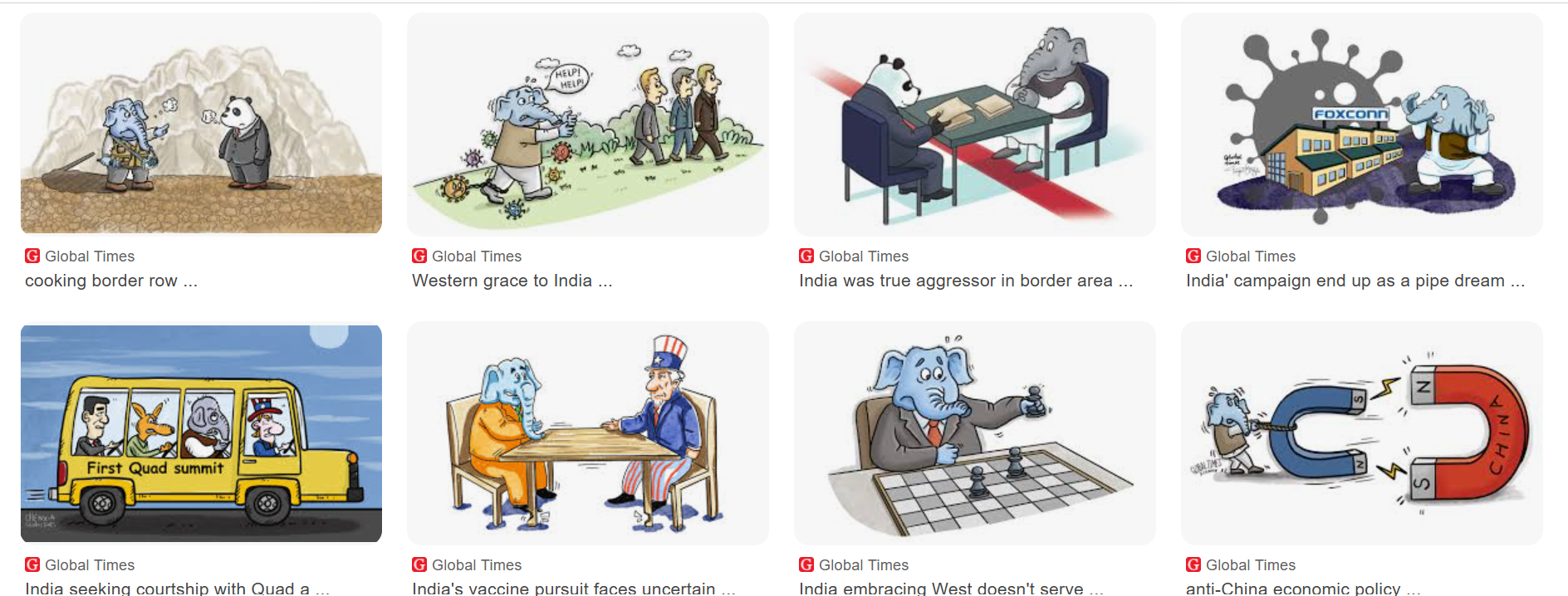
Visual propaganda also became more prominent. Political cartoons and illustrations frequently depicted India as strategically misguided and prone to miscalculation.
By 2022, another transition was underway.
The emotional language of the immediate post-Galwan period began to fade, replaced by a more analytical critique of Indian policy.
One notable example was a December 2022 article by Chinese scholar Qian Feng notable professor in China, who argued that India’s China policy was shaped by four flawed mindsets: a victim mentality, a superiority complex, a chaser mentality and a speculator mentality.(Source: Global Times, December 2022 India’s China policy entangled by four complex mindsets)
This marked an important shift. Rather than portraying India primarily as an aggressor, Chinese commentators increasingly argued that Indian behaviour reflected insecurity and poor strategic judgement.
The same theme appeared elsewhere. Chinese editorials argued that Western countries were promoting India’s rise largely because they viewed New Delhi as a useful partner against China. According to this narrative, Western praise reflected geopolitical calculations rather than confidence in India’s capabilities.
Chinese criticism also expanded beyond the border dispute. Reports increasingly portrayed India as a regional power seeking to dominate its neighbours, citing disputes with countries such as Nepal as evidence. (Source A 2022 Global Times article titled “Nepal should be vigilant about India’s bid to encroach its territory”)
By 2023, Chinese commentary had become more nuanced.
While suspicion remained, analysts increasingly acknowledged that India was not simply following Washington’s lead. Articles discussing India-US relations recognised New Delhi’s desire to maintain strategic autonomy and balance relations with multiple major powers. Some commentators questioned whether India would ever become a US proxy, while others dismissed American hopes of fully drawing India into an anti-China coalition.
(Source: Global Times, 23 January 2023Will New Delhi make the right choice as Washington pushes it as a proxy for war? – Global Times
For perhaps the first time since Galwan, Chinese analysts were treating India as an independent strategic actor.
That recognition, however, did not translate into trust.
Chinese media continued to criticise India’s trade policies, challenge its manufacturing ambitions and question claims that it could emerge as an alternative to China in global supply chains. As Apple expanded iPhone production in India, nationalist commentary on Chinese social media frequently mocked India’s industrial capabilities and dismissed suggestions that it could compete with China.
Attention also began shifting towards what Beijing calls “Southern Tibet”, its term for India’s state of Arunachal Pradesh. Around the third anniversary of the Galwan clash in 2023, Chinese propaganda increasingly focused on territorial claims in Arunachal Pradesh. As references to Galwan became less frequent, broader questions of sovereignty and disputed territory moved to the forefront. (Source: StratNews Global, June 2023CCP’s Southern Tibet Propaganda Takes Center Stage as Galwan Clash Anniversary Nears – StratNews Global)
China’s rhetoric evolved. Its memory did not.
By 2023, the Galwan narrative had become embedded in China’s official discourse and patriotic culture. The language had changed from accusation to analysis, but the central storyline remained intact.
After 2024, however, a new narrative began to emerge, one that spoke less about blame and more about cooperation. The second part of this series examines whether China genuinely changed its view of India, or merely changed its tone.
Read the second part of this series here : China’s India Reset Masks Enduring Suspicion (2024-2026