A series of US military deployments and diplomatic evacuations across the Middle East have intensified speculation that Washington and Tehran may be edging toward direct confrontation, even as nuclear diplomacy hangs in the balance.
The United States has authorised the withdrawal of non-essential embassy staff and their families from Jerusalem and reduced personnel at its mission in Baghdad. Officials also ordered some American diplomatic staff to leave Beirut on 23 February.
In advisory language described by analysts as unusually pointed, US authorities urged citizens to depart while commercial flights remain available.
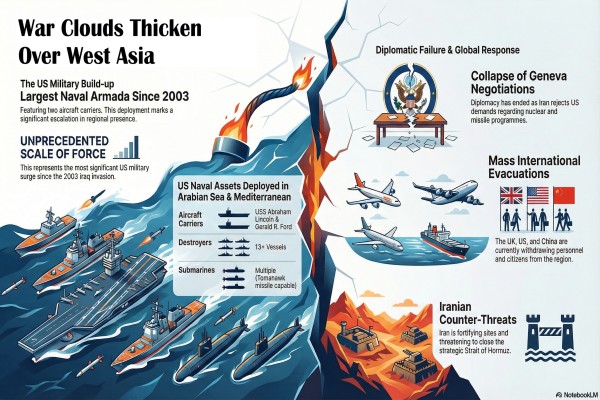
The naval posture has also shifted markedly. The USS Gerald R. Ford carrier strike group has moved into Israeli waters, while the USS Abraham Lincoln is reported to be operating in the broader region. According to regional security observers, more than a dozen US destroyers and an unspecified number of submarines are deployed across the Arabian Sea and Mediterranean, a force concentration some analysts describe as the most significant since the 2003 Iraq invasion.
Aerial assets have also been repositioned. KC-135 and KC-46 refuelling tankers were sighted at Tel Aviv’s Ben Gurion Airport, an uncommon deployment linked to reported adjustments at Al Udeid Air Base. Regional reports suggest Qatar has declined to allow its territory to be used for offensive strikes on Iran, prompting alternative basing arrangements.
Diplomatic tracks, meanwhile, appear strained.
Iranian officials and Omani mediators said on 26 February that talks with Washington over Tehran’s nuclear programme had progressed sufficiently to move toward technical discussions — typically the most complex phase of negotiations. However, separate reports indicate that broader talks in Geneva have faltered.
President Donald Trump has publicly demanded that Iran abandon not only its nuclear ambitions but also its ballistic missile programme and regional proxy network – conditions Tehran has rejected outright.
On the Iranian side, preparations also appear to be underway.
A journalist seen as close to the Iranian establishment has reported that Supreme Leader Ali Khamenei has pre-approved a list of regional targets and instructed military commanders to prepare for a prolonged conflict. Iranian authorities are reportedly reinforcing strategic sites, conducting military drills and reiterating threats to close the Strait of Hormuz — a vital global energy chokepoint — and to launch missile strikes on US bases and Israel in the event of attack.
Other countries have begun contingency measures. China has urged its nationals to leave Iran, while the United Kingdom is said to be reducing personnel in parts of the region.
Taken together, the diplomatic withdrawals, naval deployments and reciprocal military signalling point to a volatile moment in US–Iran relations. While negotiations have not formally collapsed, the parallel escalation on the ground has heightened fears that any miscalculation could rapidly spiral into open conflict.