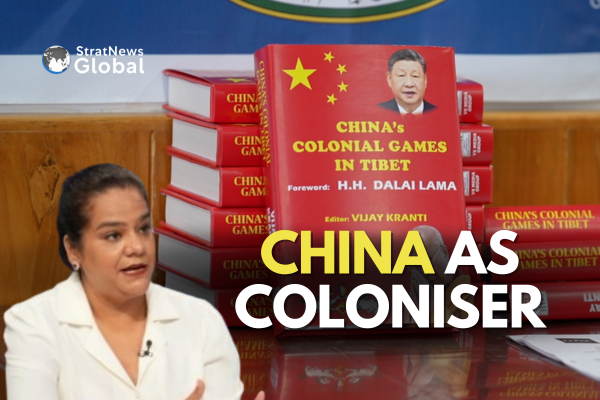
In an era where digital discourse is often transient, China’s Colonial Games in Tibet stands as a lasting archive of resistance. Edited by veteran Tibetologist and journalist Vijay Kranti, this comprehensive volume (released in March 2026) does not simply catalogue human rights abuses; it reframes Beijing’s governance of Tibet as a modern colonial enterprise.
By assembling the perspectives of 39 experts across 60 essays, the book presents a thorough critique of strategies affecting Tibetan identity. The volume’s credibility is supported by Vijay Kranti’s extensive experience. As a journalist who has worked with the BBC, Voice of America, and Deutsche Welle, Kranti brings a careful editorial approach. His background as a photographer documenting Tibetan life for 50 years ensures the book blends political analysis with observation rooted in decades of experience.
The book’s origin story is unique: it is a curated crystallisation of 15 international webinars conducted between 2020 and 2023. Recognising that vital oral testimonies often vanish into the digital ether, Kranti and the Tibetan Youth Congress (TYC) undertook the “challenge to reproduce spoken presentations into essay-like written words.” The result is a text that retains the urgency of activism while offering the rigour of written documentation.
From Online Discussions to Written Documentation
The book’s origin story is unique: it is a curated crystallisation of 15 international webinars conducted between 2020 and 2023. Recognising that vital oral testimonies often vanish into the digital ether, Kranti and the Tibetan Youth Congress (TYC) undertook the “challenge to reproduce spoken presentations into essay-like written words.” The result is a text that retains the urgency of activism while offering the rigour of written documentation.
The text is divided into 12 sections that dissect specific “games” played by the Chinese state. Two particularly harrowing themes emerge from the collection:
- The book also examines the physical impact on the Tibetan population. Notable chapters address the issue of forced organ harvesting, outlining allegations that wealthy clients can obtain organs through a system reportedly protected by officials.
- The book’s emotional anchor is the tragedy of Tsewang Norbu, a 25-year-old pop star whose self-immolation in 2022 serves as the volume’s “Why This Book” catalyst. His story—a modern, successful youth driven to the ultimate protest—shatters the narrative that Tibetan resistance is limited to the older, traditional generation.
The book is an essential Reading for the “Asian Century”. It is not light reading. It is a dense, confronting “moral indictment” intended for policymakers, legal scholars, and human rights advocates. By freezing the “spoken word” of the 2020-2023 webinars into a static, undeniable object, Kranti has ensured that these testimonies cannot be “evaporated” by censors, as Tsewang Norbu’s digital footprint was.
Read other stories here: