When Chinese dissident political cartoonist Badiucao first saw the watch, he didn’t see it as a collector’s item. To him, it was a piece of history which China tried hard to erase.
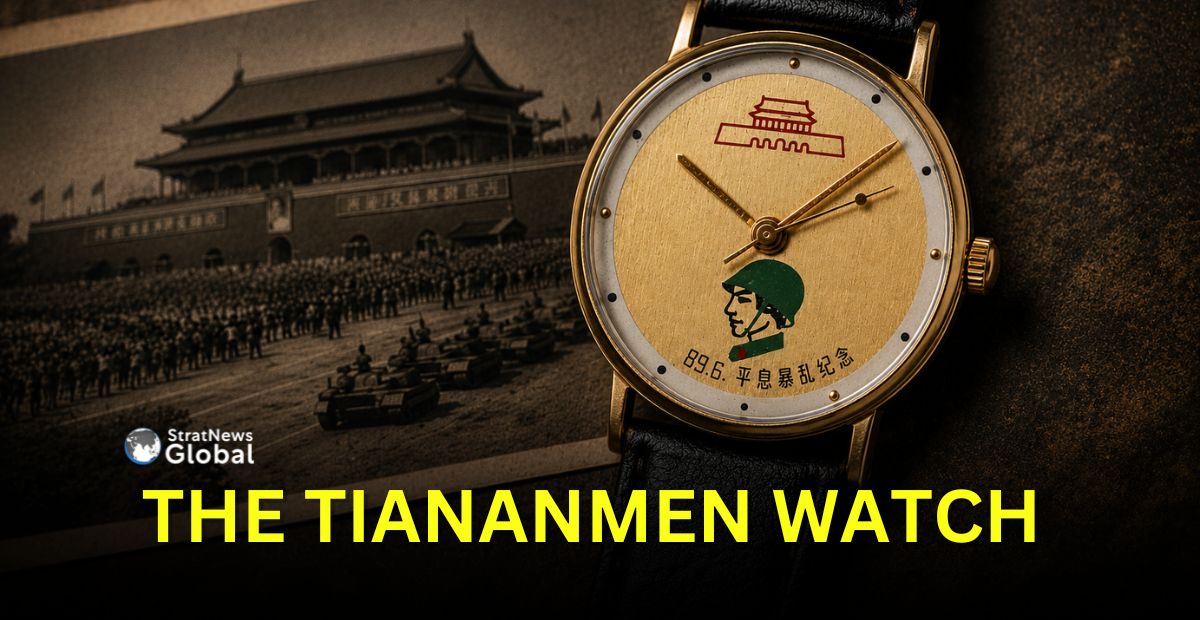
The watch was one of a limited number reportedly awarded to People’s Liberation Army soldiers who took part in the military crackdown of Tiananmen Square on 4th June 1989, along with a medal and a certificate calling them “Guardians of the Republic.”
Decades later, the object remains as a rare physical reminder of an event that remains heavily censored inside China.
The watch has the Tiananmen gate printed on the top, a PLA soldier side profile and ‘89.6’ ‘In Commemoration of Quelling the Rebellion’ inscribed at the bottom.
Chinese authorities later realised that these commemorative items could complicate efforts to control public memory of the crackdown. Hence, many of the watches and certificates were reportedly recalled, making surviving examples exceptionally rare.
However, some watches survived, and one such watch resurfaced in an auction in 2021 when it appeared in a sale catalogue of a British auction house, Fellows.
Badiucao recalled “I still remember vividly that on their website, they had a handsome male model wearing this watch as if it’s any luxury brand like a Rolex. And in the description, it just really brushed off the very history of it.”
Public criticism from the Chinese dissidents quickly gained traction, drawing attention from British media outlets. Soon afterwards, Fellows withdrew the watch from sale, citing concerns for the safety of the vendor following online threats.
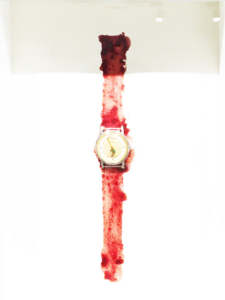
The watch later became the centrepiece of an art installation featuring 64 watch straps made using his own blood, a reference to June 4, 1989. The work has since been exhibited in galleries in Italy, the Czech Republic and Poland.
The episode of auction also highlighted a broader question of how societies should treat artefacts linked to traumatic historical events.
The journey of the watch from military award, to political taboo, to museum exhibition, reflects the continuing contest over the memory of Tiananmen.
In China, discussion of the events of June 1989 remains tightly controlled. Online references are routinely censored, public commemorations are prohibited and younger generations often know little about what happened.
In an age when history can be censored online and memories can fade, a small steel watch continues to tick as a reminder of an event that many would rather forget.