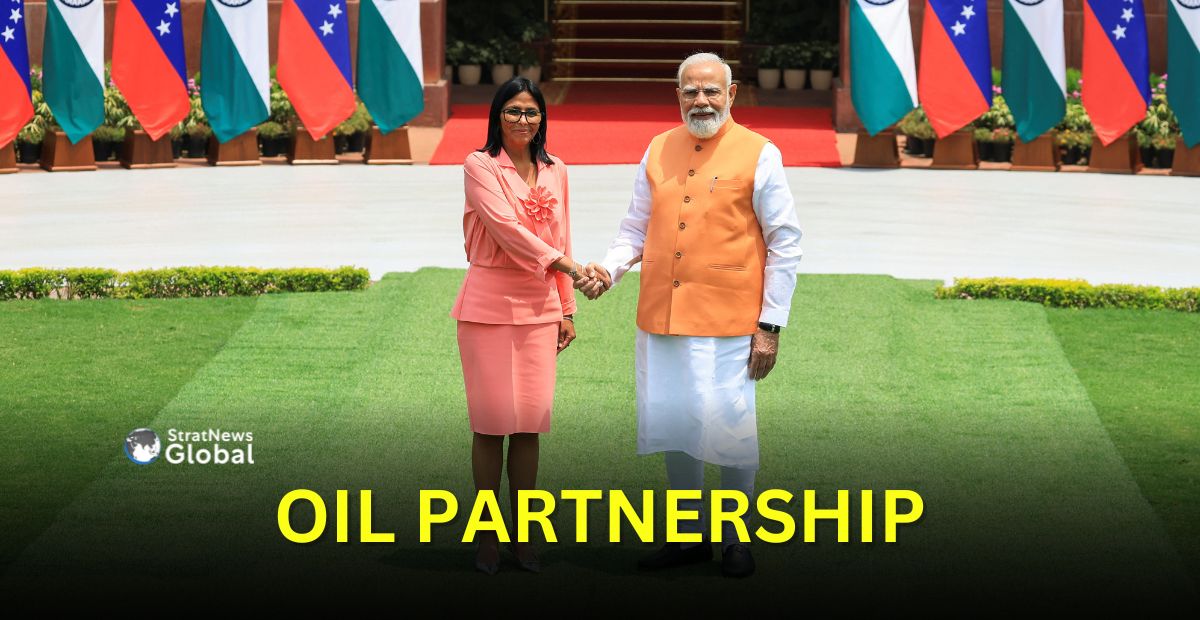
India and Venezuela are looking to expand their energy relationship beyond crude oil trade into exploration, production and refining, as Veneuela’s Acting President Delcy Rodríguez held talks with Prime Minister Narendra Modi during her working visit to India.
During a special media briefing after the meeting, Secretary (East) Rudrendra Tandon said the discussions focused on building a long-term energy partnership between the two countries, while also exploring cooperation in mining, pharmaceuticals, animal husbandry, transportation, agriculture equipment and the automotive sector.
Rodriguez, who is on a working visit from June 3 to 6, arrived with a large ministerial delegation that included ministers handling foreign affairs, economy and finance, science and technology, communication and information, transportation and petroleum.
Tandon described the energy relationship as a natural fit, noting that Venezuela possesses some of the world’s largest oil reserves while India remains one of the fastest-growing economies.
“India is a large and growing consumer of oil and will have a stable demand profile for many years to come,” he said. “There exists a perfect complementarity for India and Venezuela to work in the energy sector.”
Most importantly, he stated that the proposed partnership would extend beyond a traditional buyer-seller arrangement.
He said, “The discussions on the energy sector were extensive. The goal of a partnership would not just be buy-sell.” Adding that both upstream and downstream opportunities were discussed.
Questions were also raised about the mechanism through which Indian companies would pay for Venezuelan crude imports. While declining to discuss operational details, Tandon acknowledged that Venezuela is “undergoing a transition” and said arrangements are currently in place to facilitate transactions.
He said that commercial entities would ultimately determine how payments are executed, taking into account the prevailing financial and regulatory framework.
“All these companies operate at the global level in global markets,” Tandon said. “They will have to take into account the existing payment methods that are going to be adopted when they do economic activity in Venezuela.”
While no major agreements were signed during the visit, Tandon said Venezuela conveyed a clear message that it views India as a preferred long-term partner because of the size of its economy and its growing energy requirements.
“There won’t be any big-ticket announcements for this visit,” he said, indicating that the focus was on identifying opportunities and creating conditions for future commercial engagement.
A important aspect of the visit involves exposing Venezuelan ministers to India’s industrial and technological capabilities. Although Tandon declined to disclose details of Rodriguez’s private itinerary, he confirmed that she would visit energy and industrial facilities outside Delhi.
She will be travelling to the Jamnagar Refinery, Tata Motors facility, and a pharmaceutical laboratory located in Delhi.
“She is being exposed to several facilities to show the sophistication that we have achieved,” he said.
“Our refining industry has become so sophisticated that we are no longer tied to a particular type of crude oil,” he said, explaining that Indian refiners are capable of processing heavy grades of crude, including Venezuelan oil.
The visit comes amid a steady revival in Venezuelan crude shipments to India after years of disruption caused by sanctions. However, to a question if Venezuelan crude could replace Russian crude, he made it clear that Caracas is being viewed as an additional source of supply rather than a replacement for any existing supplier.
India, he said, is pursuing a strategy of diversifying energy imports “from as many sources as possible” to strengthen long-term energy security.
Discussions between the two leaders also touched on unresolved financial issues involving Indian companies operating in Venezuela. Responding to questions on pending dues owed to Indian public and private sector entities, he acknowledged that the matter remains under active discussion.
Questions were raised about more than $500 million in dividend payments owed to ONGC Videsh from its Venezuelan operations. Tandon described it as “our money” and said the issue remains on the table during bilateral discussions.
Indian pharmaceutical companies have also been awaiting payments running into several hundred million dollars from supplies made during earlier years. Tandon said Venezuelan authorities are aware of these concerns and that New Delhi has repeatedly raised them in its engagement with Caracas.
He added that while governments can facilitate economic cooperation, investment decisions would ultimately be taken by companies themselves.
Beyond energy, both sides explored opportunities in mining and critical minerals. Tandon described Venezuela as a resource-rich country and confirmed discussions on assessing mineral reserves and identifying future areas of cooperation.
“Mining is very much there,” he said, noting that Venezuela’s potential extends beyond oil into other strategic resources.
Pharmaceutical cooperation emerged as another priority area. Tandon highlighted India’s ability to supply high-quality generic medicines at affordable prices and said healthcare cooperation was discussed in detail during the visit.