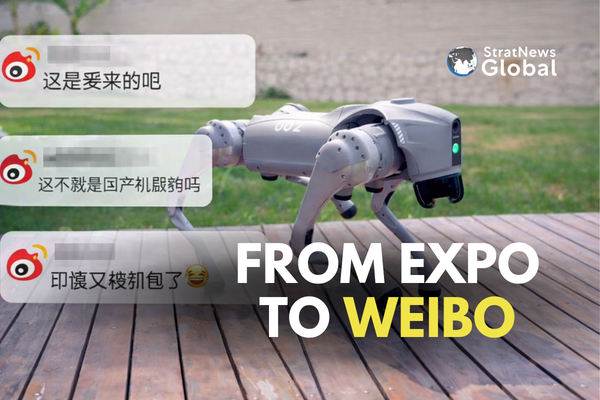
China’s state-run media and social platforms Weibo in particular have found an unlikely Spring Festival crowd-pleaser: a robotic dog from an Indian university.
What began as a routine tech showcase at the India AI Impact Summit 2026 quickly turned into one of the most discussed technology stories on Chinese social media. Not because of breakthrough innovation but because the internet did what it does best.
The controversy did not erupt under the expo lights at Bharat Mandapam. It was born online.
Soon after Galgotias University unveiled its robotic dog, “Orion,” eagle-eyed netizens concluded that the animal was less home-grown prodigy and more well-travelled import. The machine, they noted, looked suspiciously identical to the Unitree Go2, a commercially available quadruped robot sold by China’s Unitree Robotics.
Screenshots, product listings, and side-by-side comparisons began circulating at speed, all pointing to the same conclusion: Orion could be ordered online, shipped, and apparently rebranded.
As the online sleuthing gained traction, the issue migrated from social media timelines to official corridors. According to government sources, Indian authorities overseeing the expo subsequently asked Galgotias University to vacate its kiosk.
By February 18, the university addressed the matter directly, acknowledging on its official X account that the robotic dog on display had indeed been purchased from a Chinese firm. That admission, however, only added fuel to the fire.
China’s state-run Global Times amplified the episode on Weibo (China’s Equivalent to X), where the hashtag “Indian university exposed for buying Unitree robotic dog and showing it off as self-developed” crossed nine million views within two hours and shot to the top of the platform’s trending list.
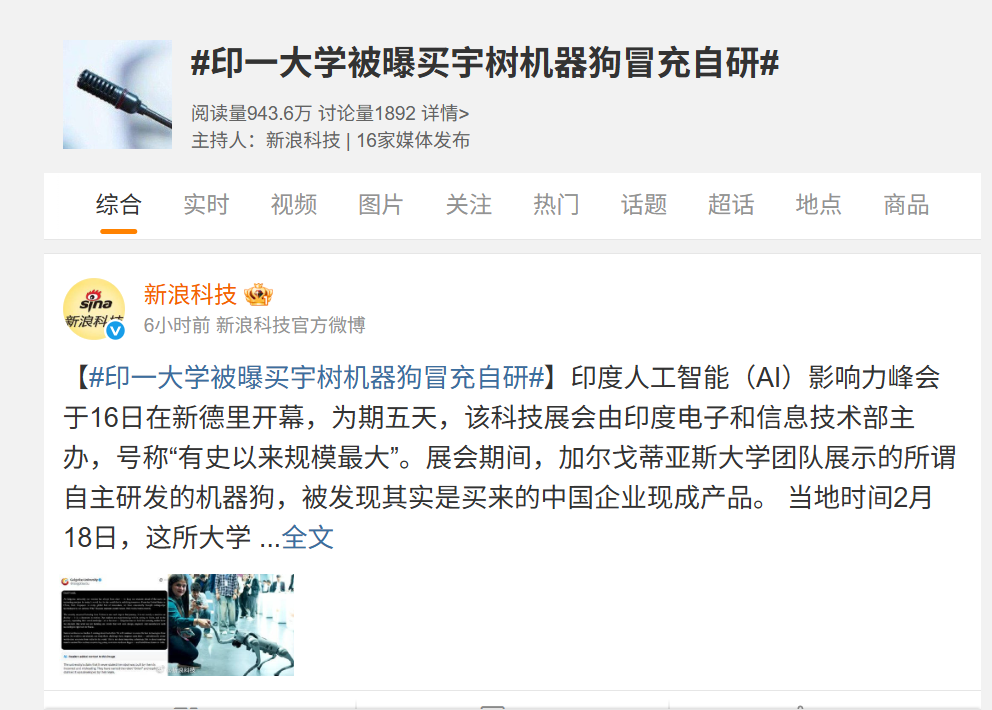
The timing could not have been better at least for Weibo’s engagement metrics. China was in the middle of the Spring Festival holiday, when phones are full, tempers are relaxed, and fun travels fast. One widely liked comment summed up the mood: “Second day of Lunar New Year and a laughing news is here.”
Commenters quickly broadened the episode into a referendum on global tech hierarchies. Many framed it as proof of China’s technological dominance, some even invoking comparisons with American robotics firms like Boston Dynamics, arguing that China had already pulled ahead in advanced technology sectors.
The reality, however, is less meme-friendly.
Despite real advances, China continues to face structural constraints across several frontier technologies from its dependence on Dutch firm ASML for the most advanced EUV lithography machines, to export controls limiting access to cutting-edge semiconductor manufacturing equipment and electronic design automation tools dominated by U.S. companies.
Even China’s leading chipmaker, SMIC, remains behind global leaders such as TSMC when it comes to consistent, high-yield production at the most advanced nodes. In commercial aviation, aircraft produced by COMAC still rely heavily on Western engines and critical components.
In short, while the robotic dog episode has provided festive entertainment and a convenient online morality play about innovation and imitation it says more about the internet’s appetite for exposure than it does about the true balance of technological power.
And as Spring Festival scroll-sessions made clear, nothing travels faster online than a robot caught without its pedigree.