Here’s a question: do you think China’s President Xi Jinping is cool?? Meaning is there anything about how he looks or walks, what he wears or his general demeanour that would invite the “cool” description?
Doubtless Xi does probably enjoy strong backing among many Chinese citizens. Even on social media he would be popular. But does that mean he’s cool? In pictures he is usually seen in his dark suit or on less formal occasions in white shirt and dark pants. Too dour, serious, obese, therefore decidedly “un-cool”.
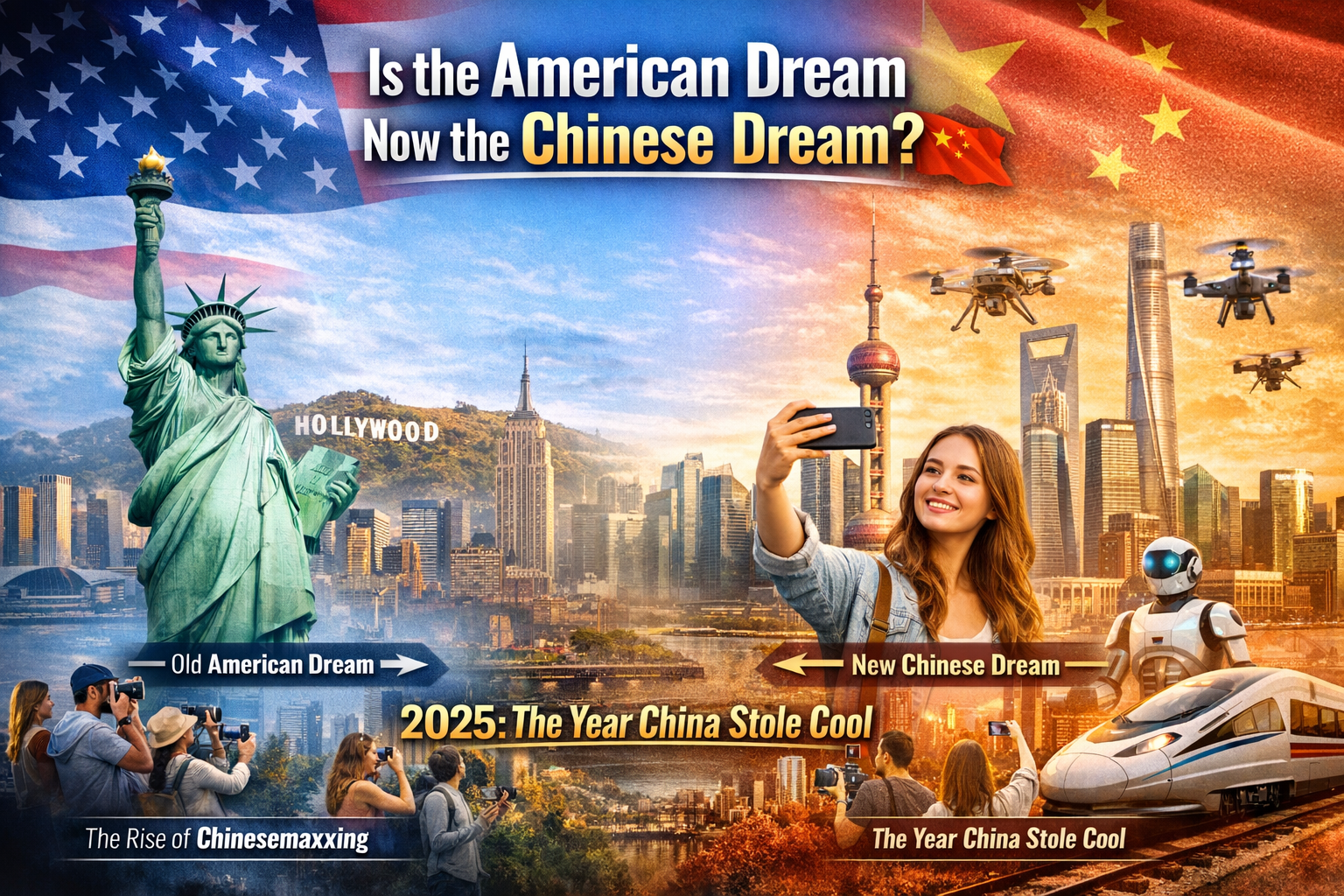
Now here’s the paradox, Xi is presiding over a country that seems to have overtaken the US in terms of being cool. Meaning from a time when anything US was cool, such as Hollywood, Silicon Valley, pop music, and the promise of upward mobility, today that appears to be receding in the rear view mirror.
The “China is cool” trend is a recent phenomenon, dating back to 2025 when a few influencers and YouTubers began exploring regions like Tibet and Xinjiang. That seems to have triggered an on-line frenzy helped in no small measure by Beijing’s determined efforts to showcase the two regions generally regarded as victimised by China.
The Rise of Chinesemaxxing
From this online frenzy emerged the term “Chinesemaxxing,” a lifestyle movement were primarily young Western audiences adopt edhabits, aesthetics, and routines inspired by modern China to “upgrade” their lives. It encompassed wellness practices like drinking hot water or eating congee in winter, engaging with Chinese apps and media, and admiring the country’s technological leaps.
It was about living the way China presents itself: efficient, stylish, and forward-looking. According to Substack writer Capital in the North in “The Year When China Became Cool”, influencers flooded Chinese cities, sharing videos of futuristic skylines, driverless cars, delivery drones, and spotless metros.
Chongqing’s highways went viral, and Shenzhen was likened to the old Silicon Valley. A Chinese video game and animated film also broke out globally, showing that China wasn’t just making goods it was shaping culture.
A Feb 2026 article in The Wall Street Journal titled “Why China Cares About Being Cool All of a Sudden,” highlighted another dimension: Chinese entertainment, from blockbuster films like Labubuls and Ne Zha to global video game releases. Chinese products and culture were no longer associated with low quality; they represented innovation and aspiration.
Technology and Culture Driving Perceptions
Cool, once America’s monopoly, was suddenly up for grabs. China’s cultural rise was mirrored by technological feats. The Global Times in “Today’s China Is Cool Because It Turns Ideas Into Everyday Reality Very Quickly” (21 December 2025) noted that innovations in are being scaled from labs to mass deployment.
Elias Khalil Jabbour, well known Brazilian Marxist economist, detailed how China’s public-sector-led system enabled rapid, society-wide impact, in contrast to Western private-sector constraints. These tangible results reinforced China’s image as efficient, forward-thinking, and globally influential.
But Namrata Hasijia, Research Fellow with the Centre for China Analysis and Strategy (CCAS), told StratNews Global that Beijing has cleverly used influencer-led content in regions like Tibet and Xinjiang to bypass traditional media skepticism.
“By showcasing China’s high-tech cities, urban safety, and cultural landmarks through influencers, the government creates a curated narrative that often downplays sensitive geopolitical issues,” she explained.
Hasijia added that this ‘cool China’ phenomenon is a strategic rebranding effort: in today’s fractured information environment, personal experiences shared online often shape perceptions more effectively than official statements, positioning China as modern, efficient, and desirable.
Separating Cool from Power Politics
China is all of that but there is also a China which is opaque, works by stealth to undermine and undercut, disregards treaties and agreements it has signed, and bullies and intimidates countries that refuse to bow to its dictates.
Even the US at the height of cool, engaged in wars, overthrew governments, unleashed conflicts and bullied and intimidated the world to bow to its dictates. So it’s important to separate the cool from the not so cool and understand that while the two can exist at the same time, wisdom lies in focusing on what makes you cool.