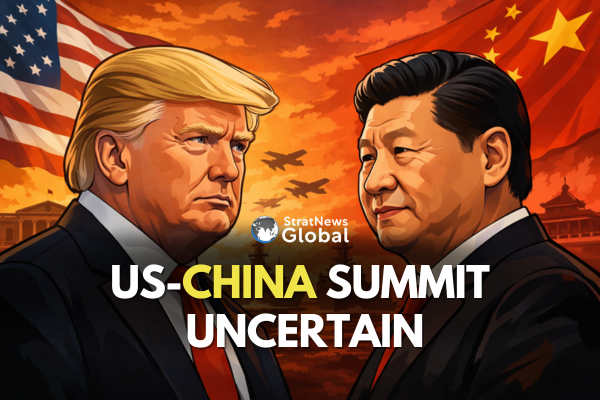
U.S. President Donald Trump’s request to delay a planned summit with Chinese President Xi Jinping in Beijing has cast a shadow over bilateral ties, though analysts say it is unlikely to cause a major breakdown.
The move comes despite relations remaining relatively stable since the leaders last met in October, highlighting how the ongoing conflict with Iran is reshaping Washington’s foreign policy priorities.
War Adds To Existing Pressures
The potential delay underscores how the Iran conflict has added a new layer of complexity to already sensitive issues between the world’s two largest economies, including trade disputes and tensions over Taiwan.
It also pauses momentum in efforts to recalibrate relations, just as both sides concluded high-level trade talks in Paris aimed at preparing for Trump’s visit, initially planned for the end of March.
Those discussions followed fresh U.S. investigations into what Washington described as “unfair trade practices”, after the U.S. Supreme Court struck down much of Trump’s global tariff framework last month.
Trade Talks Show Limited Progress
Sources familiar with the Paris negotiations said China signalled openness to increasing purchases of U.S. agricultural products, including poultry, beef and non-soybean crops.
The two sides also discussed critical issues such as access to rare earth minerals and the creation of new mechanisms to manage trade and investment between the countries.
China’s state-run China Daily described the talks as “constructive”, but warned that Beijing’s openness should not be mistaken for acceptance of U.S. pressure tactics, particularly tariffs and unilateral trade measures.
Analysts See Limited Impact
Experts say the delay reflects practical challenges rather than a fundamental shift in relations.
Zhao Minghao of Fudan University said the Iran conflict and legal challenges to U.S. tariff policy had complicated preparations, but did not place ties at immediate risk.
Others noted that the postponement could provide both sides with more time to prepare substantive outcomes, particularly as trade tensions remain unresolved.
Mixed Signals From Washington
U.S. officials have offered differing explanations for the possible delay.
Trump told the Financial Times he could postpone the meeting if China did not help reopen the Strait of Hormuz, a critical oil route disrupted by the conflict.
However, Treasury Secretary Scott Bessent said the delay was more likely linked to coordinating the war effort rather than trade disagreements or demands on China.
Focus On Stability
Despite the uncertainty, analysts say both Washington and Beijing remain focused on maintaining stability in their relationship.
For China, ensuring steady ties with the United States is seen as critical as it navigates economic challenges and prepares for long-term strategic competition.
Experts also noted that Beijing may not object to a short delay, given concerns about limited preparation on the U.S. side and the complications arising from the ongoing war.
Ongoing Diplomatic Engagement
Chinese foreign ministry spokesperson Lin Jian said communication between the two sides continues regarding the timing of the summit, emphasising the importance of leader-level diplomacy in guiding bilateral relations.
While the delay introduces uncertainty, analysts believe both countries remain committed to keeping dialogue open and avoiding a major deterioration in ties.
(with inputs from Reuters)