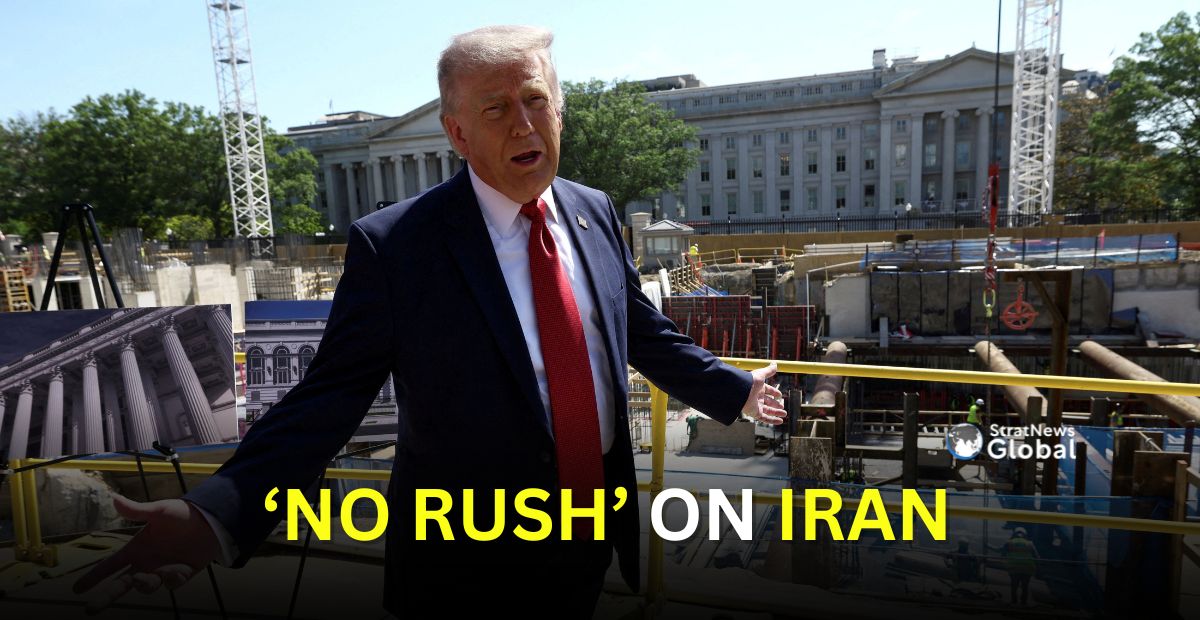
U.S. President Donald Trump said on Sunday that he had instructed his representatives not to rush into any agreement with Iran, as his administration tempered expectations of a near-term breakthrough in the three-month-old conflict, after earlier signs of progress had emerged.
He also said the U.S. blockade on Iranian ships in the Strait of Hormuz would “remain in full force and effect until an agreement is reached, certified, and signed,” adding, “Both sides must take their time and get it right.”
There was no immediate response from Iran’s government. But Tasnim news agency, which is linked to Iran’s Revolutionary Guards, said the U.S. was still obstructing parts of a potential deal, including Tehran’s demand for the release of frozen funds.
A day earlier, Trump said Washington and Iran had “largely negotiated” a memorandum of understanding on a peace deal that would reopen the Strait of Hormuz, which before the conflict carried one-fifth of global oil and liquefied natural gas shipments.
The two sides remain at odds on several difficult issues, such as Iran’s nuclear ambitions, Israel’s war in Lebanon with the Iranian-backed Hezbollah militia and Tehran’s demands for the lifting of sanctions and the release of tens of billions of dollars of Iranian oil revenues frozen in foreign banks.
Working Out Deal’s Details
A senior Trump administration official said an agreement would not be signed on Sunday, citing the Iranian system’s slow pace, but outlined the broad contours of a possible deal.
Speaking anonymously, the official said Iran had agreed “in principle” to reopen the Strait of Hormuz in exchange for the lifting of the U.S. naval blockade, and to address its stockpile of highly enriched uranium.
The official said Iran’s Supreme Leader had broadly endorsed the framework, though there was no confirmation from Tehran. He added that Washington would first focus on reopening the strait and easing the blockade, while nuclear details would be negotiated over time, with a proposed 60-day window for a final agreement.
Iran has not publicly clarified the terms and maintains that its uranium enrichment is for civilian use.
Deal Draws Out U.S. Critics
Trump, whose approval ratings have been affected by rising U.S. energy prices and who faces congressional moves to limit his war powers, has promoted the prospect of a deal to end the conflict that began on February 28. A fragile ceasefire has been in place since early April.
Oil prices fell to two-week lows at the start of the week, with Brent crude dropping over 4% to $98.83 a barrel and WTI also down more than 4%, amid reports of a possible agreement.
Critics, including former officials and Democratic lawmakers, said the proposed framework offers little beyond the 2015 Iran nuclear deal, which Trump later abandoned. Trump rejected the criticism, defending his approach in a Truth Social post.
The plan also faces uncertainty over control of the Strait of Hormuz, while Iran’s Revolutionary Guards said limited shipping has resumed under Tehran’s approval, far below pre-war levels. Analysts warn that even a ceasefire would not quickly resolve the global energy crisis, with full oil flows potentially not returning until 2027.
(With inputs from Reuters)