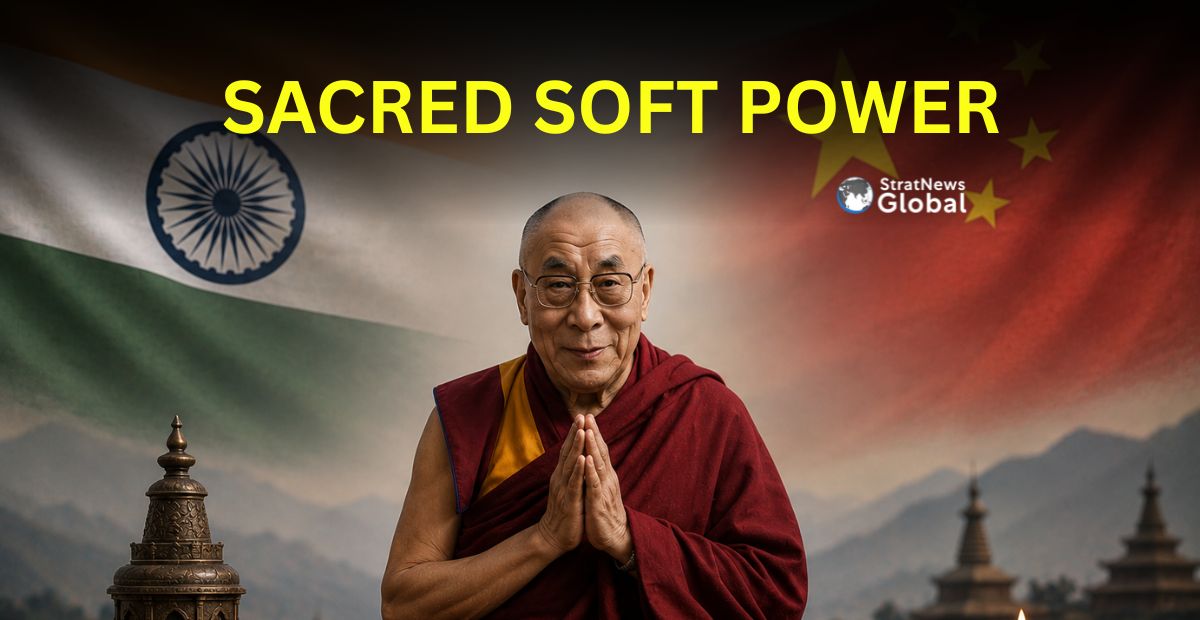
It’s been three days since Tibetans all over the world marked the 91st birthday of the Dalai Lama. Many may even experience anxiety, since Tibetan tradition requires his successor to be selected only after his death. And since the successor will be a child, add another decade at least for his training and education before he takes over as Dalai Lama. What happens in the interim?
“It is critical question” says Jayadeva Ranade, head of the Centre for China Analysis & Strategy. The years immediately after the Dalai Lama’s death, he believes, could prove to be the most challenging for the Central Tibetan Administration (CTA), which will have to preserve the very legitimacy it has long derived from the Dalai Lama himself.
There is also the practical reality of the successor’s growing-up years. That interregnum, Ranade says, is likely to test the Tibetan movement in ways it has not experienced before.
Interestingly, he does not see the migration of young Tibetans abroad as the biggest concern.
“Tibetans may move for better opportunities, but that doesn’t mean their dedication to the Tibetan cause goes down,” he says. If anything, overseas communities often remain deeply invested in the movement.
What worries him more are the differences within the community itself, regional identities, sectarian affiliations and competing political views that have largely remained in the background under the Dalai Lama’s leadership.
There could be rival centres of Tibetan Buddhism as China is certain to prop up a tame Dalai Lama. Then again, in recent years India and China have increasingly competed to be the torchbearers of Buddhism. It has acquired strategic dimensions with China restoring monasteries, hosting international Buddhist forums and expanding engagement with Buddhist institutions across Asia.
Ranade points to a basic flaw or contradiction in China’s efforts.
“China is a communist state. By its own definition, communists are atheists. So how can they be Buddhist?” he says.
In his assessment, Beijing’s outreach is less about religious revival than about shaping the institutions and networks that could influence the post-Dalai Lama landscape.
India, meanwhile, is rediscovering a legacy that has always been its own. As the land where the Buddha attained enlightenment, India has in recent years stepped up efforts to reconnect with the Buddhist world through development of Buddhist Circuits, international conferences and the display of sacred relics overseas.
Ranade says the effort came “late and in fits and starts”, but believes it is beginning to make an impact. He recalls that several Buddhist leaders have privately welcomed India’s renewed engagement, saying New Delhi had for too long allowed others to occupy that space.
Yet, Ranade points out that India’s own Buddhist landscape is far more diverse than it is often portrayed.
“As far as Buddhism within India is concerned, we have a huge population of neo-Buddhists… they’re somewhat different from the Theravada practiced in Southeast Asia and the Vajrayana practiced in Tibet.”
In numbers they are small, estimated at about 1 crore. The majority are concentrated in Maharashtra (77%) but there are significant Buddhist pockets in states like Sikkim, Arunachal Pradesh and Mizoram with smaller pockets elsewhere. Electorally they are small but Buddhim has strategic value and India continue to push hard to ensure the faith thrives and grows further.