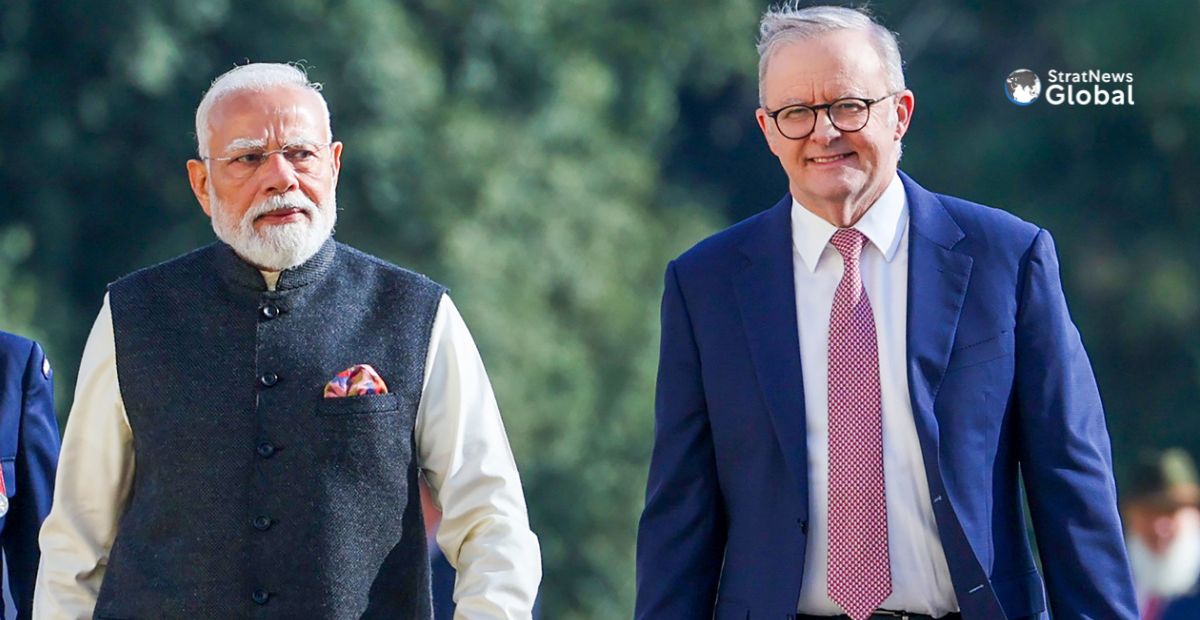
India and Australia have operationalised their long-pending Civil Nuclear Agreement, clearing the way for Australian uranium exports to India.
Prime Minister Anthony Albanese playing host to his Indian counterpart Narendra Modi, said, “The arrangement facilitates Australian uranium exports to India to help increase the share of non-fossil fuel power capacity, providing an additional market for the Australian resources sector.”
Modi pitched for the future: “We are building a manufacturing ecosystem in India for hydro projects, green hydrogen, solar modules, and windmills,” he said, while reiterating India’s target of achieving 500 GW renewable energy capacity by 2030 and 100 GW of nuclear power by 2047.
Addressing business leaders at the India-Australia CEO Forum and Economic Roadmap Business Reception, Modi described India and Australia as “natural and trusted partners” capable of building resilient supply chains and sustainable economic growth.
“Today, the world is going through a period of uncertainty, supply chain disruptions, and an energy crisis. At such a time, it is both natural and necessary for India and Australia to move forward as natural and trusted partners. Over the past few years, we have built a strong framework for future cooperation by combining the capabilities of both countries,” he said.
Modi said the Economic Cooperation and Trade Agreement (ECTA), signed in 2022, had already transformed bilateral commerce.
“Since its implementation, exports from India to Australia have doubled, and businesses in both countries have benefited from new market access. However, we have not stopped there, we are now moving towards a Comprehensive Economic Cooperation Agreement,” he said.
Both sides approved a new Joint Declaration on Defence and Security Cooperation, replacing the 2009 framework. The agreement lays the foundation for greater interoperability between the armed forces, defence industrial collaboration, cybersecurity cooperation, counter-terrorism coordination and humanitarian assistance.
The countries also adopted a Maritime Security Collaboration Roadmap aimed at strengthening maritime domain awareness, information sharing and operational coordination across the Indo-Pacific.
In another first, Australia invited India to send a military instructor to the Australian Defence College in 2028-29, while the two governments agreed to deepen cooperation between the Indian Coast Guard and Australia’s Maritime Border Command.
Modi pitched India’s infrastructure sector as a long-term investment destination.
“There are immense possibilities for Australian long-term investors in India’s port, airport, road, railway, and urban infrastructure sectors,” he said, adding that India offered “a safe, stable and sustainable growth option” for Australian pension funds.
He also invited deeper collaboration in artificial intelligence, quantum technologies, semiconductors and digital public infrastructure, noting that India had committed over $10 billion towards these strategic sectors.
Australian Prime Minister Anthony Albanese described the agreements as another milestone in the rapidly expanding bilateral relationship.
“Australia and India are close partners and even closer friends,” Albanese said after the bilateral talks.
Critical minerals also emerged as a major pillar of the partnership, with both countries agreeing to collaborate on resilient supply chains for minerals essential to clean energy technologies and advanced manufacturing.
The newly launched Australia-India Partnership for Cyber, Critical Technologies and Supply Chains (PACTS) is expected to enhance cooperation in cybersecurity, emerging technologies and digital resilience amid growing global concerns over technology security.
The visit also produced agreements in skill development, mining technologies, higher education, scientific research and innovation. Flinders University received approval to establish a campus in Bengaluru, while vocational education regulators from both countries signed an agreement to strengthen skills recognition and workforce mobility.