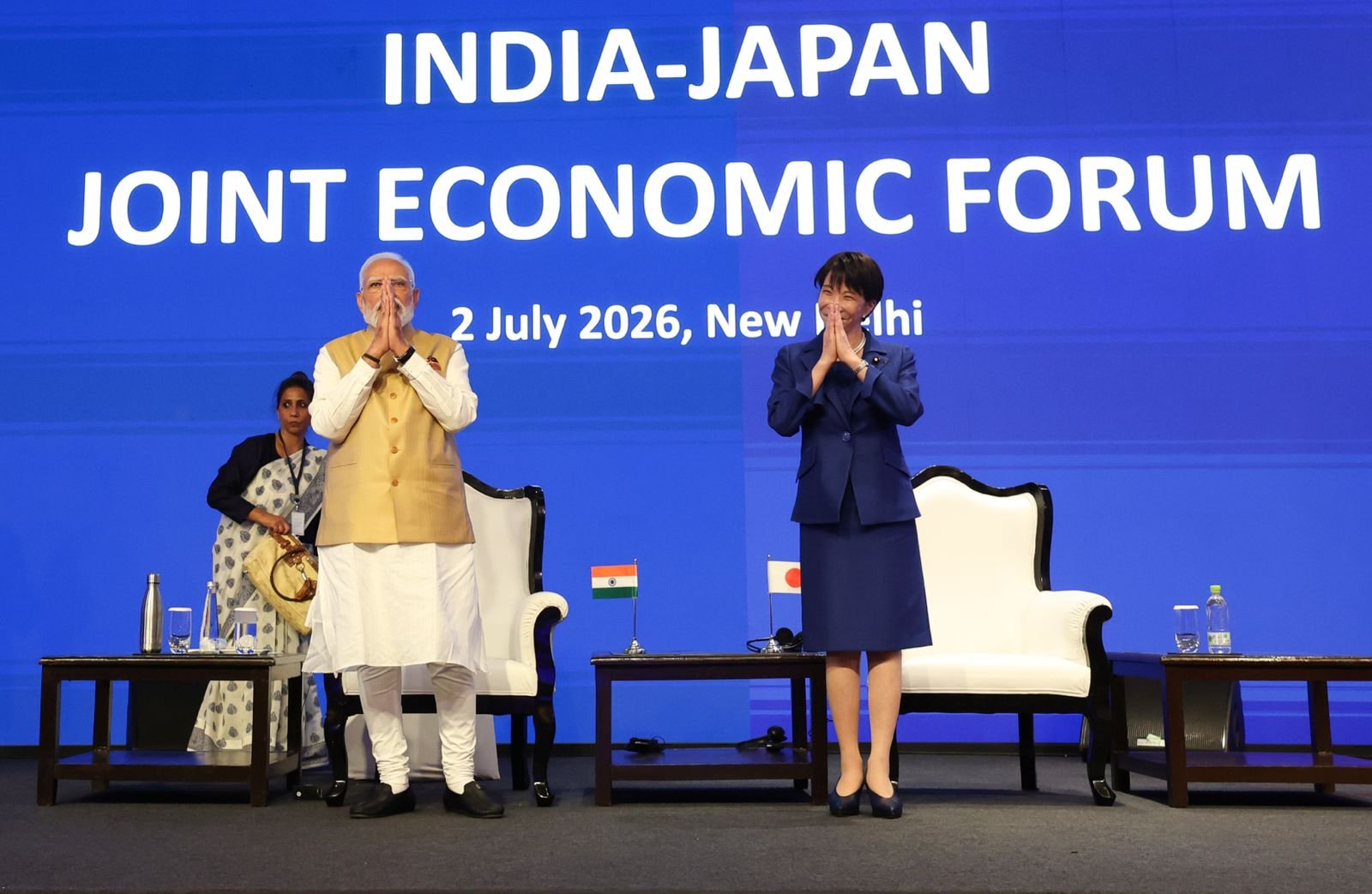
A brother-sister tango is all very well but when it involves two neighbours with whom China is not on the best of terms, Beijing’s fear of encirclement goes up several notches. Japanese Prime Minister Takaichi’s visit to India that saw a quiet upward trajectory in their defence and economic relationship, was therefore not a good development from China’s view.
The decision to co-produce the Unicorn, which integrates several naval antenna into a single mast, may only be the tip of the iceberg. Other reports suggested a common destroyer design for both navies.
That aside, the Tokyo-Delhi move to get around Chinese blockades and price manipulation regarding rare earths and critical minerals, signals a determination to slowly curb Beijing’s space for blackmail.
China’s Paranoia
The other development not widely reported, concerned Japan deploying for the first time, the Type 25 cruise missile in Kumamoto on its southernmost island of Kyushu. The 1000-km range missile brings within striking reach, China’s rich coastal cities of Shanghai, and Qingdao.
The eastern seaboard is where China’s wealth is generated and the sense of vulnerability may have deepened in Beijing.
Witness the confrontation between the Chinese Coast Guard and the Japanese Navy in the seas off the Senkaku Islands earlier this week. Strictly speaking, such locking of horns may not be new, and July is generally the time when this “hot season” plays out in the East China Sea.
The confrontation saw no exchange of fire and according to the Japanese Foreign Ministry, the Chinese vessels withdrew. Nevertheless the confrontation signalled China’s intentions and with transgressions in previous years averaging around 200 a day, according to Japanese reports, 2026 may be no different if not worse.
Fortress Senkakus?
What does China hope to gain through such transgressions? Dr Satoru Nagao, scholar and non-resident fellow at the Hudson Institute, told StratNewsGlobal on the phone from Tokyo that China sees the Senkakus “as a fortress that defends Taiwan from a potential invasion by the Chinese.”
The Senkakus guard the approach to Taiwan from the north while the Philippines, an ally of Japan and the US, holds the approach to the south.
It tells you something about China’s frustrations that Japan and the Philippines are the main targets of its maritime anger. It explains the transgressions, the constant intimidation especially of the Philippines, attacks on its ships and plans now to blockade Scarborough Shoal, which sits well within Manila’s exclusive economic zone.
For now Japan is holding its own but during Takaichi’s visit, there was a proposal mooted for India to take part in a trilateral with Japan and the Philippines.
“This would be a Track 1.5 effort,” sources said “which can encompass anything of mutual interest excluding territorial disputes of course.”
What Will US Do?
India’s response is not known but the growing tensions and confrontations in the East China Sea are a reminder to Delhi that in both cases, it is Beijing which is the cause of much of the trouble. The key issue is whether the US, Japan’s ally, will stand by Tokyo when push comes to shove.
“”Under Article 5 of the US Japan Treaty of Mutual Cooperation & Security signed in 1960, the US is committed to Japan’s defence and even maintains bases on Japanese soil, including Senkaku” said Dr Nagao. “But Japan should defend Senkaku because the US will help only when Japan shows enough effort to defend.”
It may explain Japan’s determination to counter Chinese transgressions on the high seas but what happens when the ‘pushing and shoving’ results in an armed exchange? That’s when old alliances and new partners may be tested.