India’s Union Budget 2025-26 and 2026-27 reveals how steadily New Delhi coordinates cultural heritage for strategic outreach.
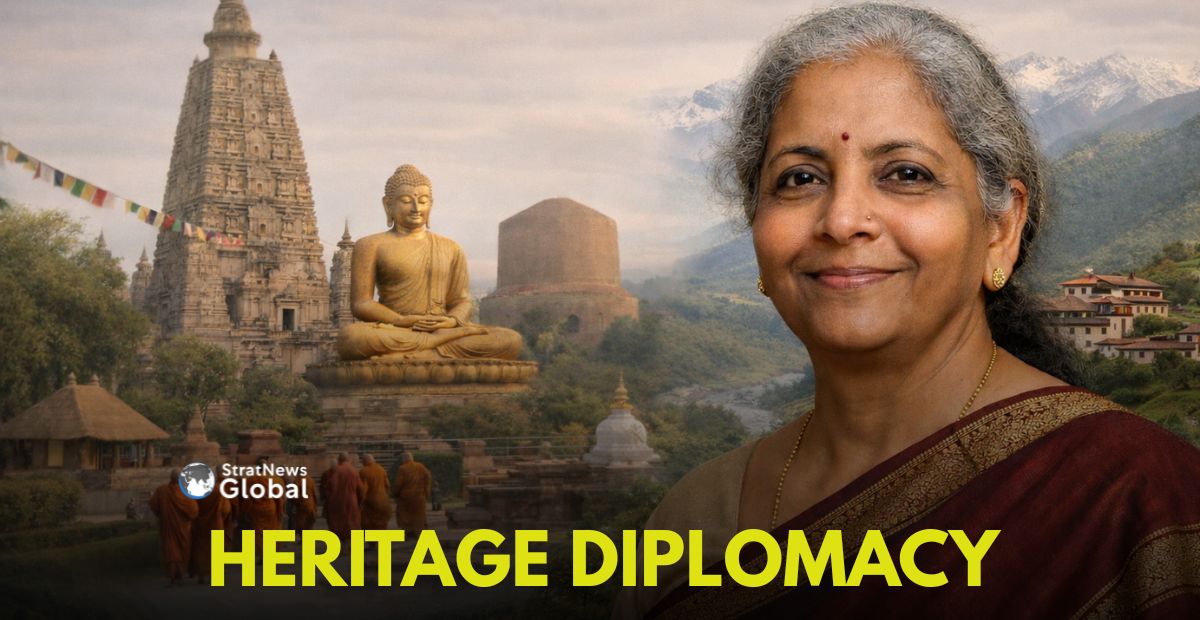
While presenting this year’s Union Budget, Finance Minister Nirmala Sitharaman announced the launch of a Scheme for Buddhist Circuit in Northeastern states of Arunachal Pradesh, Sikkim, Manipur, Mizoram and Tripura to preserve temples and monasteries, pilgrimage interception centers, connectivity and pilgrim amenities.
Last year’s Union Budget announced Rs. 165.44 crores under the scheme Swadesh Darshan 2.0 for the development of Buddhist Circuit in Bihar which involved construction of Convention Centers at Bodhgaya.
The two budgets place significant emphasis on tourism-led growth and reflect efforts to integrate heritage conservation with regional development and external outreach. It signals a strategic recognition of Buddhism both as a civilizational asset and modern instrument of soft power.
This intent found its clearest expression in the 2nd Global Buddhist Summit (GBS) 2026, organised by International Buddhist Confederation (IBC), held last week in New Delhi, which functioned not merely as a cultural gathering but as a signal of how India views Buddhism within its broader diplomatic framework.
By bringing together monks, scholars, delegates and representatives from various countries across the globe, the summit reinforced India’s role as the civilisational heartland of Buddhism.
By emphasising compassion, dialogue, and shared heritage, India avoided the politicisation of Buddhism. This enhances credibility and acceptance, positioning India as a convenor and custodian rather than a competitor. The approach allows soft power to operate quietly, through culture rather than confrontation.
Improved access to Buddhist sites strengthens people-to-people ties with Southeast Asia, East Asia, and the wider Indo-Pacific—regions where Buddhism continues to shape cultural identity and political consciousness. India is already witnessing a growing number of Buddhist pilgrims and devotees visiting sites across India.
Taking together the two budgets and the GBS 2026, India is investing not only in infrastructure, but in influence. By building Buddhist circuits, New Delhi is pursuing an approach that serves both as a development project, cultural bridge and an instrument of soft power.