In a deliberate escalation, Iran has moved from broad accusations to a dated, detailed indictment.
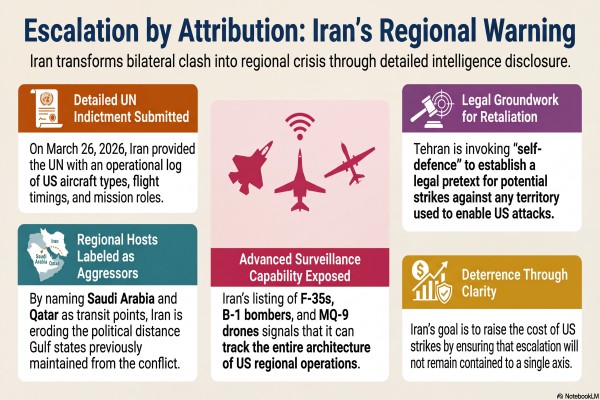
A 26 March 2026 letter to the United Nations sets out what Tehran says is a sustained pattern of US air operations routed through Saudi Arabia and, in some cases, Qatar.
The significance lies less in the accusation—long implied—than in the method. Iran has itemised aircraft types, flight timings and mission support roles across multiple days. Fighters, surveillance platforms and bombers are all named.
The document reads more like an operational log rather than a diplomatic complaint, showing that Iran is tracking US military aviation across the region with precision and continuity.
Two sentences from the communication frame the strategy:
“It has been ascertained that the aggressor… has continued to use the territory and airspace of the Kingdom of Saudi Arabia for the… execution of unlawful military attacks.”
“The Islamic Republic of Iran… reserves the right to take all necessary and appropriate measures, including… self-defence.”
Iran is preparing something big for the UAE 🔥
Iran has sent a letter to the United Nations to document the UAE’s aggression against it, and this is the step that precedes a strong Iranian response to the UAE.
In a letter to the UN Security Council, Iran accused US forces of… pic.twitter.com/tfLoArLorC
— S. Blackwood | Briefs (@BlackwoodBrief) March 27, 2026
This is escalation by attribution. By naming routes and hosts, Tehran is shifting the conflict from a bilateral US–Iran confrontation to a wider regional equation. The message is direct: if strikes originate from, or are enabled by, third-country territory, those locations are no longer neutral.
That shift carries immediate operational consequences. Gulf states have long hosted US assets while maintaining political distance from active conflict. Iran’s framing erodes that distance. It places those states inside the deterrence loop—exposed not by speculation, but by a public record of alleged involvement.
The detail also serves a second purpose: signalling capability.
Listing F-35s, F-15s, AWACS aircraft, MQ-9 drones and B-1 bombers is not incidental. It indicates breadth of surveillance—airborne, electronic and pattern-based. Tehran is saying it can see the architecture of US operations, not just isolated strikes. That complicates any assumption of opacity or deniability.
At the diplomatic level, the language is careful but firm. Iran invokes state responsibility for allowing territory to be used for attacks on a third country, then anchors its response in the right of self-defence. setting legal and political terms before any potential retaliation.
The timing amplifies the effect. With reported casualties crossing 1,500, pressure on all sides is increasing. Tehran is coupling exposure with a conditional warning: it is prepared to act but is still signalling thresholds.
For Donald Trump, the space to manoeuvre is narrowing.
The United States can intensify operations, but Iran has now made clear that escalation will not remain contained. Any strike risks drawing in host nations more directly, either through perception or response. That raises the prospect of a broader regional conflict—precisely the scenario Washington has historically tried to avoid.
De-escalation is not straightforward either. Pulling back under visible pressure carries political costs at home and abroad. It could be read as conceding leverage to Tehran at a moment when the United States is already invested militarily.
A negotiated pause or settlement remains an option, but one complicated by sequencing and trust.
Iran’s public posture—assertive yet legally framed—suggests it wants to shape those terms in advance. By documenting alleged violations and signalling restraint alongside capability, it positions itself as both aggrieved party and rational actor.
At the same time, Donald Trump has bought himself time—again. He has deferred planned strikes on Iran’s energy infrastructure by 10 days, pushing the deadline to early April while insisting talks are “going very well”.
But the pause has exposed a deeper problem: even as Trump frames the delay as a concession extracted from Tehran—” They asked for seven; I gave them ten”—mediators and Iranian officials dispute that version, saying no such request was made.
The result is a widening trust deficit at the very moment diplomacy is being presented as an off-ramp, reinforcing the perception that Washington is juggling escalation and negotiation without a settled endgame.
The Gulf states now face a sharper dilemma. Continued cooperation with US operations may invite direct risk. Distancing themselves could strain security ties that underpin their defence posture. Iran’s move forces a clearer choice, removing the ambiguity that has allowed both tracks to coexist.
What emerges is a more defined battlespace. Lines that were implicit are now explicit: origin points, transit routes, support platforms. That clarity increases risk. It reduces the room for misinterpretation but also lowers the threshold for attribution—and therefore response.
Tehran’s approach blends intelligence exposure with legal signalling. It is not a claim of immediate retaliation; it is a warning that the basis for such action has been established and publicly recorded. That changes calculations in Washington and across West Asia.
The impact is cumulative. Each additional strike now carries a wider set of consequences. Each host decision is more visible. Each response risks escalation beyond the initial axis of conflict.
Iran’s move is thus twofold: expose and deter.
By documenting US operational patterns, it raises the cost of continued strikes. By invoking self-defence against host nations, it widens the consequences of those strikes.