If Nepal’s new prime minister looks like he’s walked off a rap stage into high office, that’s because Balendra ‘Balen’ Shah pretty much has – and India is now dealing with the consequences.
At 35, Shah is the youngest head of government in the world, but also one of the least conventional. A structural engineer by training, a rapper by instinct, and a political outsider by design, his rise has been powered less by ideology and more by attitude — blunt, impatient, and wired into a generation that has had enough of Nepal’s old political class.
He first built his following in Kathmandu’s underground hip-hop scene, turning frustration with corruption and decay into lyrics that struck a chord with urban youth.
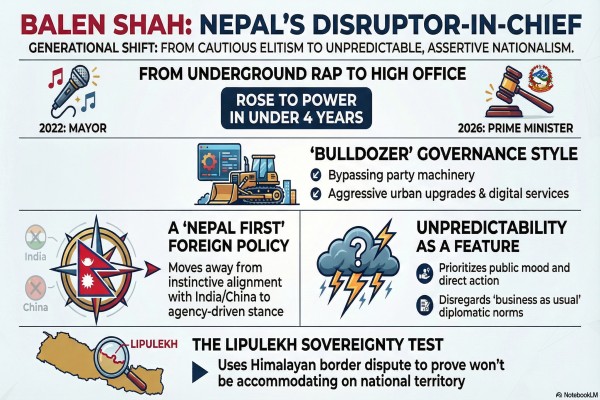
Then, in 2022, he did something that was supposed to be impossible. Running as an independent for Mayor of Kathmandu, he bypassed party machinery, ignored conventional campaigning, and went straight to voters — especially young, online, disillusioned ones. He didn’t just win, he steamrolled established candidates.
As mayor, Shah wasted little time making himself impossible to ignore. He live-streamed meetings, digitised services, and pushed visible urban upgrades — all the things reformers promise and rarely deliver.
But what really defined him was the bulldozer. Illegal structures, encroachments, misused spaces — he went after them with a zeal that supporters called decisive and critics called reckless. His attempt to dig up a buried river by tearing through private property turned governance into theatre. Evictions triggered clashes. Street vendors pushed back. The courts intervened.
It was messy, loud, and highly effective politically.
The real break came in 2025, when youth-led protests shook Nepal’s political system. Shah didn’t lead them on the streets, but he became their amplifier – backing the anger, refusing shortcuts to power, and waiting for elections. That restraint paid off. In 2026, after joining the Rastriya Swatantra Party, he led it to a landslide, crushing veteran leaders including former prime minister K. P. Sharma Oli.
From rapper to mayor to prime minister in under four years — not bad for someone who hadn’t even voted before 2022.
But the qualities that powered his rise are exactly what make him unpredictable.
Shah is decisive but also confrontational. He thrives on disruption but has limited experience managing national institutions. And when it comes to foreign policy, his record raises eyebrows.
As mayor, he displayed a “Greater Nepal” map that irritated India, banned Indian films over a cultural dispute; and posted a profanity-laced message taking aim at India, China and the United States — briefly, but memorably.
That was local politics with global overtones. Now he is running a country that sits between two powers that do not do casual.
Since taking office, Shah has dialled it down. He has spoken of maintaining “historical, close and multifaceted relations” with India and a “natural relationship” with both India and China. Even Narendra Modi moved quickly to congratulate him — a signal that New Delhi is willing to give him space to settle in.
But the constraints are real. Nepal’s economy, trade routes and energy lifelines are deeply tied to India.
China, meanwhile, offers infrastructure and strategic leverage. Every Nepali leader talks about balance; few manage it cleanly. Shah wants a “Nepal First” approach — less dependence, more agency — but geography tends to have the last word.
Which brings us to Lipulekh, a remote Himalayan pass that has suddenly become central to this equation.
In simple terms, Lipulekh is a mountain route used for trade and pilgrimage. India controls it. Nepal claims it. China sits across the border. The dispute hinges on where exactly a river — the Kali — begins. Nepal says the source is further north, which would place Lipulekh inside its territory. India says the source is further south, keeping the pass within Indian control. The disagreement goes back to an 1816 treaty that never clearly settled the geography.
Things heated up in 2025 when India and China agreed to reopen trade through the pass without consulting Nepal. Kathmandu protested. Delhi dismissed the claim. What might have remained a cartographic argument became a live political issue.
For India, Lipulekh is not just a map dispute. It is strategic ground, linked to access routes into Tibet and shaped by military realities since the 1962 war with China.
For Shah, it is something else as well — a test of credibility. A leader who built his image on defiance cannot afford to look accommodating on sovereignty. Expect him to speak more sharply on such issues, even if the underlying policy remains pragmatic.
And that is likely to define the India–Nepal relationship under him: sharper rhetoric, careful substance.
Shah cannot afford a rupture with India — Nepal’s dependence is too deep. But he also cannot afford to look dependent — his political base would not forgive it. The result is likely to be a more vocal Kathmandu, even when cooperation continues quietly beneath the surface.
China, as always, will hover in the background — useful as leverage, risky as dependence. Shah has already hinted at caution on debt and “geopolitical traps”, suggesting he is aware of the limits of leaning too far north.
The bigger shift, however, is generational.
Shah represents a break from Nepal’s familiar political faces — older, cautious, and often predictable. He is younger, more direct, and more responsive to public mood swings. That makes him harder to read, but also harder to ignore.
For India, the message is straightforward. This is not business as usual. The old playbook — built on relationships with entrenched elites — may not work the same way with a leader who built his career opposing that very system.
Balen Shah is not anti-India. But he is not instinctively aligned either. He is operating on a different instinct altogether: assert first, adjust later.
For New Delhi, that means engagement will need to be quicker, sharper, and a lot more attentive.