In May, India will do something few countries can attempt with credibility.
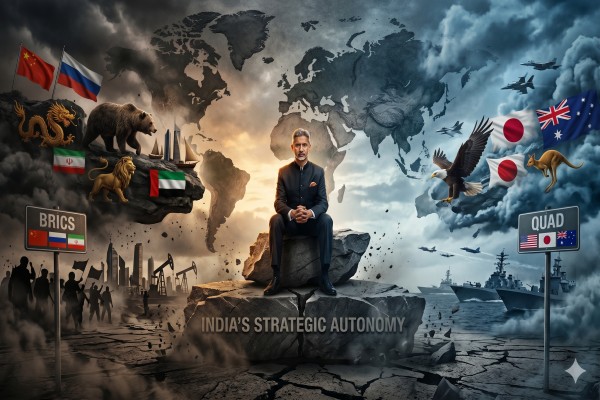
Within weeks, New Delhi will host foreign ministers from both the BRICS grouping and the Quad. One forum includes China, Russia and Iran. The other is built around strategic coordination with the United States, Japan and Australia against an increasingly assertive China.
The overlap reflects India’s foreign policy instinct in a fractured world: avoid camps, keep options open, and turn geopolitical competition into strategic space.
This balancing act becomes even harder given the current global geopolitical uncertainty. West Asia is in crisis after the U.S.-Israel attack on Iran in February and Tehran’s retaliation across the Gulf. Oil markets are unstable. The Strait of Hormuz remains under threat.
The United States and China are competing more sharply across trade, technology and security. Russia’s confrontation with the West continues. The global order is splitting into rival blocs, even if many countries refuse to admit it openly.
India now finds itself at the centre of these contradictions.
The BRICS foreign ministers’ meeting may prove especially sensitive. It will reportedly bring Iranian and UAE representatives into the same room for the first time since the current conflict escalated. That alone gives the gathering diplomatic weight. India, as the current BRICS chair, will be under pressure to ensure the grouping does not fracture over the West Asia crisis.
This is not easy because BRICS itself has changed. Originally built around Brazil, Russia, India, China and South Africa as emerging economic powers, the grouping has expanded into a far more political platform.
The inclusion of Iran, the UAE and Saudi Arabia has pulled West Asian rivalries directly into BRICS. China and Russia increasingly see the forum as a vehicle to challenge Western dominance and weaken the dollar’s centrality in global finance. India has never fully shared that objective.
New Delhi wants BRICS to remain a platform for multipolarity, not an anti-West alliance. That distinction matters deeply for India’s interests. India cannot afford a direct rupture with the West. The United States remains critical for defence technology, trade, investment and balancing China in the Indo-Pacific.
The Quad has become central to that strategy. While it is not a military alliance, it increasingly functions as a strategic coordination mechanism on maritime security, critical technologies, supply chains and regional stability.
That explains why India is equally keen to host the Quad foreign ministers’ meeting later in May. Reports that U.S. Secretary of State Marco Rubio may attend underline Washington’s continuing investment in the grouping. India also wants momentum restored after delays in holding a full Quad summit over the past two years.
For India, the Quad serves one overriding purpose: managing the China challenge without entering a formal alliance system.
China remains India’s primary long-term security concern despite periodic diplomatic engagement. Border tensions have not disappeared. Beijing’s growing naval footprint in the Indian Ocean worries Indian planners. China’s close strategic partnership with Pakistan adds another layer of pressure. The Quad gives India leverage, partnerships and technological access without sacrificing strategic autonomy.
That last phrase remains the core of Indian foreign policy.
India does not want to choose between Washington and Moscow, between BRICS and the Quad, or between the Global South and the West. Instead, it wants to remain indispensable to all sides. Hosting both meetings in the same month is almost a public demonstration of that ambition.
The problem is that the geopolitical environment is becoming less tolerant of ambiguity.
The United States increasingly expects strategic clarity from partners confronting China. China increasingly sees the Quad as containment by another name. Russia is drifting closer to Beijing. Iran’s confrontation with the West has intensified.
Even Gulf monarchies are recalibrating security ties amid fears of regional escalation. In such an environment, India’s room for manoeuvre narrows.
The West Asia crisis exposes this challenge sharply. India has deep ties across the region. It has strong relations with Israel, major energy dependence on Gulf producers, and historic civilisational links with Iran. Millions of Indians work in the Gulf. Any disruption in shipping through the Strait of Hormuz directly threatens India’s energy security and economic stability.
That is why India’s diplomacy since the conflict began has been notably cautious. New Delhi has avoided inflammatory rhetoric. It has focused on de-escalation, maritime security and economic stability rather than ideological positioning.
India knows it cannot alienate Iran entirely, especially when Chabahar port remains strategically important for connectivity to Afghanistan and Central Asia. At the same time, it cannot damage growing ties with Israel, the UAE and Saudi Arabia. This balancing act will shape the BRICS discussions.
India is unlikely to support turning BRICS into an openly anti-American platform over the Iran crisis. It will instead push for language focused on dialogue, regional stability and economic security. That may frustrate some members, particularly if China and Russia seek stronger political messaging against Washington.
Yet India also cannot appear too close to the American position while hosting BRICS. Doing so would weaken its credibility within the grouping and undermine its claim to represent an independent Global South voice.
This tension explains why India’s diplomacy today is less about ideology and more about flexibility. Critics sometimes describe this as fence-sitting. That misunderstands India’s strategic reality.
India lacks the luxury of single-axis alignment. Unlike many Western allies, it faces simultaneous continental and maritime pressures, energy vulnerabilities, development priorities and regional instability. It also sits next to China, not across an ocean from it.
Still, there are risks in trying to maintain equidistance indefinitely.
One danger is that India may end up appearing reactive rather than decisive. Another is that both sides may eventually question India’s reliability. Washington could grow impatient with India’s reluctance to fully align on Russia or Iran. BRICS members could suspect India of quietly tilting toward the West through the Quad.
Yet there are also major opportunities.
India’s greatest advantage today is that nearly every major power wants engagement with it. The United States sees India as essential to Indo-Pacific strategy. Russia values India as a major defence and energy partner. Gulf states view India as an economic and technological power. Europe wants deeper trade and strategic ties. Even China, despite rivalry, prefers stable relations over outright confrontation.
Few countries command this level of diplomatic relevance.
That creates space for India to shape conversations rather than merely respond to them. By hosting both BRICS and Quad meetings, New Delhi signals that global politics need not be binary. It is trying to position itself as a bridge between competing power centres while advancing its own rise.
Whether that approach remains sustainable will depend on how the world evolves over the next decade. If geopolitical competition hardens into rigid blocs, India’s balancing strategy will face severe strain. But if the international system remains fragmented and multipolar, India could emerge as one of its biggest beneficiaries.
For now, May’s diplomatic calendar offers a snapshot of India’s foreign policy at its most ambitious and most vulnerable.
New Delhi wants to engage rival camps without being trapped by either. It wants American partnership without alliance dependency. It wants BRICS influence without anti-Western baggage. It wants stability in West Asia without choosing sides.
That is an extraordinarily difficult line to hold. But it is also the clearest reflection of India’s growing weight in a divided world.