The absence of a unified response from BRICS to the Iran war is drawing scrutiny. Experts warn that the grouping’s credibility, and its claim to represent the Global South, may hinge on whether it can articulate a common position in the coming days.
“It is disappointing that BRICS has not issued a joint statement on the conflict,” Prof Rajan Kumar of Jawaharlal Nehru University told StratNewsGlobal, framing the debate squarely around the bloc’s founding principles. “It brings into question the credibility of the organisation because Iran is a member and BRICS espouses respect for sovereignty and non-interference.”
Kumar’s remarks go to the heart of why a potential joint statement assumes significance. With Iran now a full member, the grouping is no longer a distant observer to the crisis but a stakeholder. “When one of its members has come under attack, BRICS cannot remain silent,” he said, adding that much of the Global South views the strikes as a violation of international law and the UN Charter.
The geopolitical stakes are matched by economic urgency. For BRICS economies many of which are heavily dependent on imported energy and fertilisers, the closure of the Strait of Hormuz has led to high freight costs, volatile commodity prices, and supply chain uncertainty.
That vulnerability is particularly acute because key Gulf producers are themselves part of BRICS. Both Saudi Arabia and the United Arab Emirates are now members, placing the bloc at the centre of the global energy equation even as the conflict threatens regional infrastructure and supply routes.
Dr Lakshmi Priya, Associate Professor at the Centre for West Asian Studies at Jawaharlal Nehru University, said the attacks have heightened concerns for energy-importing nations. “Increasing attacks on energy facilities in the Persian Gulf and choking of the Strait of Hormuz in the wake of the ongoing Iranian crisis and consequent price rise have raised concerns for countries largely dependent on imports,” she said.
Highlighting India’s dependency, she added, “India depends on the GCC countries and Iraq for 40–50 percent of its needs and the disruptions are bound to affect us.”
Kumar argues that this shared vulnerability should compel collective action. “The US can put pressure on an individual state but it will not act unilaterally against a collective forum,” he said, advocating not just a statement but long-term mechanisms such as intra-BRICS energy trade systems designed to withstand sanctions.
India Under Pressure
As the current BRICS chair, New Delhi finds itself balancing competing strategic relationships, with Iran, the United States, Israel and Gulf nations, while attempting to keep the bloc focused on its economic agenda.
Officials acknowledge the challenge. The Ministry of External Affairs during a recent briefing has pointed out that some BRICS members are directly involved in the conflict, complicating efforts to forge a common position.
India has so far stressed on “dialogue and diplomacy,” maintaining a neutral stance even as Tehran has pushed for stronger collective condemnation.
Recent diplomatic outreach underscores the pressure. Iranian President Masoud Pezeshkian has spoken with Prime Minister Narendra Modi, urging BRICS to “activate” its diplomatic machinery. Parallel conversations between foreign ministers have reinforced Tehran’s expectation that the bloc should play a more assertive role.
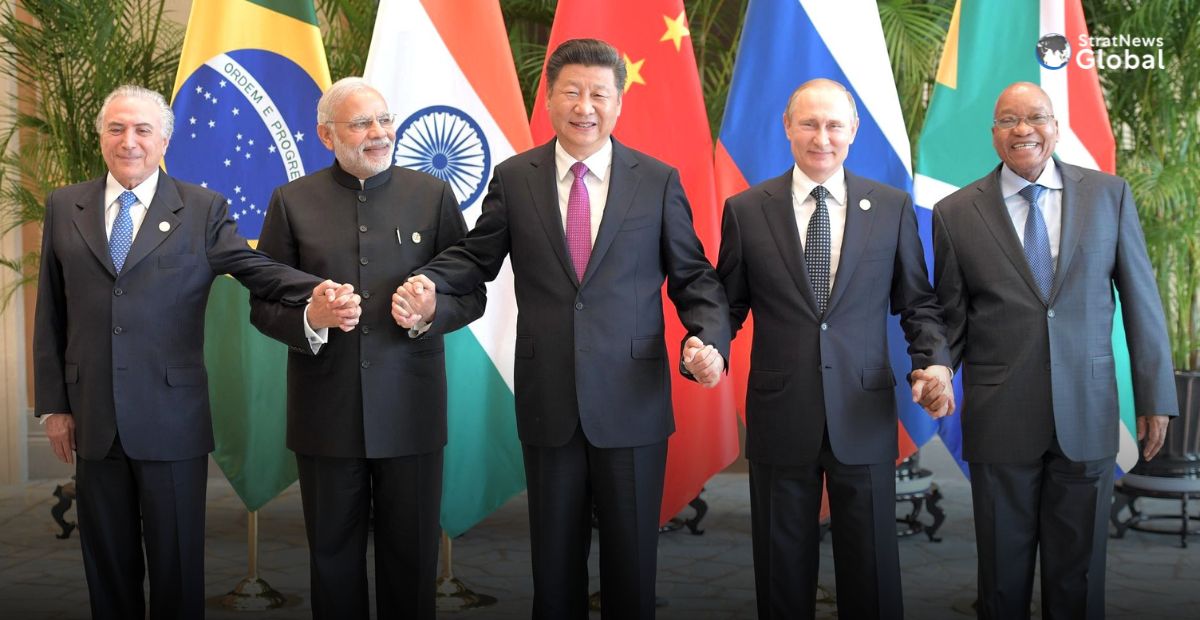
A consensus statement from BRICS would carry weight not merely because of its members, but because of what the bloc represents. BRICS has positioned itself as a voice for emerging economies and an advocate for a multi-polar world order.
The expanded BRICS now includes countries with competing regional interests. Iran’s ongoing strains with Gulf members countries including Saudi Arabia and the UAE, alongside India’s multi-aligned diplomacy and China and Russia’s strategic controls, make agreement difficult.
Economic Issues
For countries like India, which rely on stable import flows, even short-term interruptions can trigger inflationary pressures.
Dr Priya noted that India can cushion the immediate shock but only for a limited window. “We can manage in the short term with our reserves, but that means this is the buffer time for us to look for alternative sources,” she said, estimating that existing reserves could last six to eight weeks.
She pointed out that diversification is already underway. India has been sourcing energy from North America, West Africa and Latin America, with Russia also emerging as a potential alternative. However, she emphasised that Gulf supplies remain the most viable due to proximity and established trade ties.
“In the long term, it might lead to diversification of our energy dependence, reducing our energy security vulnerabilities,” she added.
New Delhi has already moved to cushion the impact, maintaining fertiliser stockpiles and securing alternative supply lines. But policymakers recognise that prolonged instability could force broader interventions, from subsidies to strategic sourcing shifts.
Kumar cautions that such crises are not isolated events. “Iran is neither the first, nor the last conflict,” he said, stressing that ensuring energy and food security must become a central priority for BRICS going forward.