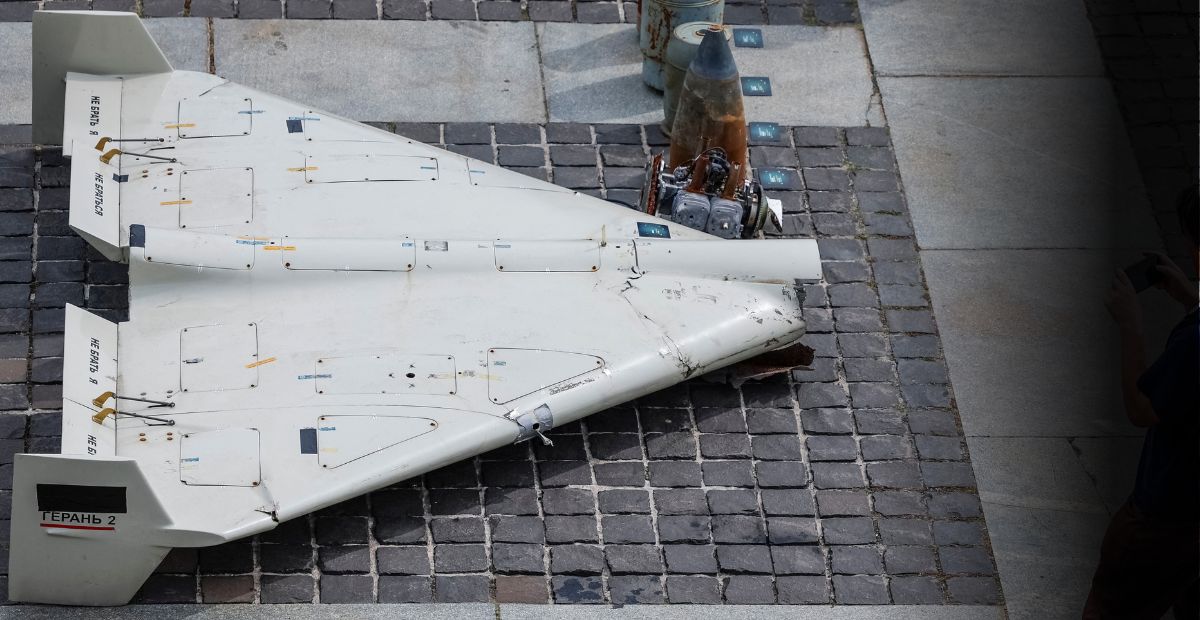
Iran claims the United States and Israel are deploying a reverse-engineered version of its widely used Shahed-136 drone in an attempt to shift blame for attacks across the region.
Iranian Foreign Minister Abbas Araghchi has alleged “The Americans have developed a drone called ‘Lucas’ that is fully compatible with our Shahed drone, and through it, attacks are being launched against targets in Arab countries.”
He said Tehran is investigating what it believes could be coordinated strikes intended to implicate Iran in attacks on civilian infrastructure in Turkey, Kuwait and Iraq.
“Iran is ready to form a joint investigation committee with regional countries to examine the targets that have been attacked and determine whether they were American targets or not,” Araghchi said. “Our attacks only target American bases and interests in the region.”
The accusations reflect a deepening technological contest in which rival powers are increasingly copying and modifying each other’s weapons to produce cheaper, mass-deployable systems.
In its Iran attacks over the weekend, the U.S. Central Command confirmed that it had used its drones modelled on the Shahed for the first time in combat.
Shahed Drone
At the centre of the controversy is the Shahed‑136, a one-way “kamikaze” drone developed by Iran in the early 2020s. It has gained notoriety for its ability to overwhelm air defences through sheer numbers.
Each drone can cost as little as $20,000 to $50,000, far less than the millions required to intercept it using sophisticated missile defence systems.
The drones typically carry between 30 and 50 kilograms of explosives and can travel more than 1,900 kilometers, making them capable of striking distant targets while flying low enough to evade some radar systems.
Their distinctive engine noise, often compared to a lawnmower or motorcycle, has become a familiar warning sound in several conflict zones.
The United States has acknowledged developing its own version of the drone after examining examples recovered from battlefields in Ukraine. The system, known as the LUCAS drone, was reportedly produced by Arizona-based manufacturer SpektreWorks.
According to U.S. defence officials, the drone was fielded rapidly and deployed for the first time during the opening stages of Operation Epic Fury.
The American system is smaller than the Shahed-136 and carries a lighter payload, around 18 kilograms of explosives, but it is designed to achieve similar operational effects at comparable cost.
With a range of roughly 434 nautical miles and an endurance of up to six hours, the drone can be launched using catapults or rocket-assisted rails, allowing rapid deployment in large numbers. The Pentagon has also created a dedicated one-way attack drone unit to operate the platform.
Cheap Weapons, Expensive Defences
The rise of low-cost attack drones is forcing militaries to rethink the economics of air defence. Iran has used hundreds of Shahed-136 drones during recent operations, including Operation True Promise‑4, attempting to overwhelm U.S.-backed defence systems in the Gulf.
Many of the drones have been intercepted by systems such as the MIM‑104 Patriot, but analysts say the financial imbalance favours the attacker. Individual interceptor missiles can cost between $3 million and $12 million, meaning each successful defence can expend resources worth dozens or even hundreds of times the value of the attacking drone.
Despite being widely described as an Iranian innovation, the Shahed-136 concept traces back decades. In the mid-1980s, German aircraft manufacturer Dornier GmbH developed a similar unmanned aircraft known as the Drohne Anti-Radar (DAR), designed to destroy enemy radar installations during suppression-of-air-defence missions.
The delta-wing design, small engine and kamikaze flight profile pioneered by that Cold War project bear striking similarities to modern Shahed drones.
Iran later adapted and expanded on these concepts, producing the Shahed-136 for its own arsenal and supplying variants to its allies, Hezbollah and the Houthis. Russia has also built its own versions for use in the Ukraine War.
Regional Tensions
The current conflict intensified after joint strikes by the United States and Israel on February 28 targeted Iranian facilities and leadership figures.
Iranian authorities say more than 1,200 people were killed in the attacks, including senior officials, with hundreds of civilians among the casualties.
Tehran has since retaliated with waves of drone and missile strikes against Israeli and U.S.-linked targets across the region.
Araghchi warned that if Iranian energy infrastructure is attacked, Tehran could target facilities belonging to American companies operating in the Middle East.
Despite the rising tensions, diplomatic contacts between Iran and regional powers including Qatar, Saudi Arabia and Oman remain ongoing.