Does caste exist in China or not? Although there’s nothing to suggest it exists, it became a matter of controversy on Chinese social media after some Indians claimed China’s “four occupations” system bore caste-like indications.
The Hukou System and China’s Urban-Rural Divide
Called the Shi-Nong-Gong-Shang, meaning scholars, farmers, artisans and merchants, the Indians said this was nothing less than caste. But Chinese academics disagreed, pointing out that social mobility was possible and that people were not locked into an occupation by birth as in India’s caste system.
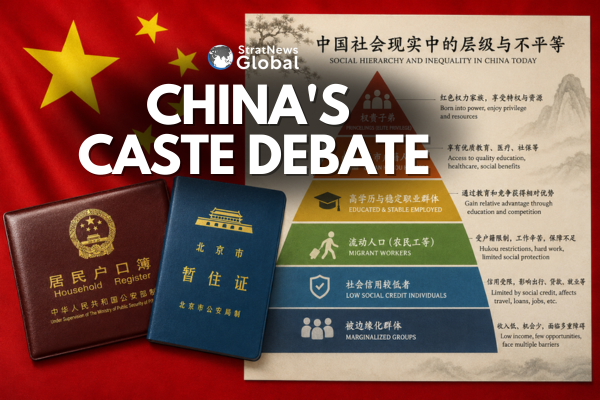
That does not mean there are no hierarchies in China. The Hukou system of the 1950s for instance, divided the population into rural and urban residents.
The system helped fuel China’s economic rise, but it also created one of the world’s largest internal divides. Hundreds of millions of migrant workers left villages for booming cities, only to discover that access to education, healthcare and social benefits often remained tied to where they were officially registered.
Although China has spent years reforming the system, the urban-rural gap remains a defining feature of Chinese society. For many migrant workers, the question is not caste but registration. Where a person is registered shapes his or her access to opportunities, public services and social mobility.
China scholar Prof Geeta Kochhar of Jawaharlal Nehru University, New Delhi (JNU) argues that hukou reforms have seen restrictions eased in smaller cities, but major centres such as Beijing and Shanghai still control and regulate local residency.
In practice, access to an urban hukou often depends on economic status, meaning many migrant workers remain excluded from the education, healthcare and welfare benefits enjoyed by registered urban residents. “All these factors greatly influence social mobility,” she notes.
Social Credit and New Forms of Inequality
Add to that the social credit system which is not a single nationwide score but a growing network of regulations, databases, blacklists, incentives and compliance mechanisms designed to reward trustworthiness and penalise misconduct. And far from fading away, it appears to be expanding, creating new forms of inequality in Chinese society.
Last month a symposium in Beijing (Source: https://www.sohu.com/a/1028744475_121925623) brought together credit associations, policy experts and business representatives to discuss strengthening China’s social credit framework. Participants explored ways to integrate credit records into areas ranging from financing and procurement to contract fulfilment and corporate governance.
Community events in Henan province explained social credit regulations to residents and businesses. Volunteers distributed pamphlets, answered questions about credit records and promoted the importance of maintaining trustworthy behaviour.
Taken together, these developments point to a broader trend: China is increasingly governing through data, compliance and measurable trustworthiness.
Prof. Kochhar believes that people who fail to meet official standards may find themselves at a disadvantage, not because they lack talent or ability, but because they do not fit the approved model of behaviour.
In a country as large and diverse as China, she says, it is difficult to expect everyone to follow a single standard. Over time, this could create new divisions between those seen as “trustworthy” and those labelled as less desirable citizens.
Then there’s the question of “princelings”, the sons and daughters of leading Communist Party veterans who are privileged and form the elite. Xi Jinping is one. This contradicts China’s narrative that it is a meritocratic society where talent and hard work determine success.
According to Prof. Kochhar, this is only one layer of a much broader picture. Chinese society today contains multiple forms of inequality and social stratification. Beyond the divide between agricultural and non-agricultural populations, there are regional disparities, income gaps and new social categories shaped by decades of economic reform.
Concerns over Censorship
China also faces growing concerns over censorship, where certain views can carry professional or legal consequences. The much-celebrated Gaokao exam is often presented as a ladder to success, but students from major cities continue to enjoy advantages over those from rural areas.
Meanwhile, many graduates are struggling to find stable jobs, and workers over 35 increasingly complain that employers are pushing them out of the labour market.
None of these systems are equivalent to India’s caste structure. Yet they raise questions about privilege, opportunity and social mobility. China may not have a caste system, as its scholars rightly point out. But it continues to grapple with hukou barriers, elite privilege, social credit expansion and unequal access to opportunity challenges that deserve as much scrutiny as the flaws Beijing is often quick to highlight elsewhere.