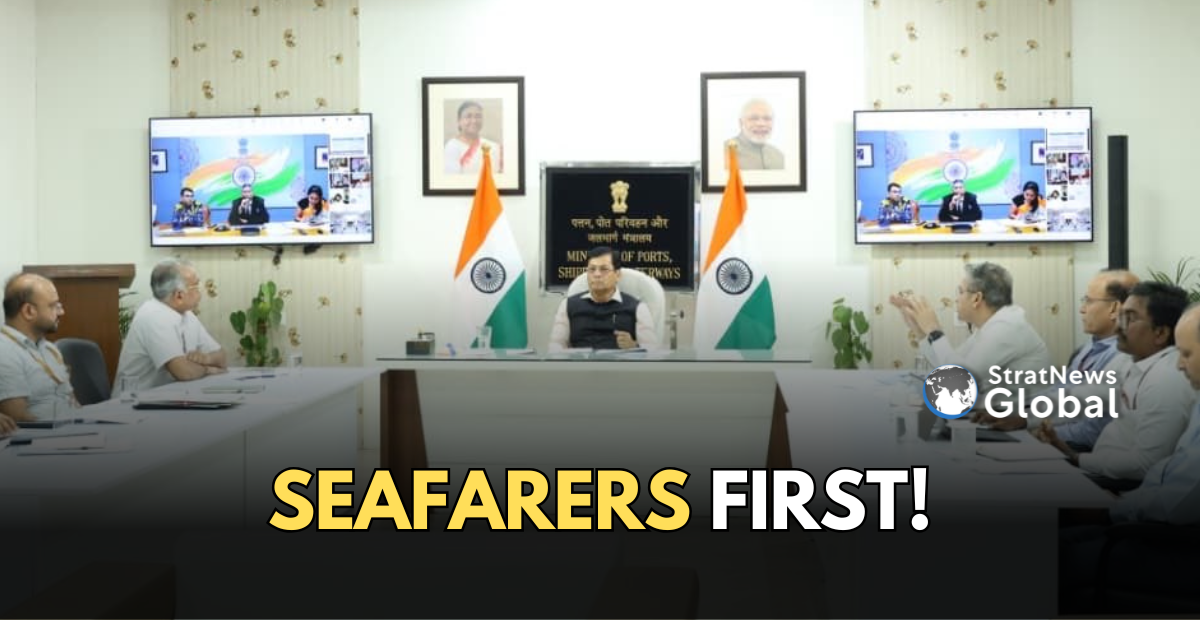
The standard operating procedures (SOP) announced by Union Minister of Ports, Sarbananda Sonowal on Monday, underscore an uncomfortable fact:
There are, according to media reports, nearly 150 Indian seafarers currently on seven Indian-flagged vessels in the Persian Gulf. But, there are 18,000 other Indian seafarers in the broader Gulf/West Asian region, and most are not on Indian flagged vessels.
India has around 1,500 vessels, with less than 60 classified as “large ships” (10,000 tons or more). This presents a problem. One can expect Indian flagged vessels to follow Sonowal’s SOPs, but what about the other ships that are not Indian flagged and make up the majority employing India’s estimated 3 lakh plus seafarers?
What happens if a vessel is flying a “flag of convenience”? This is a widely known maritime practice where the vessel owner registers his ship in a foreign country even if he has no ties with that country?
This is usually done to avoid environment, labour and safety regulations in their home countries, or to avoid paying higher taxes.
Panama and Liberia are known to offer flags of convenience for which they get easy revenue. But what happens if the vessel gets into trouble? What happens if it gets caught in a war zone, or is suspected of carrying illegal oil from a war zone?
The Indian seafarers are not at fault, but they are the victims. And since the vessel they are on is operating under a flag of convenience, neither Panama nor Liberia have any interest or wherewithal in coming to their aid.
Sonowal’s SOPs is attempting to strengthen the safeguards for Indian seafarers, whether on Indian-flagged ships or otherwise.
He has ordered real-time vessel-by-vessel monitoring and the appointment of dedicated liaison officers for every affected Indian seafarer, along with round-the-clock coordination in collaboration with other ministries, the Indian Navy, the Directorate General of Shipping (DGS), and the Indian Missions in Iran and Oman.
This inter-ministry collaboration will help obtain verified, real-time information relating to navigational safety, coastal-state advisories, and route status. Other assistance, including port-of-refuge arrangements, hospitals, medical evacuation, repatriation procedures, mortal remains management and the status of ongoing investigations, will also be given.
In a statement Sonowal said, in a press statement, “India has expressed its strong resentment and objection to the manner of attacks on defenceless civilian merchant vessels. We shall ensure that our seafarers’ families are supported and cared for. I want to assure every Indian seafarer and their family that the entire Government is committed to assisting you in every possible way, and at all costs.”
The dashboard of the Seafarer-first response team will provide India with real-time information on vessel position, ownership, cargo, crew strength, crew welfare, threat assessment, intended voyage, next port of call and the availability of facilities.
Each liaison officer will also serve as the single point of contact for families of the seafarers. The officer will also coordinate medical updates, travel documentation, family assistance, repatriation, Seafarers Welfare Fund support, outstanding wages, contractual entitlements and other compensations.
The Shipping Ministry has also directed shipowners, vessel managers, and sailor recruiting agencies that employ Indian seafarers in the region to furnish compliance reports. It will also mandate confirming that no Indian seafarer is being compelled to sail without adequate information, protection and support.
India ‘s Seafarer First response team will also set up a 24X7 Grievance Support service where concerns can be addressed, available on WhatsApp.