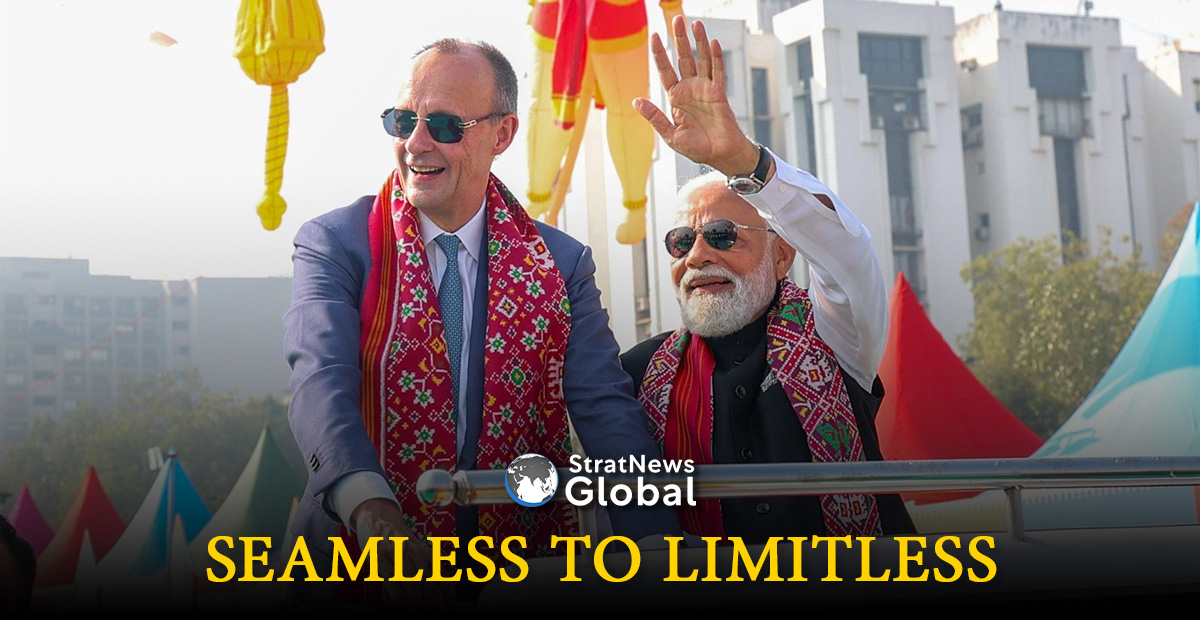
Pleasure before business: Prime Minister Modi and his guest Germany’s Chancellor Friedrich Merz did the honours on the opening day of the International Kite Festival in Ahmedbad and then it was business.
At the India–Germany CEOs Forum in Ahmedabad, Modi said “We have decided to make this seamless economic partnership limitless. Along with traditional economic sectors, we will now deepen cooperation in strategic sectors as well.”
Defence figured high on the agenda although there was no word on the long pending plan to buy and build German submarines. But the joint statement issued at the end of the summit said “Both leaders lauded the continuing cooperation in submarines.” So it would appear that things are moving.
The two leaders endorsed a Joint Declaration on Defence Industrial Cooperation, facilitating defence innovation, and strengthening military supply chains.
“We will work on a roadmap to enhance cooperation between our defence industries, which will open up new opportunities for co-development and co-production,” Modi said during the press interaction. “I express my heartfelt gratitude to Chancellor Merz for simplifying the processes related to defence trade.”
They welcomed outcomes of the High Defence Committee meeting held in New Delhi in November 2025. Institutionalised staff talks will be expanded as will service chief-level engagements and joint training programmes.
Germany confirmed participation in major Indian naval and air exercises, including MILAN and TARANG SHAKTI, and announced a reciprocal logistics support agreement. A liasion officer will be stationed at India’s Information Fusion Centre–Indian Ocean Region (IFC-IOR).
Both sides also noted ongoing cooperation between India’s DRDO and Europe’s OCCAR on the Eurodrone MALE UAV programme.
Chancellor Merz described the defence partnership as strategically significant, noting that closer military cooperation would also help diversify defence dependencies in an increasingly contested global environment.
Critical Minerals
A major outcome of the talks was a Joint Declaration of Intent on cooperation in critical minerals. The agreement gives Germany improved access to India’s mineral ecosystem while supporting India’s ambition to integrate into trusted global supply chains.
The two sides formalised an India–Germany Semiconductor Ecosystem Partnership, recognising semiconductors as foundational to both digital and green technologies. Additional institutional linkages were signed between India’s electronics bodies and German firms to deepen cooperation in chip design, power electronics and advanced manufacturing.
“India and Germany are working together to build secure, trusted and resilient supply chains,” Modi said, underlining the strategic dimension of the partnership.
Clean Energy
Energy cooperation featured prominently, reflecting shared priorities in climate action and sustainability. A commercial outcome was a long-term offtake agreement between India’s AM Green and German utility Uniper for up to 500,000 tonnes of green ammonia annually, with deliveries expected to begin in 2028. The deal positions India as a key supplier of green molecules for Europe’s energy transition.
The leaders also announced the establishment of a German–Indian Centre of Excellence for renewable energy, designed as a joint platform for technology exchange, innovation and capacity building. Agreements were signed covering hydrogen, bio-energy, gas and water regulation, and skilling in renewable energy technologies.
Modi said India is moving rapidly towards becoming a global leader in clean and green energy, highlighting opportunities for German companies in solar cells, electrolysers, batteries and wind turbines.
India and Germany finalised a comprehensive roadmap on higher education, with Prime Minister Modi inviting German universities to establish campuses in India. The two sides also agreed on frameworks for ethical and sustainable recruitment of healthcare professionals and launched plans for a National Centre of Excellence for skilling in renewable energy.
Modi thanked Chancellor Merz for announcing visa-free transit for Indian citizens, calling it a step that would significantly strengthen people-to-people ties and professional mobility