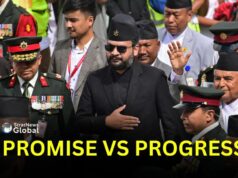
Global diplomacy briefly veered into dowry negotiations when Uganda’s military chief, General Muhoozi Kainerugaba, demanded that Turkey settle a billion-dollar dispute with cash—and a bride.
According to reporting by The Deep Dive and regional outlets, Gen. Kainerugaba—son of President Yoweri Museveni—publicly demanded $1 billion from Turkey as compensation for Uganda’s years of military deployment in Somalia.
Then he added a condition that ensured nobody would take the rest of the argument seriously: Turkey should also provide “its most beautiful woman”.
Minus the theatrics, Uganda’s complaint is straightforward. Its troops have spent years fighting Al-Shabaab in Somalia, absorbing casualties and costs.
Turkey, meanwhile, has expanded its footprint—training forces, running infrastructure, and deepening influence in Mogadishu.
Kainerugaba didn’t stop there. He reportedly gave Turkey a 30-day ultimatum: pay up, or risk a diplomatic rupture, including the possible closure of embassies.
Throw in the fact that this is not his first foray into international romance—he previously made headlines for expressing interest in marrying Italy’s Prime Minister Giorgia Meloni and even offered a dowry of 100 cows.
When she ignored him, he threatened to invade Italy, forcing his father to step in and apologise for him.
In parallel posts, Kainerugaba pivoted away from Turkey entirely and declared that Uganda would stand with Israel in the event of a major war, including against Iran, and suggested he could deploy up to 100,000 Ugandan troops to “protect the Holy Land”.
BREAKING; Ugandan Military Leader Chief Muhoozi Who Offered 100,000 Soldiers to Israel Now Reportedly Flying to Tel Aviv
Ugandan defense chief who promised to deploy “500,000 hungry people” to defend Tel Aviv is actually on his way there. pic.twitter.com/zOB2QYuHv1
— Global Surveillance (@Globalsurv) April 11, 2026
He framed it in ideological terms—Christian solidarity, historical ties, and a long memory stretching back to the 1976 Entebbe raid, when Israeli commandos rescued hostages at Entebbe Airport.
He also announced plans to honour Yonatan Netanyahu, who was killed in that operation, with a statue at the same airport.
And just to remove any ambiguity, he added, if Israel needs help, it only has to ask.
Turkey has, predictably, not engaged or responded officially. Ankara’s approach in Africa has been methodical—projects, training, trade—not public arguments that sound like contract disputes mixed with matrimonial negotiations.
Meanwhile, in Somalia, where both Uganda and Turkey are deeply involved, the reaction has been careful. President Hassan Sheikh Mohamud has defended Uganda’s role, signalling that whatever is happening online should not spill into operational reality.
Because Ugandan troops are central to security operations, while Turkish investment is central to state-building. Somalia needs both. It cannot afford a falling-out triggered by social media improvisation.
As noted in earlier reporting by the BBC, Kainerugaba has a record of incendiary online remarks. These include threatening to castrate an opposition figure and making grandiose personal claims—including suggesting a form of divine lineage from Jesus.
Kainerugaba is not a fringe figure. He is Uganda’s Chief of Defence Forces and widely seen as a central political actor. When he speaks, even like this, it carries weight—unclear, shifting, but real.
Strip away the spectacle, and there are three actual signals underneath:
First, Uganda wants recognition—and possibly compensation—for its long military role in Somalia.
Second, it is willing to air that frustration loudly and publicly.
Third, Kainerugaba is positioning himself—and by extension Uganda—as an ideological ally of Israel, not just a quiet partner.
Turkey doesn’t respond. Somalia tries to stabilise. Diplomats go back to private channels.
But the message has already travelled.
The risk is not that any of this is implemented literally. Uganda is not about to ship 100,000 troops into West Asia on a social media promise.
The risk is erosion of credibility, of coordination, of the quiet mechanisms that actually hold fragile arrangements together.
The episode is also a stark reminder that in parts of the world where the stakes are already high, the line between statecraft and spectacle is getting thinner than ever.