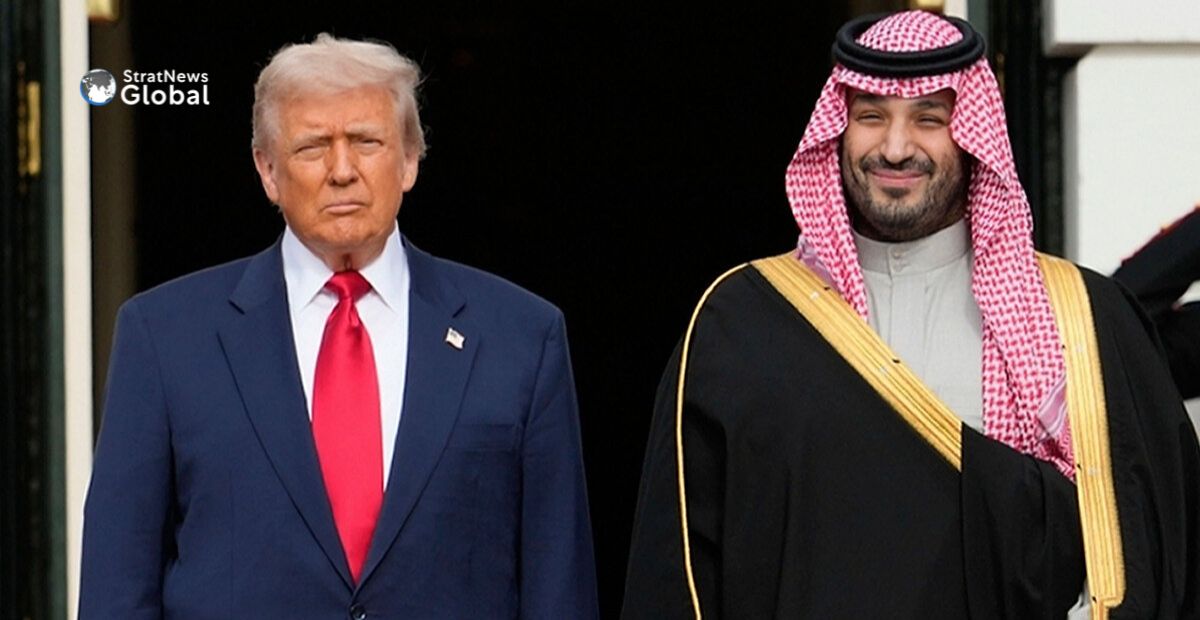
How does India view the US-Saudi nuclear deal? There is the standard Indian line that in principle, this country supports cooperation to harness civil nuclear energy for peaceful purposes.
India therefore would have no issue if the US helps Saudi Arabia build a civil nuclear capability which would also help wean the kingdom away from its dependence on oil. But as always, there’s another side to this.
Countering Iran
“The US decision to help Saudi Arabia may flow from a view that it cannot stop Iran from going nuclear,” Brig Arun Sahgal, Director of the Forum for Security Initiatives, a think tank in Delhi, told StratNewsGlobal. “Therefore it is waging war to prevent Iran from enriching uranium. It is using its leverage to support interest based proliferation.”
Prof Khinvraj Jangid, Director of the Jindal Centre for Israel Studies concurs, pointing out that “Saudis going nuclear is a sign that Israel and the US have taken into account a reality of the future — nuclear Iran. They would not offer this to the Saudis otherwise.”
There could even be a role for Pakistan in supporting a Saudi nuclear weapons programme. Recall that last year Islamabad and Riyadh sealed a Strategic Mutual Defence Agreement covering collective defence, joint military mechanisms and intelligence sharing.
Israel-based commentator and analyst Shay Gal argues that the idea is to weaken the Pakistani Saudi link.
“Saudi dependence on Pakistan compromises Saudi sovereignty. Normalisation with Israel would weaken that dependence and could ultimately dissolve it,” he said underscoring that “Normalisation with Saudi Arabia remains a major strategic objective (of Israel). If Riyadh acquires civilian nuclear capacity, it belongs in American hands, not Chinese or Russian ones,” he told StratNewsGlobal.
But he acknowledged that “The concern is not the reactor, it is enrichment, incomplete safeguards and the absence of the IAEA Additional Protocol,” in the US-Saudi deal. So if tomorrow Riyadh comes under the influence of a radical, Israel-hating leadership, then everything goes out of the window. But there appears to be some insurance for Israel.
US-Israel Tech Integration
The US House of Representatives has passed the National Defense Authorization Act 2027 which integrates the defence innovation ecosystem of the US and Israel. With the Senate expected to vote in favour soon, there will be a permanent framework for collaboration with Israel in emerging defence technologies.
That means everything from “Artificial intelligence, autonomous systems, cyber security, electronic warfare, missile defence, directed energy, quantum technologies, advanced manufacturing, and next-generation sensors,” writes Brig Anil Raman (Retd), head of the Defence Fellowship Programme at the Takshashila Institution.
India could also benefit given that Israeli military hardware account for about 15% of India’s total arms imports, Brig Raman says. While accessing the results of US-Israeli collaboration may not be easy, Tel Aviv needs dependable partners given its growing isolation from parts of Europe.
Final point: India and the US signed the Initiative on Critical & Emerging Technology in 2023, to deepen cooperation in AI, Semiconductors, Quantum, Space etc. Add to that INDUS-X for collaboration across startups, industry and investors.
There’s also the India-Israel R&D & Tech Innovation Fund and more recently, an initiative on Critical & Emerging Technologies headed by the NSAs.
“These three partnerships create an intriguing possibility,” writes Brig Raman. “India today possesses institutional mechanisms for advanced technology cooperation with both Washington and Jerusalem. Few countries occupy that position. If managed effectively, India could benefit from knowledge flows, collaborative research, industrial partnerships, and technology development across all three relationships.”