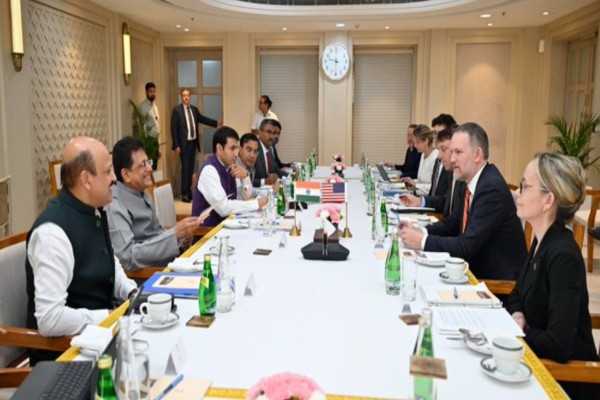
India and the United States appear closer than ever to concluding the first phase of a Bilateral Trade Agreement (BTA), but New Delhi is making it clear that speed will not come at the expense of certainty.
Negotiators on both sides insist talks remain constructive and deny reports of a deadlock.
Yet India’s latest public messaging suggests the focus has shifted from meeting political timelines to ensuring that any agreement delivers lasting commercial benefits and protects Indian exporters from future trade disruptions.
The broad contours of the deal are largely understood. Discussions have covered market access, digital trade, supply-chain resilience, non-tariff barriers and cooperation in strategic sectors.
But Indian officials believe the final hurdle is no longer negotiating tariff concessions alone. It is ensuring those gains are not undermined by future US trade actions.
Commerce Secretary Rajesh Agrawal has articulated this concern with unusual clarity.
“Trade deals are about comparative advantages and that is something, an integral part of the deal that we are finalising. Whenever you do a trade deal, it should not happen that new tariffs come in,” he said.
The remark reflects New Delhi’s principal negotiating objective. India wants assurances that exporters will not secure improved market access through the BTA only to face fresh tariffs imposed under separate US trade laws shortly afterwards.
That concern is rooted in developments unfolding in Washington rather than in the negotiations themselves.
The Office of the US Trade Representative (USTR) is currently conducting two Section 301 investigations involving India. One, linked to alleged forced-labour inputs in exported products, has already proposed an additional 12.5 per cent tariff on selected Indian imports, with a final decision still pending. Another investigation examining policies related to excess industrial capacity remains underway.
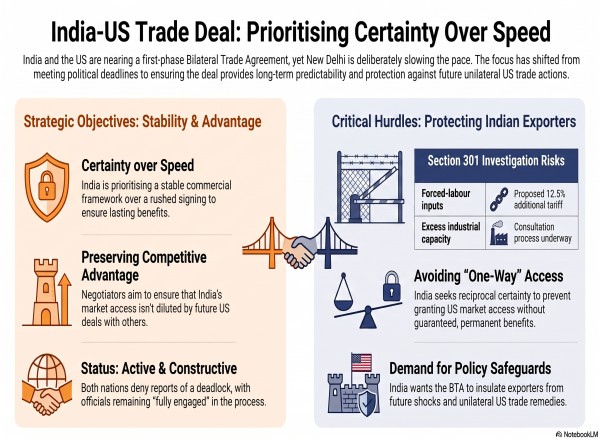
India has participated in both consultation processes and submitted its responses. But the investigations reinforce a broader point: even a comprehensive trade agreement does not automatically insulate a country from unilateral US trade actions.
This explains why New Delhi is seeking a framework that offers greater predictability rather than simply improved tariff access.
Commerce and Industry Minister Piyush Goyal has continued to project confidence, saying both sides remain committed to concluding a “balanced, commercially meaningful” agreement that benefits businesses, farmers, workers and consumers.
“Our teams remain fully engaged in achieving this objective,” he said, rejecting suggestions that negotiations have stalled.
Washington has echoed the same message.
US Ambassador to India Sergio Gor dismissed reports that India had rejected a fast-tracked agreement as “fake news.”
“No one has rejected anything. Both sides had very constructive meetings and reaffirmed their commitment to finalising a trade deal. We continue to stay actively engaged,” he said.
The repeated public reassurances from both capitals suggest there is little disagreement over the direction of the negotiations. Instead, the remaining issues appear to centre on how future trade risks will be managed once the agreement comes into force.
That challenge has become more significant because US trade policy itself remains in flux.
Legal and policy uncertainty surrounding Washington’s reciprocal tariff regime has left several trading partners waiting for greater clarity before making long-term commitments. Indian officials have avoided commenting directly on those developments but acknowledge that evolving US tariff policies strengthen the case for building safeguards into the agreement.
Another factor shaping India’s approach is the competitive landscape.
Washington is negotiating trade arrangements with several countries simultaneously. New Delhi wants to ensure that concessions secured under the BTA preserve India’s competitive advantage and are not diluted if similar or better terms are subsequently extended to other economies.
For India, the agreement is therefore about relative market access as much as absolute tariff reductions.
Trade analysts argue that India’s caution also reflects changes in the negotiating environment since Prime Minister Narendra Modi and President Donald Trump announced plans to pursue the BTA earlier this year.
Ajay Srivastava, founder of the Global Trade Research Initiative (GTRI), says the original understanding envisaged reciprocal tariff concessions from the United States in return for greater market access for American goods.
Subsequent legal developments in the US, however, have raised questions over whether some of those promised tariff benefits can still be guaranteed.
According to Srivastava, India risks signing what effectively becomes “a one-way market access agreement” if it undertakes binding commitments without receiving equivalent certainty from Washington.
He also cautions that the existence of a trade agreement does not necessarily prevent future US trade actions.
The United States has previously launched Section 301 investigations and imposed trade remedies against countries with which it already has free trade agreements, highlighting the limits of such accords in constraining domestic trade enforcement.
That assessment aligns with India’s current negotiating posture.
Rather than pursuing the quickest possible conclusion, New Delhi appears determined to ensure that the agreement creates a stable commercial framework capable of withstanding shifts in US trade policy.
The June visit of US Trade Representative Jamieson Greer to New Delhi reinforced the momentum behind the negotiations, with both sides working towards an interim agreement that would serve as the foundation for a broader Bilateral Trade Agreement.
Officials continue to insist there are no major obstacles, bilateral trade is expanding and economic ties remain strong, including rising Indian imports of US energy.
Yet India’s negotiating strategy suggests the final phase of the talks is no longer about whether the agreement can be signed. It is about ensuring the benefits survive beyond the signing ceremony.
For New Delhi, a successful trade agreement is one that provides predictable market access, preserves India’s competitive position and reduces the risk of future tariff shocks.
Until those assurances are sufficiently addressed, India appears willing to trade speed for certainty.