India and six other BIMSTEC member states have adopted a new framework to strengthen maritime cooperation, including common guidelines for humanitarian assistance and disaster relief (HADR) operations and principles governing coordination between maritime law enforcement agencies.
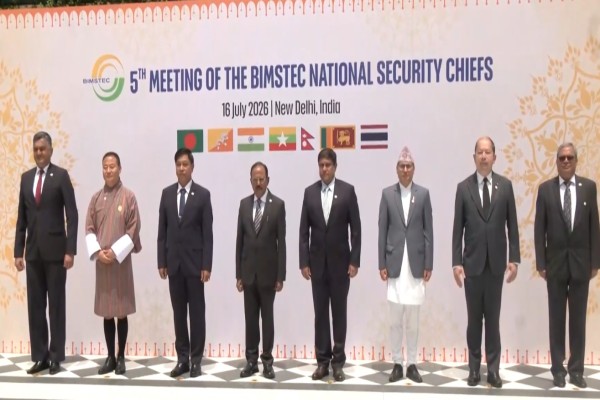
The framework was adopted at the fifth BIMSTEC National Security Chiefs’ Meeting in New Delhi, hosted by National Security Adviser Ajit Doval. The meeting brought together National Security Advisers and senior security officials from Bangladesh, Bhutan, Myanmar, Nepal, Sri Lanka and Thailand.
The member states also discussed cooperation against terrorism and organised crime, cyber and energy security, regional connectivity, disaster response and other emerging security challenges across the Bay of Bengal.
A key outcome was the adoption of maritime HADR guidelines aimed at enabling faster and better coordinated disaster response during natural disasters and emergencies. The meeting also endorsed guiding principles for maritime law enforcement agencies to improve operational coordination and promote safer interactions at sea.
BIMSTEC Secretary General Indra Mani Pandey briefed delegates on progress across the organisation’s security agenda, including counter-terrorism, disaster management and institutional capacity building.
Opening the meeting, Doval said the region was facing geopolitical uncertainty, technological disruption and economic stress, making closer regional cooperation essential.
“In this setting, there’s an urgent need for us to collaborate, take decisive actions for our mutual benefit, and find solutions through mutual discussions and deliberations to the vexed problems that we are all facing,” he said.
Doval said BIMSTEC connects South and Southeast Asia, representing about 1.7 billion people—around 22 per cent of the world’s population—with a combined GDP of nearly $5 trillion.
“We are united by the Bay of Bengal, not just geographically, but also through deep civilisational and cultural legacies that have evolved over a millennium of shared history,” he said.
He said the grouping had steadily expanded cooperation in counter-terrorism, transnational organised crime, cyber security and maritime security, while urging members to keep regional security, connectivity, economic resilience and capacity building at the centre of BIMSTEC’s future agenda.
Describing BIMSTEC as central to India’s regional outreach, Doval said it reflected New Delhi’s Neighbourhood First policy, Act East policy and the MAHASAGAR vision for regional security and growth.
Ahead of the multilateral session, Doval held bilateral meetings with senior security officials from Myanmar, Thailand, Sri Lanka and Bangladesh.
His discussions with Myanmar National Security Adviser U Tin Aung San focused on bilateral security cooperation and the regional security situation, including concerns over cross-border insurgency, narcotics trafficking and border management.
Talks with Thailand’s National Security Council Secretary General Chatchai Bangchuad covered intelligence sharing, law enforcement cooperation, connectivity and institutional coordination.
Maritime security featured prominently during Doval’s meeting with Sri Lanka’s Defence Secretary Air Vice Marshal Sampath Thuyacontha (Retd.), reflecting growing security concerns across the Indian Ocean.
Doval also met Brig General (Retd.) Dr AKM Shamsul Islam, Defence Adviser to Bangladesh’s Chief Adviser, to discuss continuing security cooperation between the two countries.
The meeting comes ahead of India’s participation in the Shanghai Cooperation Organisation Summit next month and the BRICS Leaders’ Summit, which India will host in September.
As BIMSTEC approaches its 30th anniversary in 2027, member states reaffirmed their commitment to strengthening regional cooperation, expanding institutional capacity and improving coordination to address both traditional and emerging security challenges.
With SAARC remaining largely inactive, BIMSTEC has become an increasingly important platform for India’s engagement with South and Southeast Asia, covering cooperation in maritime security, counter-terrorism, cyber security, disaster management, connectivity and energy security.