For nearly eight decades, Pakistan’s politics has revolved around one enduring reality: governments may change, but the military remains the country’s most powerful institution.
Prime ministers have been elected, dismissed, jailed and exiled. Political parties have risen and fallen. Yet through it all, the army has remained the ultimate arbiter of power, ruling directly through coups or exercising enormous influence from behind the scenes.
That is why Maulana Fazlur Rehman’s latest confrontation with Pakistan’s military leadership has resonated far beyond routine opposition politics.
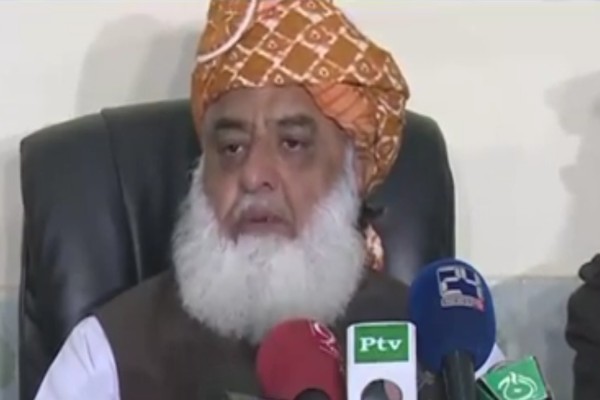
Rehman is no firebrand outsider. The 69-year-old cleric heads the Jamiat Ulema-e-Islam-Fazl (JUI-F), one of Pakistan’s largest religious political parties, and has spent more than three decades navigating the country’s complex civil-military landscape.
He has served in parliament, helped build coalition governments and maintained working relationships with successive army chiefs. Often described as Pakistan’s consummate political survivor, Rehman has usually preferred negotiation to confrontation.
His decision to openly challenge Field Marshal Asim Munir therefore marks a striking departure. When a seasoned insider begins questioning the military’s political authority, Pakistan’s establishment cannot but sit up and take notice.
Munir today commands more authority than perhaps any Pakistani military leader since General Pervez Musharraf. His tenure as Army Chief has been extended to five years, he became only the second officer in Pakistan’s history to be promoted to the five-star rank of Field Marshal, and he simultaneously serves as Pakistan’s first Chief of Defence Forces.
Together, those roles have cemented his position at the apex of Pakistan’s security establishment, which actually rules the country.
Munir has also become the face of what many describe as a “Pakistan First” doctrine—a security-first approach that advocates a hard line against terrorism, projects military strength abroad and places the armed forces at the centre of Pakistan’s national identity.
It is this narrative that Rehman has begun challenging.
The immediate trigger was Munir’s appeal for civilians to form armed militias, or lashkars , to help combat rising militant violence in Khyber Pakhtunkhwa and Balochistan.
Pakistan has experimented with such militias before, often with mixed and sometimes tragic results. Tribal leaders who sided with the state became targets for militant groups, while local communities found themselves trapped between insurgents and security forces.
Rehman argued that repeating the experiment would only deepen Pakistan’s internal conflicts.
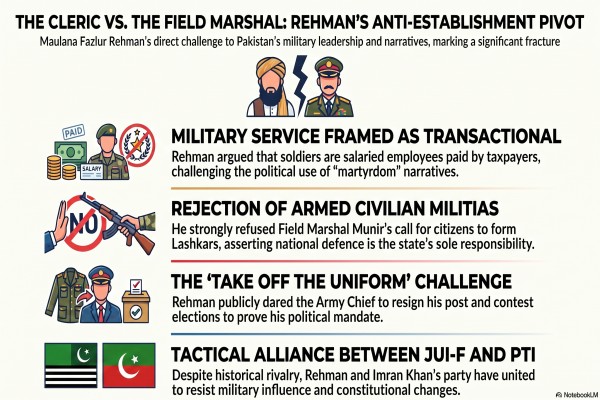
National defence, he said, is the responsibility of the state—not ordinary citizens. Asking civilians to take up arms would create generations of blood feuds and lawlessness while signalling that the state itself was unable to fulfil its most basic duty.
He then went on to question one of the military’s most powerful narratives.
For decades, Pakistan’s armed forces have drawn moral authority from the language of sacrifice and martyrdom. Rehman challenged that narrative by reminding audiences that soldiers voluntarily join the military and are paid by taxpayers to defend the country.
“You are taking your salaries from the taxes earned through our blood and sweat,” he said. “I have taken no salary. I will not form any Lashkar.” Few mainstream politicians in Pakistan have dared frame military service in such transactional terms.
His most provocative remark, however, was directed personally at Munir.
“If you want to do politics,” Rehman declared, “take off the uniform and come; participate in the elections.”
The comment struck at the heart of Pakistan’s civil-military imbalance. Although the military insists it remains politically neutral, opposition parties have long accused it of influencing governments, shaping elections and deciding which political leaders rise or fall. Rehman merely voiced publicly what many Pakistani politicians discuss privately.
He also challenged Pakistan’s regional security narrative.
Rehman questioned why Pakistan justifies conducting cross-border strikes inside Afghanistan while simultaneously condemning India’s military operations across the border into Pakistan. His point was not to endorse India’s actions but to argue that Islamabad cannot invoke one principle of sovereignty for itself and another for its neighbours. In doing so, he exposed what he described as a strategic inconsistency in Pakistan’s foreign policy.
The government’s response was swift.
Senior ministers accused Rehman of insulting Pakistan’s soldiers and martyrs, insisting that military personnel sacrifice their lives out of patriotism rather than for salaries. Petitions seeking criminal proceedings have since been filed, alleging that his speeches violated cybercrime laws and hurt public sentiment by questioning the sacrifices of the armed forces.
The bigger political story, however, lies elsewhere.
For years, Rehman and former Prime Minister Imran Khan were among Pakistan’s fiercest political rivals. Rehman once declared that voting for Khan’s Pakistan Tehreek-e-Insaf (PTI) was “haram”. Today, the two sides are moving towards an unlikely tactical understanding, united by a common belief that Pakistan’s military has accumulated excessive political influence.
Their cooperation against the government’s proposed constitutional amendments could prove significant. PTI retains a large urban support base despite Khan’s imprisonment, while JUI-F commands an extensive network of religious seminaries and disciplined grassroots workers. Together, they could form one of the broadest anti-establishment coalitions Pakistan has seen in years.
That presents Munir with a difficult choice.
A forceful crackdown risks turning Rehman into an unlikely symbol of civilian resistance while strengthening opposition unity. Ignoring him, on the other hand, allows criticism of the military’s political role to gain wider acceptance.
Neither option is particularly attractive for a military leadership that has worked hard to project political stability while pursuing economic recovery. Munir has personally championed efforts to attract foreign investment through the Special Investment Facilitation Council, presenting Pakistan as a stable destination for Gulf and international capital. Prolonged political confrontation would undermine that message.
There is little evidence that Rehman alone can fundamentally alter Pakistan’s civil-military balance. The military remains by far the country’s strongest institution, and Munir’s authority remains formidable.
But that is not what makes this confrontation significant. Its importance lies in the identity of the challenger.
This is not a liberal activist, an exiled dissident or a politician with little to lose. It is a veteran insider who has spent decades operating within Pakistan’s power structure and understands its unwritten rules better than most.
When such a figure openly rejects the military’s security doctrine, questions its political legitimacy and dares Pakistan’s most powerful general to seek a democratic mandate, it suggests that the country’s long-standing civil-military compact is coming under fresh strain.
Whether Rehman succeeds is almost beside the point. His challenge has highlighted a deeper reality: Pakistan’s military remains immensely powerful, but its dominance is no longer beyond public question.
For Field Marshal Asim Munir, that may prove a more enduring challenge than any speech delivered from a political stage.