U.S.-India relations, long described as one of the defining partnerships of the Indo-Pacific, entered a turbulent phase in 2025—one that exposed structural vulnerabilities beneath years of strategic convergence.
A new interim trade deal announced in February 2026 offers a pathway to recovery, but the underlying breach of trust remains unresolved, raising questions about how durable the partnership truly is.
A recent report by the Center for a New American Security (CNAS), authored by Lisa Curtis, Keerthi Martyn, and Sitara Gupta, examines this rupture and the prospects for repair.
It argues that while economic, defence, and technological cooperation have endured, political mistrust—particularly linked to trade actions and U.S. engagement with Pakistan—continues to cast a long shadow over the relationship.
At the heart of the crisis lies a sharp economic shock. In August 2025, the United States imposed steep tariffs—effectively 50 per cent—on Indian exports, citing both reciprocal trade concerns and India’s continued imports of Russian oil.
This move marked a dramatic escalation, placing India among the most heavily tariffed U.S. trade partners. The February 2026 interim deal reduces tariffs to 18 per cent and includes commitments by India to expand purchases of U.S. goods, particularly in energy and technology.
While this reset has eased immediate tensions, the damage to confidence is harder to reverse. The tariff episode accelerated India’s push to diversify trade partnerships, exemplified by its parallel agreement with the European Union.
More importantly, it reinforced a long-standing instinct in Indian strategic thinking: avoid overdependence on any single partner, including the United States.
Yet, paradoxically, the economic relationship has not collapsed—it has evolved. The report highlights how cooperation is increasingly anchored in strategic sectors such as energy, critical minerals, and pharmaceuticals. India’s reforms in mining and its $4 billion investment in critical minerals aim to move it up the value chain, aligning with U.S. efforts to build non-Chinese supply chains.
Similarly, pharmaceutical interdependence—India supplies over 45 per cent of U.S. generic medicines—creates both opportunity and vulnerability, particularly given shared reliance on Chinese inputs.
Energy cooperation remains a relative bright spot. India’s legislative opening of its nuclear sector through the SHANTI Act creates new opportunities for U.S. firms in advanced reactor technologies and small modular reactors. This builds on a legacy of civil nuclear engagement but also signals a shift toward deeper industrial integration.
If economics reflects cautious reengagement, defence ties reveal a more resilient core. Despite political friction, military cooperation has continued largely uninterrupted. Joint exercises, renewed defence frameworks, and ongoing arms deals—including maritime surveillance aircraft and missile systems—underscore a shared strategic logic that transcends short-term disputes.
However, even this pillar shows signs of strain. India’s diversification of defence procurement—evident in renewed deals with Russia and expanded engagement with Europe—suggests hedging behaviour is intensifying. The report notes that mistrust linked to U.S. policy choices has made private-sector defence cooperation more difficult, hinting at longer-term implications if political tensions persist.
Technology, meanwhile, remains the most robust and forward-looking dimension of the partnership. Initiatives such as the Initiative on Critical and Emerging Technology (iCET) and the TRUST framework have institutionalised collaboration across semiconductors, artificial intelligence, and biotechnology. U.S. investments—running into tens of billions of dollars—in India’s digital infrastructure reinforce this trajectory.
India’s role in the global technology ecosystem is expanding rapidly. It produces a significant share of global data and hosts a large portion of the world’s chip design talent, even as it seeks to build domestic manufacturing capacity. For Washington, integrating India into trusted supply chains serves both economic and strategic goals, particularly in reducing dependence on China.
Yet, the most politically sensitive fault line lies elsewhere: Pakistan and terrorism. The CNAS report identifies this as the most persistent source of divergence. While the United States has taken steps—such as designating groups linked to attacks in India—New Delhi remains dissatisfied with what it sees as insufficient U.S. focus on Pakistan-based terrorism.
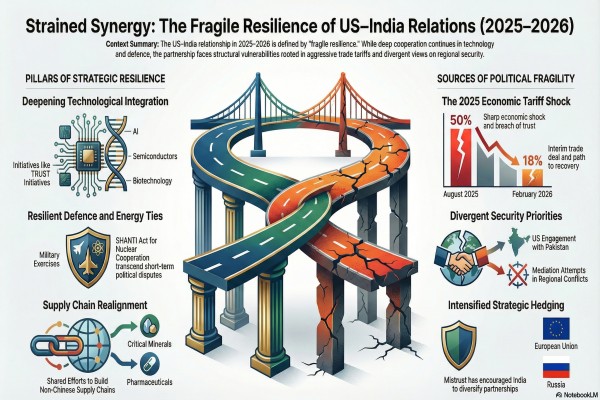
The situation was exacerbated by events following the May 2025 India-Pakistan conflict. U.S. claims of mediating the ceasefire, coupled with high-level engagement with Pakistan’s military leadership soon after the crisis, triggered sharp reactions in India. For New Delhi, these moves cut directly against a core strategic principle: rejection of third-party mediation in its disputes with Pakistan.
This divergence is not merely tactical—it reflects fundamentally different threat perceptions. For India, Pakistan-linked terrorism remains an immediate and existential concern. For the United States, it is one among many competing priorities in a broader global security framework. Bridging this gap will be essential for rebuilding trust.
The CNAS report ultimately frames the current moment as one of both risk and opportunity. The interim trade deal provides a platform for stabilisation, and multiple areas—from critical minerals to AI infrastructure—offer pathways for deeper cooperation. But these opportunities will only be realised if political trust is restored.
That, in turn, requires careful recalibration. The report recommends that Washington respect India’s red lines on Pakistan, reinvigorate counterterrorism dialogue, and deepen cooperation in sectors that deliver tangible mutual benefits.
The broader strategic stakes are clear. India is central to the balance of power in the Indo-Pacific, and its trajectory will shape the region’s future. The United States sees India as a key partner in managing China’s rise, but a partnership cannot be sustained on alignment alone—it requires credibility and consistency.
What emerges from this analysis is a relationship that is neither broken nor secure. It is functional, even dynamic in parts, but politically fragile. The events of 2025 have revealed that convergence in interests does not automatically translate into trust.
The challenge now is not just to repair the breach but to build a more resilient foundation—one that can withstand the inevitable shocks of an increasingly contested geopolitical landscape.