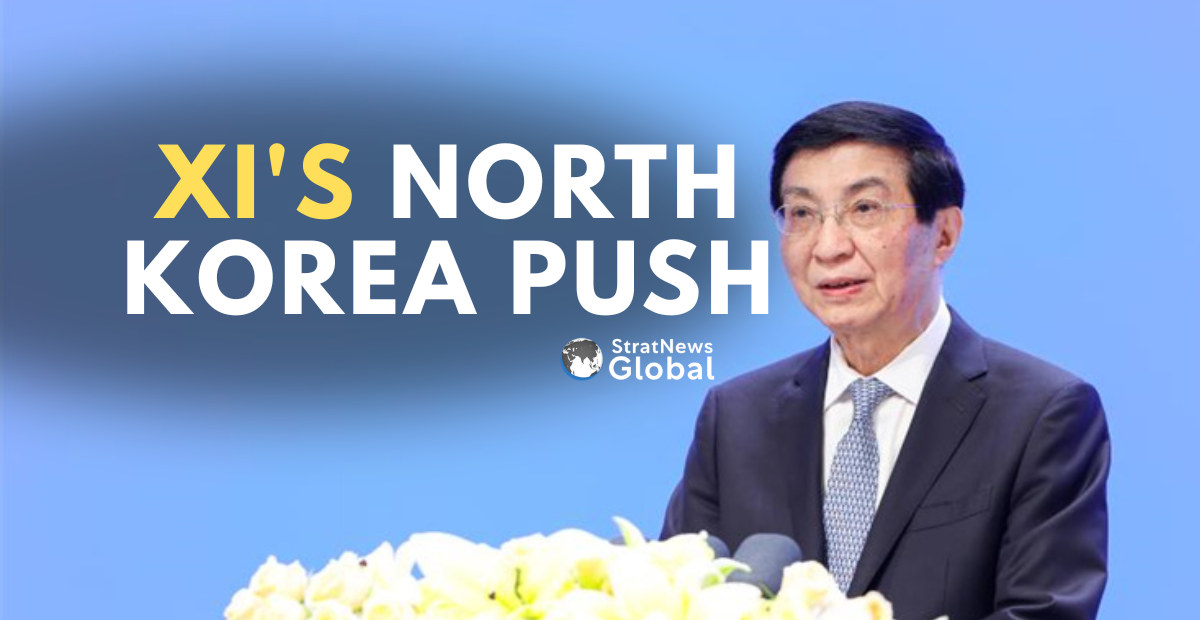
China’s fourth-ranked official, Wang Huning, will visit North Korea this week, continuing a series of high-level exchanges between Beijing and Pyongyang, according to an article by the South China Morning Post.
Chinese state news agency Xinhua reported that Wang will lead a Communist Party and government delegation on an official goodwill visit to North Korea from Wednesday to Friday.
Wang is a member of the Politburo Standing Committee, China’s highest decision-making body, and also serves as chairman of the National Committee of the Chinese People’s Political Consultative Conference, the country’s top political advisory body.
The visit comes just days after North Korean Premier Pak Thae-song concluded a three-day visit to Beijing to mark the 65th anniversary of the friendship treaty between the two countries. During the visit, Pak met Chinese President Xi Jinping, who called for both sides to deepen cooperation, maintain “firm strategic resolve” and jointly safeguard their sovereignty, security and development interests, according to the Chinese government.
The latest trip follows Xi’s own visit to Pyongyang in June—his first trip to North Korea since 2019 and his first overseas visit of the year. Ahead of that visit, Xi wrote in North Korea’s ruling party newspaper that China was willing to elevate bilateral relations to “a strategic height” and promote their continued development.
Wang will become the third senior Chinese leader to visit North Korea within three months, following Xi’s June visit and Foreign Minister Wang Yi’s trip in April.
According to the South China Morning Post, analysts believe the sustained pace of high-level exchanges reflects a broader effort to institutionalise closer ties between the two neighbours.
Zhan Debin, Director of the Centre for Korean Peninsula Studies at Shanghai University of International Business and Economics, said Wang’s visit demonstrates that the recent warming of relations is not merely symbolic but represents a long-term strategic shift.
He said Xi’s visit provided top-level political direction, while Wang Huning’s trip is intended to translate that consensus into practical cooperation through expanded party-to-party exchanges and broader political coordination.
Zhan also argued that both countries are seeking to reinforce their strategic partnership amid growing security tensions in Northeast Asia, including closer cooperation between the United States, Japan and South Korea.
“China-North Korea relations are moving from a new historical starting point towards interaction that is of a higher level, more stable and more institutionalised,” he was quoted as saying.
Ryu Yong-wook, Assistant Professor at the Lee Kuan Yew School of Public Policy at the National University of Singapore, told the newspaper that both Beijing and Pyongyang appear to have reassessed each other’s strategic importance.
He suggested North Korea may be looking to strengthen ties with China as the economic and strategic benefits of its close military relationship with Russia diminish. Moscow has relied heavily on North Korea for military supplies and manpower during its war in Ukraine.
Ryu also argued that China, facing continued strategic competition with the United States and increasing pressure from Western countries, cannot afford to lose key regional partners such as North Korea.
He added that the recent flurry of diplomatic exchanges could also serve as preparation for any future negotiations between North Korea and the United States, particularly as US President Donald Trump has indicated an interest in improving relations with Pyongyang.
The latest visit highlights Beijing’s efforts to deepen political and strategic coordination with North Korea at a time of growing geopolitical competition and heightened security tensions across the Indo-Pacific.
(with inputs from Reuters)