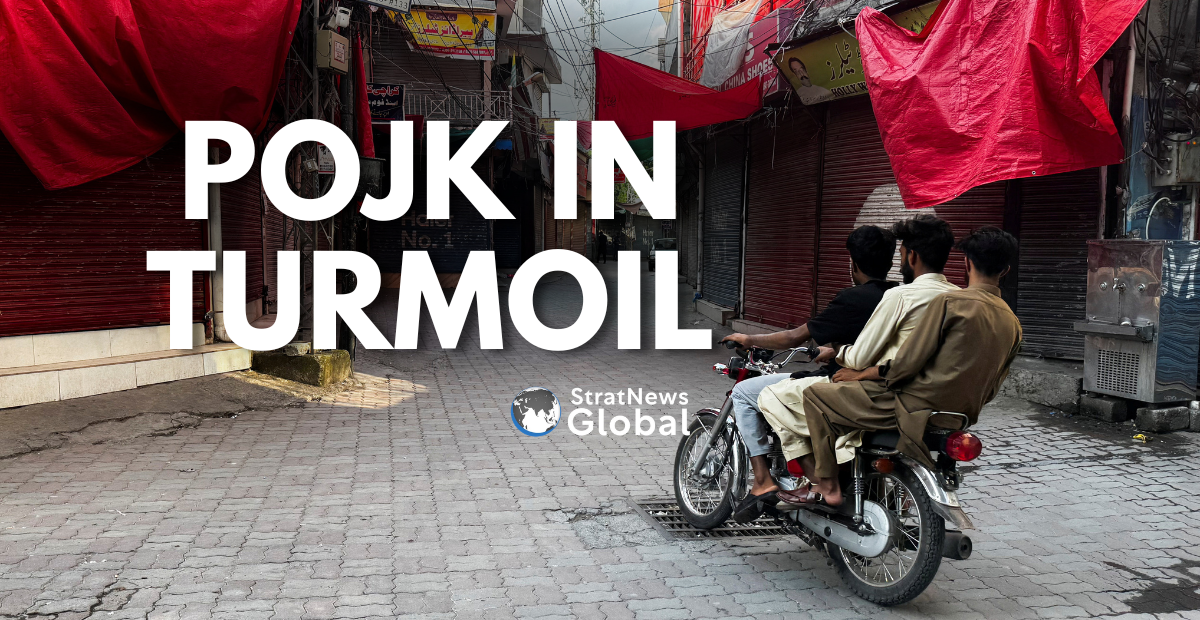
A territory-wide shutdown has brought daily life across Pakistan-Occupied Kashmir (POK) to a near standstill after the region’s deadliest unrest in years left at least 24 people dead during nearly two weeks of protests.
The confrontation between local authorities and supporters of the recently banned Joint Awami Action Committee (JAAC) has emerged as a significant challenge for Islamabad, which frequently criticises India’s handling of dissent in Jammu and Kashmir but is now facing growing unrest in the territory under its own control.
Election Seat Dispute Sparks Protests
The unrest began ahead of a June 9 strike called by the JAAC to protest the reservation of 12 seats for refugees in the July 27 elections to the region’s 45-member legislative assembly. The refugees currently live in Pakistan after being displaced from Indian-administered Kashmir.
Tensions had already been building before the strike, with protests spreading across the region.
Government officials, speaking anonymously, said at least 20 civilians were killed between June 6 and June 14, while dozens more sustained injuries.
Security Forces Suffer Casualties
Regional police chief Liaqat Ali Malik said four police officers were killed and 97 wounded during clashes with protesters. Authorities have also detained 515 people in connection with the unrest.
Meanwhile, thousands of JAAC supporters have gathered on the outskirts of Rawalakot, around 100 kilometres south of the regional capital, Muzaffarabad, maintaining pressure on the administration.
Authorities Tighten Restrictions
In response to the escalating protests, authorities have shut major roads, suspended internet services and restricted media access across large parts of the region.
The measures have severely disrupted transportation, communication and commercial activity, leaving residents increasingly isolated.
Economic Hardship Deepens
The shutdown has hit ordinary workers particularly hard.
In Muzaffarabad’s Upper Adda commercial district, daily wage labourers have been left without work as markets remain largely deserted.
“Since June 9, I have not earned a single rupee,” said 27-year-old labourer Ikhlaq Ahmed, who travelled from a remote village in search of work.
The normally bustling commercial hub, known for its busy grocery markets and evening food stalls, has fallen unusually quiet.
Businesses Struggle to Operate
While some medical stores and grocery shops have begun opening for limited hours, most businesses remain closed.
Banking services have also been severely affected. Notices posted by banks cite the government’s suspension of internet and satellite services as the reason for ATM outages and disruptions to financial operations.
Petrol stations across the region have also been ordered to remain closed.
Workers Bear the Brunt
For many residents who rely on daily earnings, the prolonged shutdown has become increasingly difficult to endure.
Motorcycle taxi driver Asif Naz described the situation as devastating for working-class families.
“Those with resources may sustain it, but for blue-collar workers like us, it is self-slaughter,” he said.
Uncertainty Remains
With protesters continuing their mobilisation and authorities maintaining strict restrictions, there is little indication of an immediate resolution. The ongoing standoff has raised concerns over further instability in Pakistan-Occupied Kashmir as the region heads towards the July assembly elections.
(with inputs from Reuters)