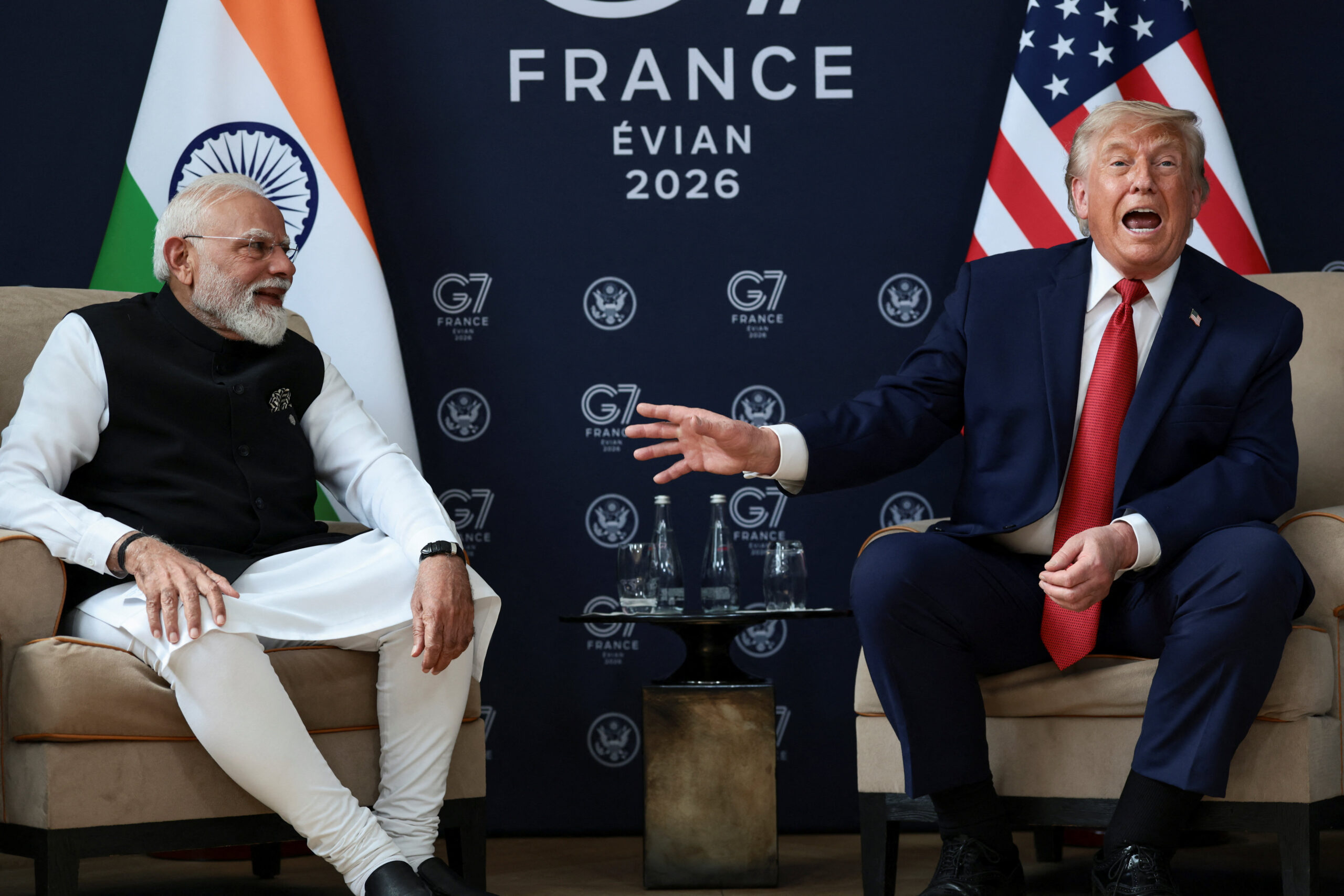
Prime Minister Narendra Modi and US President Donald Trump held their first bilateral meeting in nearly 16 months on the sidelines of the G7 Summit in Évian on Wednesday. The meeting came at a sensitive moment.
Washington is preparing to implement a draft agreement with Iran that could pause hostilities in West Asia and help reopen the strategically vital Strait of Hormuz, while New Delhi is still seeking answers after three Indian sailors were killed in a US military strike on a commercial vessel near Oman earlier this month.
Trade, defence cooperation, maritime security, energy supplies and the future of the Indo-Pacific were all high on the agenda. But beneath the formal diplomatic language, the meeting was equally about managing a growing trust deficit.
From tariff disputes and trade negotiations to disagreements over regional security, many of the recent shocks to the relationship have originated in Washington. Indian officials and strategic analysts have privately expressed concern over what they see as mixed signals from the Trump administration.
Just days before the Évian summit, the decision by the US administration to reportedly rebrand the US Indo-Pacific Command as simply the Pacific Command triggered unease in strategic circles in New Delhi. For India, the “Indo-Pacific” concept has been a cornerstone of its regional vision and a symbol of its growing strategic importance.
“It is a very important meeting taking place after 16 months,” said former diplomat Veena Sikri. “Then there is the whole issue of three Indian sailors who were killed and attacked by missiles from the American Navy.”
The Gulf crisis featured prominently in the discussions.
“In the world of maritime trade, hundreds of thousands of Indian seafarers are performing their duties across global maritime trade routes, including the Strait of Hormuz, contributing heavily to global progress. Their safety is of the utmost importance to us,” Modi told Trump.
“I am confident that the issue of seafarers’ safety will receive the highest priority during the implementation of this agreement.”
The meeting gained additional significance because it coincided with what G7 leaders described as a breakthrough understanding between Washington and Tehran. The agreement is expected to halt active hostilities and create conditions for the reopening of the Strait of Hormuz.
For India, the stakes are huge. India imports a considerable percentage of its energy needs from the Gulf region, and any disruption to maritime routes directly affects energy prices, shipping costs and inflation.
New Delhi also has a strong interest in ensuring that the agreement does not undermine regional stability or create new geopolitical fault lines. Trump suggested India could play a larger role in regional diplomacy.
“Yes, I do. I think India plays a big role in everything. As long as he is the leader, India is going to play a big role,” Trump said.
If security concerns dominated the political backdrop, trade remained the most immediate deliverable. Both sides indicated that negotiations on an interim trade agreement are nearing completion.
Trump acknowledged that discussions had made progress while describing Modi as a formidable negotiator.
“We have had some very good conversations with Prime Minister Modi. We are doing trade deals. A lot of things are happening between the United States and India. He’s very tough. He’s a tough trader.”
Officials confirmed that US Trade Representative Jamieson Greer is expected to travel to New Delhi next week to finalise details of the agreement, which could serve as a stepping stone toward a broader Bilateral Trade Agreement.
The optics of the meeting were carefully managed. Trump repeatedly praised Modi, describing him as a trusted partner and friend.
“As long as I am President, India has a great friend in the White House.” And, also reiterated support for India’s security. “If they were attacked, we would be there to help.”
In characteristic fashion, Trump mixed praise with colourful personal observations.
“He’s a very tough negotiator. People say he’s such a nice man. I said he’s very tough. He’s a tough trader.”
The comments appeared aimed at reassuring both domestic and international audiences that despite recent disagreements, the personal rapport between the two leaders remains intact.
What Experts Said
Wendy Cutler, Senior Vice President at the Asia Society Policy Institute, described the meeting as a necessary corrective.
“The Trump-Modi meeting on the margins of the G7 was a necessary step in getting our bilateral relations back on track.”
She added that the upcoming visit by the US Trade Representative offered an opportunity to conclude the first phase of trade negotiations.
“Each of these steps will help repair the bilateral relationship, which should be a strategic and economic priority for the Trump administration.”
Farwa Aamer, Director of South Asia Initiatives at the Asia Society Policy Institute, argued that symbolism mattered.
“There were a lot of eyes on the meeting given that Trump and Modi were coming face-to-face after a year of strained ties.”
According to Aamer, the meeting helped address concerns over a growing trust deficit.
The importance of the Évian meeting lies not in any single announcement but in the broader message it sends.
The India-US relationship remains one of the most important strategic partnerships of the 21st century, driven by shared concerns over supply chains, technology, defence cooperation, maritime security and China’s growing influence.
Yet recent months have demonstrated that personal chemistry alone cannot insulate the relationship from policy disagreements.
For New Delhi, the challenge is to maintain strategic cooperation with Washington while signalling that actions affecting Indian interests, from maritime security incidents to symbolic moves such as downgrading the Indo-Pacific framework, carry consequences.
For Washington, the challenge is ensuring that tactical decisions do not erode long-term trust with one of its most important partners in Asia.