India and the European Union have agreed to accelerate efforts to formally sign their long-awaited Free Trade Agreement (FTA) before the end of 2026, marking a significant step forward in one of India’s most important economic partnerships.
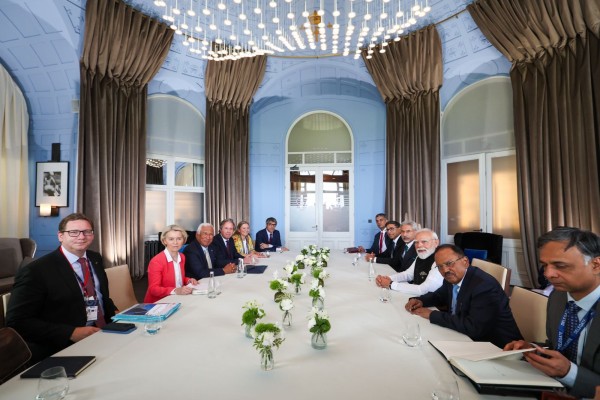
The commitment emerged from talks between Prime Minister Narendra Modi, European Commission President Ursula von der Leyen and European Council President António Costa on the sidelines of the G7 Summit in Évian.
The leaders welcomed the successful conclusion of FTA negotiations earlier this year and called for its early signing and implementation. In a joint statement, they described the agreement as a historic achievement that would unlock new opportunities for trade and investment while helping diversify global supply chains.
European Commission President Ursula von der Leyen said both sides were moving quickly to deliver on commitments made under the agreement and confirmed efforts to complete the signing process before year-end. Negotiations on a separate Investment Protection Agreement are also being fast-tracked.
The FTA is expected to expand market access, reduce trade barriers and strengthen industrial cooperation between India and the EU. Officials view the agreement as a strategic response to growing uncertainty in the global economy, with countries increasingly seeking more resilient and diversified supply chains.
Alongside the trade pact, India and the EU are advancing discussions on an Investment Protection Agreement that would provide safeguards against discriminatory treatment, facilitate investment flows and establish dispute-resolution mechanisms while preserving governments’ regulatory authority.
Negotiators are also working on a Geographical Indications (GI) Agreement aimed at protecting region-specific products and traditional knowledge. The arrangement is expected to benefit producers on both sides by strengthening protection for agricultural products, food items and handicrafts.
The leaders also reviewed progress on the India-Middle East-Europe Economic Corridor (IMEC), the connectivity initiative linking India, West Asia and Europe through ports, rail networks, digital infrastructure and energy corridors. Both sides reaffirmed their commitment to advancing the project despite continuing geopolitical challenges in the region.
Modi said India and the EU would continue deepening economic cooperation and strengthening collaboration across trade, technology, connectivity and supply chains. The leaders also reviewed progress under the Joint India-EU Comprehensive Strategic Agenda and reiterated their support for a resilient multipolar global order.
The discussions underscored the growing strategic importance of India-EU ties at a time of increasing geopolitical uncertainty and economic fragmentation worldwide.