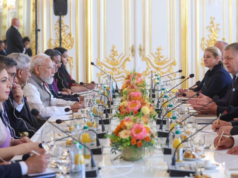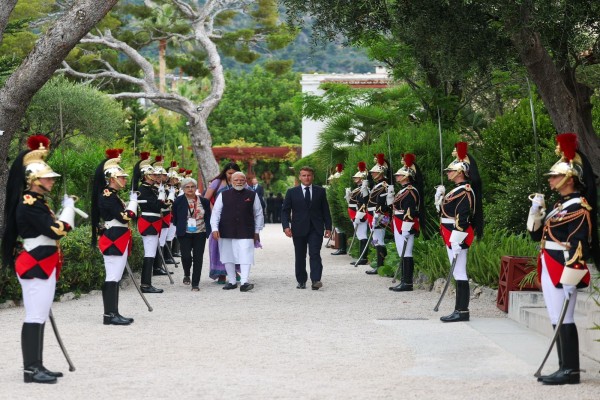
India and France have signalled a significant evolution in their strategic partnership, moving beyond traditional defence cooperation to embrace artificial intelligence, economic security, innovation and advanced manufacturing following talks between Prime Minister Narendra Modi and French President Emmanuel Macron in Nice.
The discussions at Villa Kerylos produced a wide-ranging set of outcomes spanning defence, emerging technologies, trade, space, nuclear energy, healthcare and talent mobility, underscoring the growing importance both countries attach to their relationship amid an increasingly uncertain global environment.
The leaders also exchanged views on major international developments, including the conflicts in Ukraine and West Asia, with both sides emphasizing the need for strategic resilience in a rapidly changing geopolitical landscape.
While defence cooperation remains a cornerstone of India-France relations, the talks highlighted a shift towards co-development, co-production and co-manufacturing of advanced defence technologies. The two leaders expressed satisfaction with the growing depth of bilateral defence collaboration and agreed to intensify efforts focused on joint design and manufacturing initiatives.
Foreign Secretary Vikram Misri said India’s preference in future defence partnerships is increasingly centred on technology transfer and domestic production. “We need to co-develop, have co-production and do co-manufacturing in India,” he said, reinforcing New Delhi’s emphasis on expanding the Make in India initiative in strategic sectors.
In a move expected to deepen security cooperation, the two countries signed a General Security Agreement on the Exchange and Protection of Classified Information, creating a framework for enhanced defence-industrial collaboration.
A major outcome of the visit was the adoption of the Innovation Roadmap 2030, designed to strengthen cooperation in critical and emerging technologies, research partnerships, startup ecosystems and innovation-led solutions. As part of the initiative, India and France agreed to establish a Joint AI Working Group to advance collaboration on artificial intelligence research, governance and capacity building.
The announcement coincided with the inauguration of Bharat Innovates 2026 by Modi and Macron, bringing together more than 120 Indian startups alongside global investors and industry leaders.
Economic security emerged as another key pillar of the partnership. The two countries agreed to launch a dedicated Dialogue on Economic Security focused on critical minerals, semiconductors, cybersecurity, critical technologies and supply-chain resilience. The initiative reflects growing concerns among major economies over vulnerabilities exposed by geopolitical crises and disruptions to global trade networks.
The leaders also established a high-level annual mechanism aimed at doubling bilateral trade within five years and reiterated support for the early implementation of the India-European Union Free Trade Agreement.
Cooperation in space technology received fresh momentum as India’s space agency ISRO and France’s CNES agreed to deepen collaboration in human spaceflight, microgravity research and space situational awareness. A new Letter of Intent is expected to support India’s Gaganyaan mission and future plans for a Bharatiya Antariksh Station.
Nuclear energy also featured prominently in the discussions. French companies are expected to explore greater participation in India’s nuclear sector following legislative reforms that permit private investment and foreign participation. Both sides highlighted opportunities in Small Modular Reactors and advanced nuclear technologies as part of broader clean-energy goals.
The leaders further discussed expanding the reach of India’s Unified Payments Interface (UPI) across France, improving student mobility, and strengthening educational and talent exchanges.
The outcomes from the Modi-Macron talks underscore the emergence of a broader strategic partnership centred on advanced technologies, secure supply chains, defence manufacturing, critical minerals and economic resilience. As global power dynamics continue to shift, India and France appear increasingly aligned in shaping the economic and technological architecture of the twenty-first century.