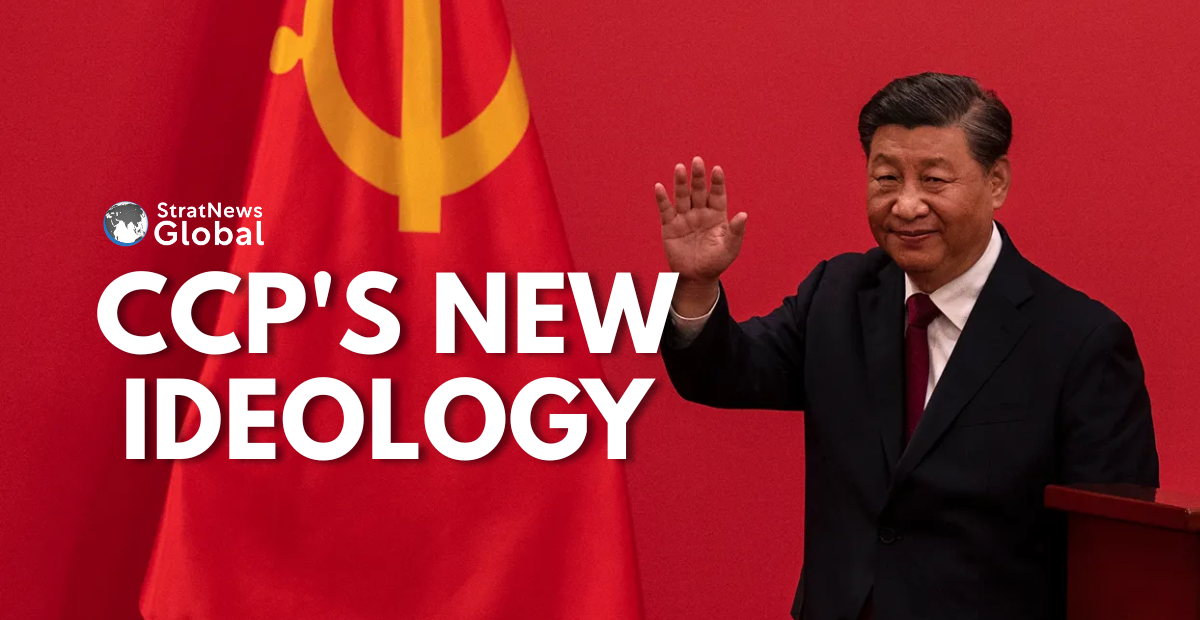
China’s ruling Communist Party (CCP) has formally introduced a new branch of President Xi Jinping’s political ideology, centred on strengthening party discipline, reinforcing centralised leadership and tightening internal governance. According to South China Morning Post the doctrine, officially named “Xi Jinping Thought on Party Building”, was unveiled during a national conference on party building held on Monday. Chinese state media described it as a major development in both Marxist theory and the history of CCP governance.
New ideological framework
The concept was formally endorsed at a meeting chaired by senior CCP leader Cai Qi, who oversees ideology and ranks fifth in the party’s top leadership body, the Politburo Standing Committee. Senior officials responsible for discipline, personnel and organisational affairs also attended the meeting.
According to state broadcaster CCTV, the new doctrine is based on ideas Xi has developed since taking power after the 18th Party Congress in 2012. It is presented as an answer to key questions surrounding how the Communist Party can maintain long-term rule while preserving its Marxist foundations.
Chinese officials said the framework would serve as the guiding principle for party-building efforts in the coming years.
Emphasis on discipline and unity
At the heart of the doctrine are what state media called the “14 insists” — a set of principles focused on strengthening the party’s authority and cohesion.
Among them are calls for unwavering support for the CCP Central Committee’s unified leadership, strict self-governance within the party and the creation of a highly coordinated organisational structure spanning all levels of government.
The doctrine also places heavy emphasis on ensuring party discipline and loyalty to the central leadership.
Anti-corruption remains a priority
The new ideological framework reinforces Xi’s long-running anti-corruption campaign, which has been one of the defining features of his leadership.
According to official descriptions, the doctrine seeks to create conditions in which officials “do not dare, are unable, and do not wish” to engage in corrupt activities. Chinese authorities have repeatedly framed anti-corruption efforts as essential to maintaining the party’s legitimacy and effectiveness.
Ahead of a key political transition
The timing of the announcement is significant, coming roughly a year before the CCP is expected to hold its next Party Congress in 2027.
The congress is likely to bring major leadership changes, with more than two-thirds of the Central Committee expected to be replaced under customary retirement rules. Analysts also anticipate significant reshuffles within the Politburo and its powerful Standing Committee.
Strengthening Xi’s ideological legacy
State news agency Xinhua said the doctrine helps explain “why the Communist Party of China works, why Marxism works and why socialism with Chinese characteristics works”.
Official commentary also highlighted the framework’s focus on improving institutional coordination, refining governance mechanisms and using laws and regulations more effectively to strengthen party rule.
The introduction of “Xi Jinping Thought on Party Building” further expands Xi’s ideological footprint within the CCP and underscores Beijing’s continued emphasis on party discipline, organisational control and political unity as it prepares for a crucial leadership transition in 2027.