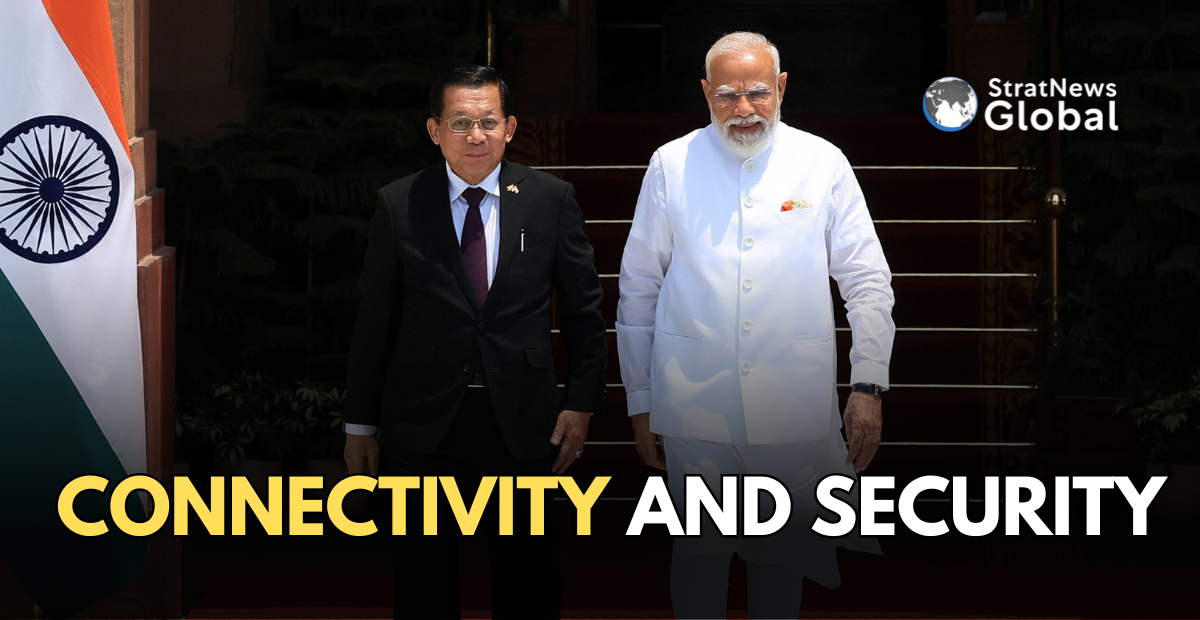
India’s worldwide hunt for critical minerals found an echo in the visit of Myanmar’s newly-elected President and former army chief Gen Min Aung Hlaing.
“Issues relating to critical minerals and rare earths did come up during the discussions today,” Foreign Secretary Vikram Misri told journalists at a briefing after talks between the president and Prime Minister Modi got over in Delhi on Monday.
“This is something that has been a subject of bilateral discussions for some time, and there was an understanding that the two governments and relevant entities from both sides would remain in touch and take forward cooperation in these areas.”
Myanmar possesses significant deposits of rare earth minerals concentrated in northern Kachin state bordering China and in areas close to the border with Thailand. Accessing them is not easy since armed ethnic groups control them but it is hoped that at some point favourable conditions will prevail.
A key focus of the discussions was the long-delayed Kaladan Multi-Modal Transit Transport Project and the India-Myanmar-Thailand Trilateral Highway, crucial for India’s connectivity with Southeast Asia.
“These projects have been underway for several years and have been delayed in most cases. The obstacle that faces both of these projects is the security situation in Myanmar,” Misri acknowledged.
“The highway is in an area where active hostilities are going on right now between the army and ethnic armies. Similarly, sections of the trilateral highway where work was underway are also in areas where armed groups and the military are engaged in hostilities.”
“Wherever there has been a possibility to take forward the work by securing the safety of workers and project teams, we have been able to move forward.”
President Hlaing assured India that Myanmar would do everything possible to facilitate completion of the projects.
“The President of Myanmar reiterated assurances that Myanmar’s territory would not be permitted to be used against India’s security interests,” he said.
“We reiterated our concerns and the President once again assured us that Myanmar was sensitive to these concerns and would do everything necessary to ensure that action was taken against these elements.”
Defence cooperation between the two countries continues to focus largely on training, capacity-building and institution-building.
Misri revealed that Indian authorities have already repatriated more than 2,400 Indian nationals who had been trafficked into cyber fraud compounds in the country. He said more than 180 Indians are still believed trapped in such facilities.
“We are in contact with the Myanmar government to try and evacuate them as well.” Highlighting the need for broader regional cooperation, he noted that victims are often trafficked through third countries before reaching scam centres.
“This underlines the need not just for bilateral cooperation but also for greater regional cooperation on this issue.”
The discussions also touched upon Myanmar’s prolonged political crisis and efforts to restore democratic governance.
Misri confirmed that Prime Minister Modi raised issues related to the country’s peace process and democratic transition.
“The Prime Minister conveyed the need for peace in the country, the need for inclusion, the need to have all stakeholders at the table and to examine the points of view of all interlocutors who have been part of this process over a long period of time.”
“Our engagement with Myanmar is not intended to be a commentary on the internal political arrangements in that country,” he said.
“We have always proceeded on the principle that sustained dialogue is what is important and what is imperative for India as a neighbour. The answer is clearly not disengagement. History has shown that disengagement does not give us any results and certainly does not produce democratic change.”
He disclosed that India has been sharing its experience of constitutional governance and federalism with Myanmar as the country searches for a political settlement.
Workshops and seminars have been organised through the Indian Embassy in Yangon to explain India’s experience with federalism and constitutional democracy.
“They obviously look next door at India and see an example worth following,” he said. “I do believe these are seen as very valuable lessons by the authorities there.”
The leaders also agreed to deepen cooperation in trade, investment, healthcare, education, energy, artificial intelligence and space technology. Bilateral trade currently stands at around $2 billion.
President Min Aung Hlaing, who is on a visit to India from May 30 to June 3, also attended an India-Myanmar Business Conclave and visited technology and infrastructure facilities, including the NTPC Energy Technology Research Alliance.