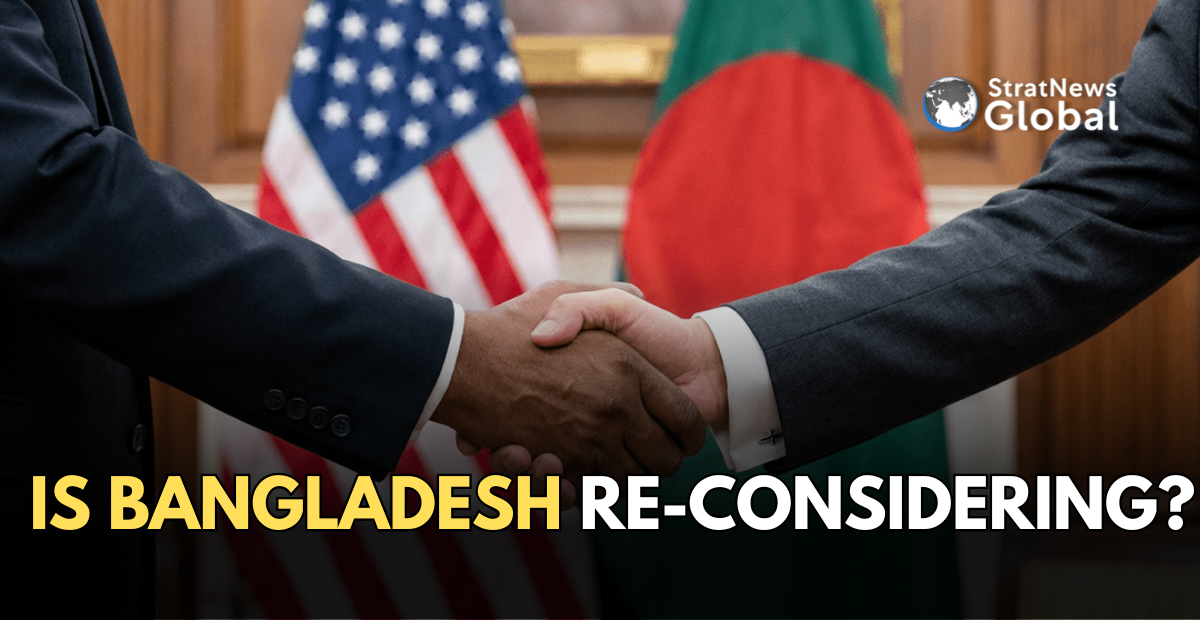
This week marked two months since Bangladesh signed an Agreement on Reciprocal Trade with the US. It was an agreement signed by the interim government of Mohammad Yunus, and increasingly, questions are being raised as to the conditions it has imposed on Dhaka.
In an analysis in The Diplomat, Mohd Amdadul Haque, a doctoral candidate at Shandong University in China and Assistant Professor in Gopalganj, Bangladesh, argues that the agreement functions as a geopolitical instrument designed to use Bangladesh for the U.S.’ strategic interests, especially to target China and Russia.
The BNP is trying to navigate it by utilising selective implementation and narrative management. By emphasising domestic reviews, parliamentary scrutiny, and the contingent nature of the deal, the BNP is leveraging internal opposition from the Jamaat-e-Islami and civil society as a shield.
This allows the government to pocket the economic benefits (such as garment sector tariffs) while stalling on the more intrusive geopolitical clauses. It has also invoked the language of review, conditionality, and domestic oversight, portraying that Bangladesh is not giving up autonomy but instead is actively managing the implementation process.
But Dhaka’s room for hedging is limited. The agreement prohibits it from concluding any trade or economic accords with non-market economies. If Dhaka flouts this clause, it would be placed under 37% reciprocal tariffs.
Articles 4.1 and 4.2 demand that Dhaka align with Washington’s export controls and likely push it to enforce U.S. third-country issues, stripping it of its policy autonomy and role as a neutral intermediary in the Indo-Pacific area.
Thirdly, the agreement also mandates the purchase of U.S. LNG, aircraft, and defence equipment for Dhaka, creating a long-term dependency. This move would limit Bangladesh into U.S. supply chains and restrict its ability to diversify energy or security portfolios.
While the U.S. is impatient about taking this agreement further—as was visible by U.S. Assistant Secretary of State for South and Central Asian Affairs Paul Kapur’s visit to Dhaka soon after Tarique Rahman’s oath ceremony—the new government is playing it cautiously.
But with the US Supreme Court striking down blanket tariffs issued under the International Emergency Economic Powers Act, has Dhaka got a reprieve? According to an analysis in Eurasia Review, why should Bangladesh continue to honour a bargain extracted under legal conditions that have collapsed?
As the analysis notes, Bangladesh made concessions to avoid a trade punishment whose legal foundations the Supreme Court would not sustain. Even worse, the agreement was drafted so that discretionary pressure could survive afterwards through elastic language on non-compliance and future tariff action.
“Bangladesh was browbeaten to concede under one threat, only to find that the test tried to preserve Washington’s leverage even after the original threat had become unstable,” said Eurasia Review. It notes that Malaysia has already walked out of a similar deal with the US, declaring it “null and void.”
The problem for Dhaka is that the former national security adviser Khalilur Rahman negotiated and signed the agreement. He is currently foreign minister in the Tarique Rahman government and remains a defender of that deal even now. This could be embarrassing for the government if Rahman is sent for re-negotiation.
Eurasia Review has a solution: Bangladesh should stop behaving as though this document descended from some higher order of inevitability. It should either suspend its path to implementation entirely or return to the table demanding extensive renegotiation. And if Washington wants the same concessions again, let it justify them without the shadow of an illegal emergency tariff hanging over Dhaka’s head.