The war over Iran took a violent turn in the early hours of April 3, 2026.
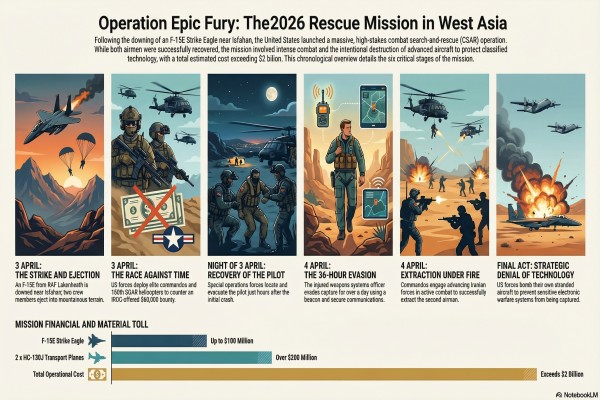
An American F-15E Strike Eagle, part of the U.S.-led Operation Epic Fury, was struck by Iranian air defences near Isfahan during a deep-strike mission.
The jet—flown by the 494th Fighter Squadron out of RAF Lakenheath—went down fast. Its two-man crew ejected into hostile terrain controlled by the Islamic Revolutionary Guard Corps. They landed miles apart in rugged, mountainous ground—cut off, exposed, and immediately hunted.
Within hours, the stakes escalated dramatically. Reports emerged that the IRGC had placed a $60,000 bounty on the capture of the airmen.
That single move transformed a standard rescue into a race against time—not just against organised military units, but potentially armed civilians and militia drawn by cash and propaganda value.
By the night of April 3, the United States had launched a full-scale combat search-and-rescue (CSAR) mission.
This account has been assembled from multiple government briefings, defence sources, and cross-verified reporting to reconstruct what unfolded over the next 36 hours—through April 3 and into April 4, 2026.
The response was immediate and overwhelming. Elite pararescue teams and special operations commandos were mobilised, supported by aircraft from across the U.S. Air Force Special Operations Command.
Overhead, a dense and dangerous aerial network formed: HC-130J and MC-130J command-and-control aircraft, HH-60 rescue helicopters, MH-6 Little Bird insertion platforms flown by the 160th Special Operations Aviation Regiment—the “Night Stalkers”—along with MQ-9 Reaper drones and A-10 Thunderbolt II attack aircraft providing close-air support. Tankers, surveillance aircraft, and fighters filled the skies across the wider theatre, stretching into neighbouring airspace.
The first breakthrough came quickly. On the night of April 3, special operations teams located the pilot and extracted him in a relatively smooth operation under cover of darkness. But the second airman—the weapons systems officer—was still on the ground.
Injured during ejection, he began a desperate fight for survival that would stretch into April 4. Moving on foot through harsh terrain, he evaded capture for more than a day. Iranian search teams were closing in, sweeping the area with increasing intensity.
From above, U.S. drones tracked his beacon and movement, while command aircraft coordinated an expanding rescue grid. On the ground, the airman relied on a pistol, a secure communications device, and constant movement to stay ahead of those hunting him.
As the hours ticked on, the operation grew in scale and urgency. Additional aircraft were pulled in. More pararescue teams were deployed. The rescue envelope widened, and the risk increased. This was no longer a contained extraction—it was a live, contested battle space.
By April 4, the mission reached its most dangerous phase.
A specialised commando unit, inserted deep into hostile territory by MH-6 Little Birds, converged on the wounded officer’s position. But Iranian forces were already closing in.
What followed was a high-intensity extraction under fire. U.S. commandos engaged advancing enemy elements, actively firing to hold them back while air support conducted targeted strikes to suppress Iranian positions. Under this cover, the officer was finally secured and extracted.
After more than 36 hours behind enemy lines, both airmen were out.
President Donald Trump later confirmed the rescue, stating that the injured officer would recover. But even as the mission succeeded in its primary objective, a new crisis was unfolding.
In the immediate aftermath of the April 4 extraction, several U.S. aircraft involved in the operation became stranded at an improvised refuelling site inside Iran. The exact cause remains disputed—enemy fire, mechanical failure, difficult terrain, or fuel exhaustion—but the implications were immediate and severe.
These were not ordinary aircraft. The stranded HC-130J and MC-130J platforms carried some of the most sensitive technology in the U.S. arsenal: encrypted communications systems, advanced navigation suites, electronic warfare capabilities, and airborne command-and-control equipment designed to coordinate complex missions deep inside hostile territory.
There was no possibility of recovery.
Faced with the risk that this technology could fall into Iranian hands—or be transferred onwards to adversaries such as Russia or China—U.S. commanders made a stark decision. The aircraft would be destroyed.
Precision strikes were ordered. On April 4, the stranded planes—along with at least one MH-6 Little Bird helicopter—were bombed by U.S. forces themselves, reduced to burning wreckage scattered across the Iranian desert.
The cost of those 36 hours is now being reckoned.
Initial estimates placed the financial loss between $210 million and $310 million. But deeper analysis suggests the true cost may exceed $2 billion. The tally includes the destroyed F-15E Strike Eagle (valued up to $100 million), two specialised C-130 variants costing over $100 million each, multiple MQ-9 Reaper drones, at least one MH-6 helicopter, and an A-10 Thunderbolt II shot down by Iranian fire—its pilot ejecting safely over Kuwait. Two HH-60 rescue helicopters were also damaged during the operation.
Beyond hardware, the operational costs soared: precision munitions used to suppress Iranian air defences, the deployment of dozens of supporting aircraft, emergency logistics, and the long-term strategic impact of losing rare, specialised rescue platforms that cannot be quickly replaced.
Despite the successful recovery of both airmen, the aftermath has been complex—and contested.
Iran moved swiftly to shape the narrative. Images of burning U.S. aircraft were broadcast across state media, presented as proof that Iranian forces had foiled the operation.
Officials claimed they had destroyed multiple American aircraft themselves, blurring the line between combat losses and U.S.-initiated destruction. The visuals—charred wreckage deep inside Iran—delivered a powerful propaganda message.
For Washington, the operation delivered both a victory and a warning.
The mission upheld a core military principle: no one is left behind.
But it also exposed the realities of operating in contested skies, where even a successful rescue can come at extraordinary cost. Over April 3 and 4, 2026, the United States brought its men home—paying for it in fire, steel, and a couple of billion dollars.