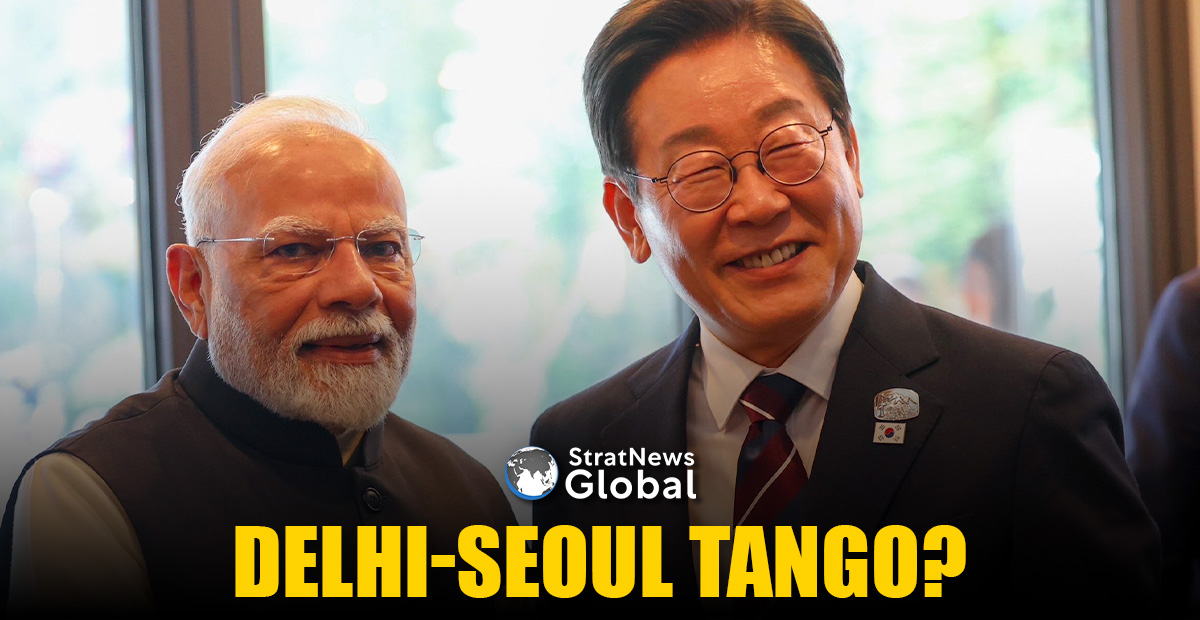
Shipbuilding, semiconductors and energy are expected to top the agenda when South Korean President Lee Jae Myung visits India later this month.
Dates are still not clear but if the visit goes ahead, it will help strengthen regional outreach by Seoul after recent engagements with China and Japan.
Delhi and Seoul describe their relationship as a “Special Strategic Partnership,” but in practical terms, trade and industrial cooperation have moved more slowly than anticipated.
They have set a target of $50 billion in bilateral trade by 2030, though getting there will require more than high-level statements.
Shipbuilding stands out as one area where progress looks immediately possible. India has been pushing to expand its maritime capacity, backed by new funding and policy support, while South Korea remains one of the world’s most advanced shipbuilders.
Existing industry tie-ups could move faster if they receive clearer political backing and financing support.
In semiconductors, India is trying to build a deeper ecosystem, moving beyond assembly into materials and manufacturing capabilities. South Korea’s experience across the chip value chain makes it a natural partner, but any outcome is likely to be incremental, focused on specific segments rather than sweeping agreements.
Energy security has emerged as another point of urgency. South Korea is seeking to increase imports of naphtha from India, as supply disruptions linked to tensions in the Gulf expose its dependence on overseas sources.
Naphtha, a key industrial feedstock used widely in petrochemicals, forms a significant share of Korea’s imports from India.
The issue was recently discussed by South Korean Trade Minister Yeo Han-koo and his Indian counterpart Piyush Goyal on the sidelines of a World Trade Organization meeting, with both sides expected to continue talks at the working level.
For Seoul, diversifying supply is becoming less of a choice and more of a necessity. For India, it opens up space to strengthen its role in regional supply chains.
Beyond these sectors, discussions are expected to touch on areas such as clean energy and artificial intelligence, though these are likely to remain longer-term tracks.
There is already some political momentum behind the relationship. Prime Minister Narendra Modi and President Lee have met twice in recent months, at the G7 Summit and the G20 Summit, but translating those interactions into tangible outcomes has been uneven.